Vanity metrics vs. real metrics
A vanity metric looks good in a report but does not guide decisions or reflect business results. Follower counts, impressions, likes, and even raw traffic often fall into this category: they can grow without sales or profitability changing.
A real (actionable) metric ties directly to a business goal and guides a decision: if the metric changes, you know what to do. Conversions, customer acquisition cost, lead quality, and customer lifetime value are examples of metrics that tell whether marketing works.
A marketing director's job is to prune vanity metrics from the dashboard and surface the few numbers that truly steer the business. Less is more: five real metrics are more valuable than fifty that nobody acts on.
The north star metric: one number that guides
A north star metric is a single, organization-wide metric that best captures the value delivered. It is not revenue itself but a value metric that predicts it — for example activated customers, recurring revenue (MRR), or profitable new-customer acquisition.
The power of the north star is focus: when the whole team knows which single number to grow, decisions become clearer. Channels, campaigns, and content are judged through it: does this advance the north star or not?
Supporting metrics that explain its movement are built under the north star. If the north star is profitable new customers, supporting metrics are CAC, conversion rate, and lead quality. The hierarchy keeps the dashboard clear: one headline number, a few explanatory metrics.
Funnel metrics: stage by stage
The marketing funnel should be measured stage by stage so you can see where the bottleneck is. Each stage has its own metric, and the conversion rate between stages reveals where potential leaks.
A typical structure: reach and visibility (awareness) → traffic and engagement (interest) → leads and conversions (consideration) → deals and revenue (decision) → retention and referral (loyalty). When you measure the transitions, you see whether the problem is traffic volume, conversion, or retention.
It is important to measure quality, not just volume: 1,000 leads of which none buy is worse than 100 quality ones. Lead quality and conversion to deals are often more important than the raw number of leads.
- Awareness: reach, impressions, brand searches
- Interest: traffic, engagement, returning visitors
- Consideration: leads, lead quality, conversion rate
- Decision: deals, average order value, revenue
- Loyalty: retention, repeat rate, referral (NPS)
CAC, LTV and profitability
Customer acquisition cost (CAC) tells you how much acquiring one new customer costs — all marketing and sales costs divided by new customers. It is the basis of profitability: if CAC exceeds the value the customer brings, you grow at a loss.
Customer lifetime value (LTV) tells you how much a customer produces over the whole relationship. The LTV:CAC ratio is a key health metric: a healthy ratio is typically 3:1 or better — the customer produces at least three times their acquisition cost. Too low a ratio means unprofitable growth; too high may mean under-investing in growth.
Payback period completes the picture: how quickly a customer pays back their acquisition cost. A short payback enables faster, cash-flow-friendly scaling. These three — CAC, LTV:CAC, and payback — tell you whether growth is profitable.
Attribution and incrementality
Attribution distributes the credit for a conversion across touchpoints. The last-click model is simple but misleading: it gives all credit to the last channel and underrates demand-generating channels (Meta, content). A data-driven or multi-touch model gives a truer picture.
Attribution does not tell the whole truth, however — it only describes measured touchpoints. Incrementality answers a more important question: how much additional revenue does a channel bring compared to a situation without it? This reveals whether customers would have bought anyway (e.g. brand searches that would convert without ads).
A marketing director should complement attribution with experiments: geo tests, channel pauses, or incrementality tests reveal the true impact. Do not rely on platform-reported ROAS alone — it usually overstates its own channel.
An effective marketing dashboard
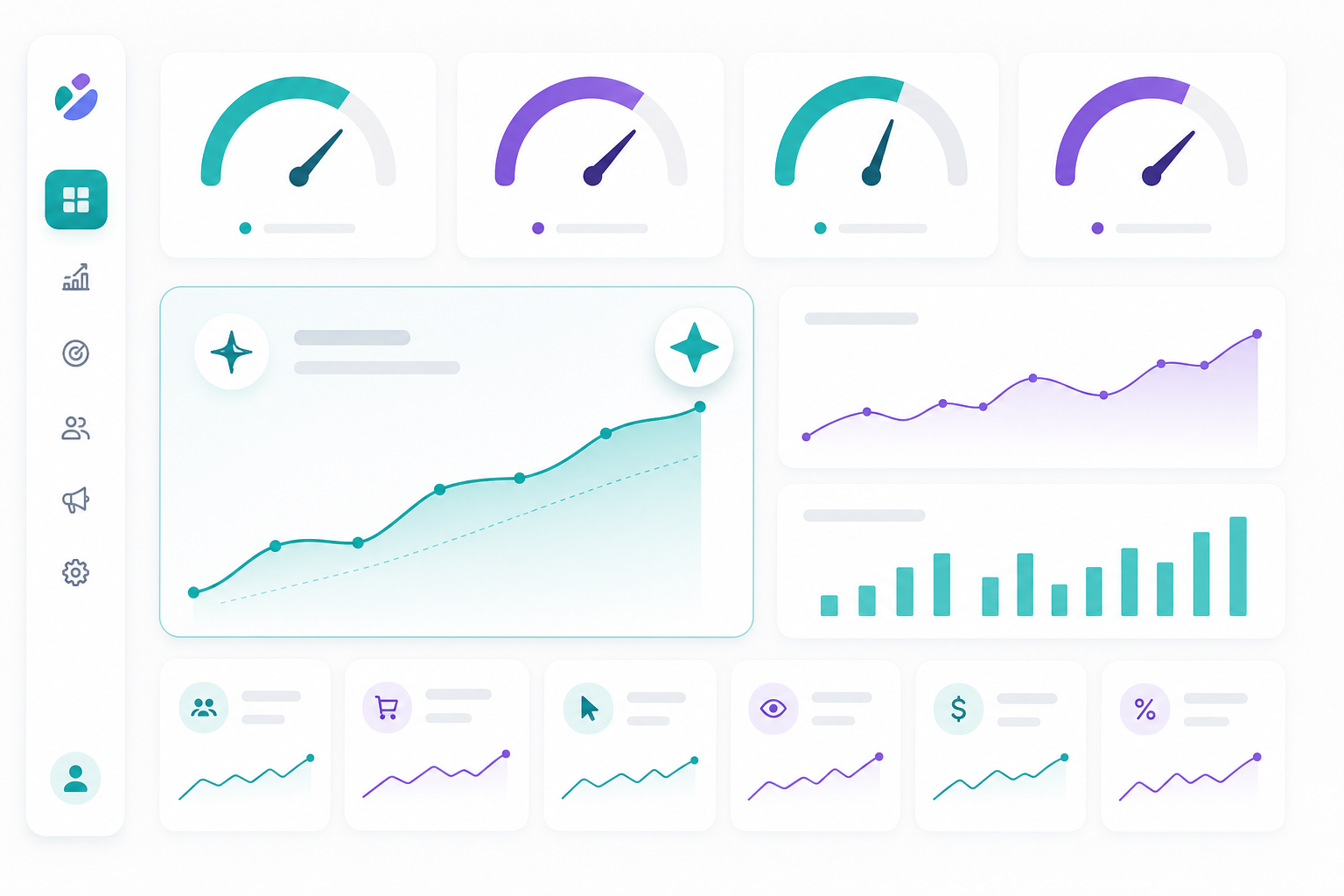
A good dashboard tells the situation at a glance: the north star at the top, its explanatory supporting metrics below, and the trend over time (not just a snapshot number). Always compare to the goal and the previous period — a number without context does not guide a decision.
Connect the data into one view: marketing (Ads, Meta, SEO/GEO), analytics (GA4), and business (CRM, deals) data must meet in the same dashboard. Otherwise you see only marketing's own metrics, not the connection to euros.
Keep the dashboard concise and actionable: every metric should lead to a decision. If a metric changes no decision, remove it. The dashboard is a decision-making tool, not a data warehouse.
Reporting cadence
Different metrics require different monitoring cadences. Operational metrics (campaign CPA, budget spend) are checked daily or weekly for optimization. Strategic metrics (CAC, LTV:CAC, north star) are reviewed monthly or quarterly as a trend.
Avoid short-term over-optimization: daily staring leads to hasty changes that disrupt machine learning and distort the picture. Give campaigns and channels time to produce data before drawing conclusions.
A regular review (e.g. monthly) focuses on the whole: which channel produces the most at the margin, where the next euro should go, and whether marketing advances the north star. This cadence connects operational optimization to strategic steering.
Common mistakes in marketing measurement
We see these mistakes repeatedly — often in organizations with plenty of data but no improvement in decisions.
- Tracking vanity metrics → impressions and likes do not reflect results
- Disconnecting marketing from euros → metrics do not link to CAC and revenue
- Last-click attribution only → demand-generating channels are underrated
- Too many metrics → focus is lost, decisions do not get clearer
- Daily over-optimization → machine learning is disrupted, the picture distorts
- Ignoring the LTV:CAC ratio → growth can be unprofitable without noticing
Frequently asked questions
What should a marketing director measure?
Focus on metrics that connect marketing to business results: a north star metric, CAC, the LTV:CAC ratio, conversion rate, and lead quality. Prune vanity metrics (impressions, likes) that do not guide decisions.
What is a north star metric?
A north star is a single, organization-wide metric that best captures the value delivered and predicts revenue — e.g. activated customers or profitable new-customer acquisition. It creates focus and a shared direction.
What is a healthy LTV:CAC ratio?
Typically 3:1 or better — the customer produces at least three times their acquisition cost. Too low a ratio means unprofitable growth; a very high one may mean you should invest more in growth.
Is platform-reported ROAS enough?
Not alone. Platforms (Google, Meta) usually overstate their own channel. Complement attribution with incrementality tests (geo tests, channel pauses) to see the true added impact — how much revenue a channel brings that would not happen anyway.
How often should marketing be reported?
Operational metrics (CPA, budget) weekly for optimization; strategic metrics (CAC, LTV:CAC, north star) monthly or quarterly as a trend. Avoid daily over-optimization that disrupts machine learning.