
Why is GEO auditing mandatory in 2026?
Generative search is fundamentally changing marketing measurement. An increasing share of research queries end in AI answers where your brand is either mentioned, cited as a source, or absent entirely. Without systematic auditing, you do not know which channels you appear in, which competitors win citations, or which content decisions actually move the needle.
GEO auditing differs clearly from SEO auditing. SEO audits check indexability, technical errors, keywords, and links. GEO auditing tests how AI engines answer real customer questions — and whether they choose your brand as a source. You need both, but they serve different channels. Read the SEO vs GEO article on how the strategies combine.
Monthly auditing is critical because AI visibility changes fast. A competitor can publish a new deep guide and take citations within a week. Google can expand AI Overviews coverage to new queries. ChatGPT search integration updates. A one-time check gives a snapshot — continuous tracking reveals trends and optimization impact.
For B2B companies, GEO auditing is especially valuable: purchase decisions start with research queries where AI answers shape the shortlist before the first sales contact. If a competitor is the recommended vendor in an AI answer and you are not, you lose visibility before analytics shows traffic decline.
Auditing also gives leadership an understandable KPI. Share of Voice states clearly: "We appear in 35% of relevant AI answers, competitor A in 52%." That is more concrete than "ChatGPT mentioned us once last month."
Monthly GEO audit process
A repeatable audit process ensures measurement is comparable month over month. Without standardized queries, channels, and documentation, trends mix with random changes.
Week 1 tasks: update the query list (remove outdated, add new topic areas), manually test all queries in three channels, and fill the audit spreadsheet. Use the same browser, incognito mode, and document date and version (e.g. ChatGPT Pro vs. free).
Week 2 tasks: analyze results — calculate SOV for your brand and competitors, identify queries where you do not appear at all, and compare to the previous month. Prioritize queries where competitors are cited but you are not.
Week 3 tasks: link audit results to actions. If citations are missing in how-to queries, optimize existing articles for citability. If the brand is absent from comparison queries, publish an honest comparison article. If technical crawl blocks visibility, fix robots.txt and llms.txt first.
Week 4 tasks: report SOV trend, top competitors, and next month priorities to leadership. Keep the report concise: one page KPIs, one page competitor comparison, one page actions.
Automated GEO tools can speed testing, but manual audit remains the best quality check — it reveals context, mention tone, and source order that tools often oversimplify.
GEO audit metrics and KPIs
Effective GEO auditing tracks more than SOV alone. A combined view shows whether visibility improves qualitatively or only quantitatively.
Mention count shows how often your brand appears in answers. Citation count shows how often your URL is a source. Mention context (recommendation, neutral, list mention) affects business impact more than count alone.
Source position measures where your URL ranks in the source list — first source gets most clicks in Perplexity and Google AI Overviews. Track position change monthly, not just presence.
Channel distribution shows where you are strong and weak. Typical B2B profile: Perplexity citations quickly, ChatGPT mentions slower, AI Overviews variable. Prioritize the channel where your audience does research.
Brand query growth in GSC may correlate with GEO visibility: users see the brand in an AI answer, then search directly later. Combine SOV trend with brand query trend in reporting.
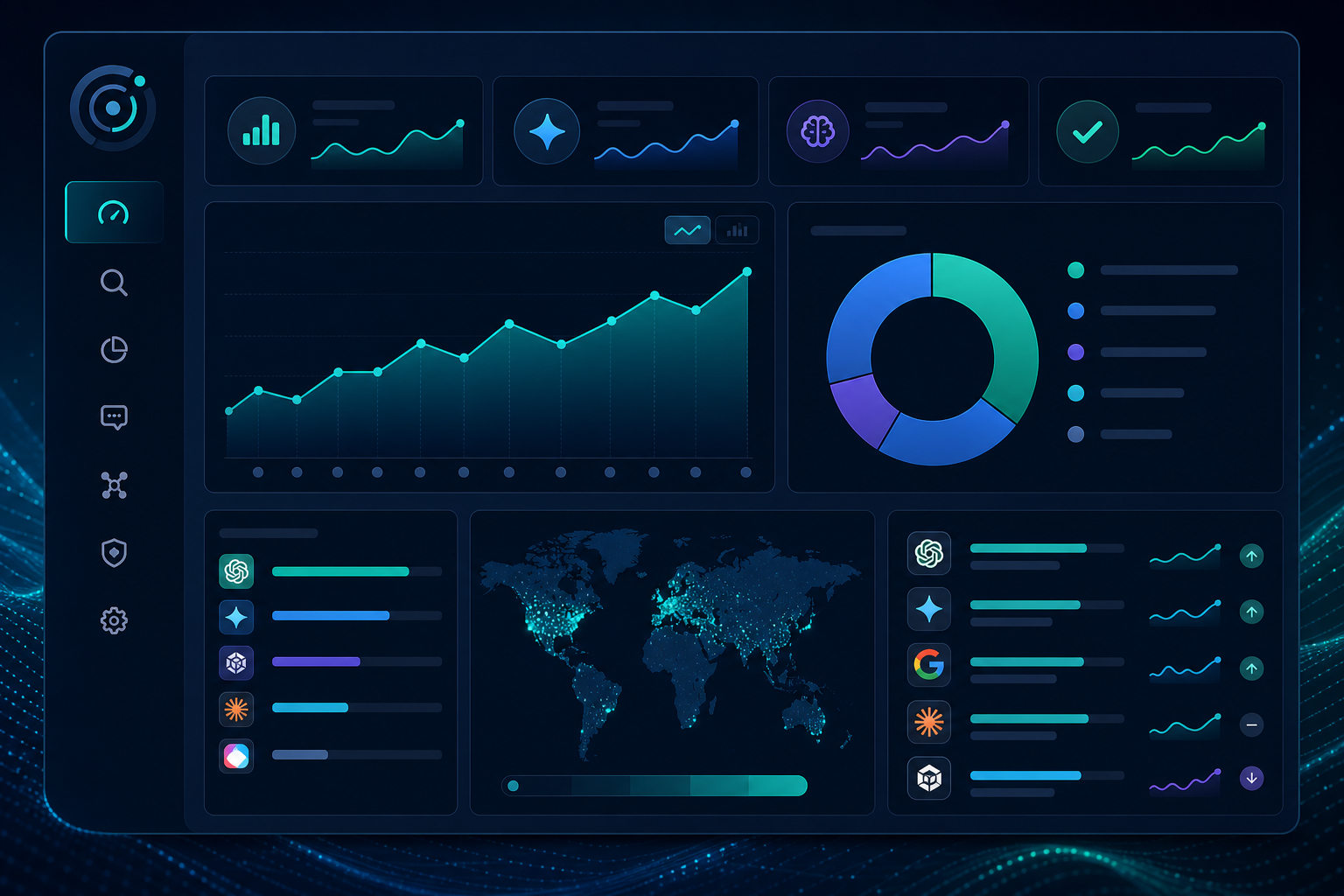

ChatGPT, Perplexity, and AI Overviews: channel comparison
GEO auditing covers multiple channels because each selects sources differently. Combined SOV is useful, but channel-specific analysis drives priorities.
Perplexity cites the web in real time — optimized content can become a source within weeks. Track Perplexity separately and emphasize freshness and citable structure. See the Perplexity visibility guide for channel-specific actions.
ChatGPT combines training data and Bing search. Visibility can come from historical authority without a direct link. Test both free and Pro/Search versions — results can differ significantly.
Google AI Overviews directly affects organic traffic: visibility as a source can offset CTR decline. Combine AI Overviews audit with the AI Overviews traffic measurement framework alongside GSC data.
Report channel SOV separately to leadership: "Perplexity SOV 42%, ChatGPT 18%, AI Overviews 25%." This directs resources to the right channel instead of assuming one optimization serves all.
30-day GEO audit launch
Week 1: list 30 relevant queries from support, sales, GSC, and competitor analysis. Test current visibility in all three channels. Calculate baseline SOV and document top competitors.
Week 2: build audit spreadsheet and dashboard template. Define KPIs and reporting cadence (monthly). Check technical foundation: robots.txt allows AI crawlers, llms.txt guides to key content.
Week 3: optimize three queries where SOV is zero — update an existing article or publish a new deep guide with citable structure (direct answer, FAQ, schema).
Week 4: repeat the 30-query test and compare to week 1. Report SOV change and prioritize next month. GEO is iterative — auditing continues, it does not end.
If resources are limited, start with the free SEO / GEO site test or explore the GEO service: you get baseline SOV, competitor comparison, and a concrete action list without building the measurement framework from scratch. Auditing is an investment — without it, GEO optimization is guesswork.
Summary: GEO auditing and Share of Voice
GEO auditing turns generative search visibility into a measurable KPI. Share of Voice states clearly where you stand vs. competitors — and monthly process reveals trends a one-time check cannot show.
A successful audit combines standardized queries, channel-specific testing, competitor SOV, and a dashboard leadership can follow. Mention and citation are separated, source position tracked, and results linked to content and technical actions.
Start with 30 queries and three channels. Expand the query list and automate partially once the process is established. GEO is long-term — auditing is the compass that shows whether you are heading the right direction.
Frequently asked questions
What is the difference between GEO auditing and SEO auditing?
SEO auditing checks indexability, technical errors, keywords, and links for classic search. GEO auditing tests whether your brand is mentioned and your content cited in AI answers in ChatGPT, Perplexity, and Google AI Overviews. You need both — SEO is the foundation of GEO, but alone it does not measure generative visibility.
How is Share of Voice calculated in GEO?
List 25–40 relevant queries, test them in selected AI channels monthly, and calculate: SOV = (brand mentions + citations) / (all tested answers) × 100. Separate mention SOV and citation SOV. Calculate the same for competitors for comparison. Keep the query list stable for reliable trends.
How often should GEO auditing be done?
Monthly is the minimum cadence for B2B brands. AI visibility changes quickly with competitor content, algorithm updates, and new channels. Weekly spot-checks on top queries help, but a formal SOV report monthly suffices for most teams.
Do I need a tool or is manual auditing enough?
Manual audit is the best starting point: it reveals context, mention tone, and source order. Automated GEO tools speed scaling, but often oversimplify qualitative signals. Start with spreadsheet and dashboard, automate once the process is established and the query list is stable.