Why does campaign type matter?
Each Google Ads campaign type reaches the user in a different situation and with a different intent. Search reaches an actively searching user; Display and Video reach a browsing user who is not yet looking for you. Choosing the wrong type means your message reaches the wrong mindset — and budget burns inefficiently.
The campaign type also determines how much control you have and how the algorithm optimizes. Search gives precise control over keywords; Performance Max automates almost everything. Different types require different approaches and different metrics.
The key principle: choose the campaign type by goal and stage of the buying journey, not by habit or because "everyone uses Performance Max". The right type choice is one of the biggest sources of efficiency differences in a Google Ads account.
Search campaigns: capturing existing demand
Search campaigns show text ads in Google's search results when a user searches with your chosen keywords. This is the highest-intent advertising: the user is actively searching, so they are close to a decision. Search is almost always the most profitable starting point because it captures existing demand.
Search gives precise control: you choose keywords, match types (exact, phrase, broad), negative keywords, and ad copy. Responsive search ads (RSA) let Google combine headlines and descriptions automatically into the best combination.
Always start with brand searches (cheapest, highest conversion) and then expand to generic buying terms. Negative keywords are critical: they prevent budget from leaking into irrelevant searches. Search is the foundation the other campaign types build on.
Performance Max: all channels in one
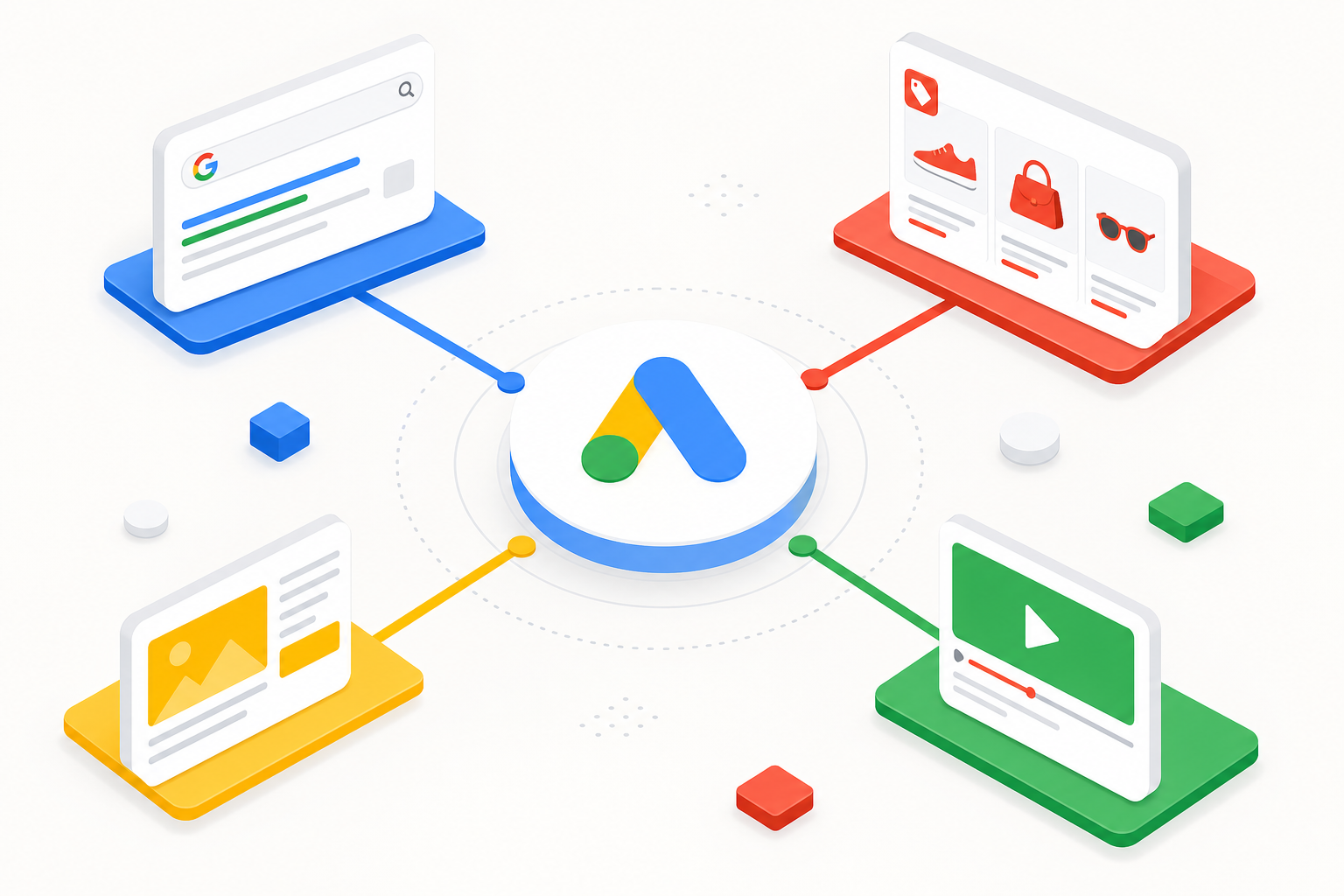
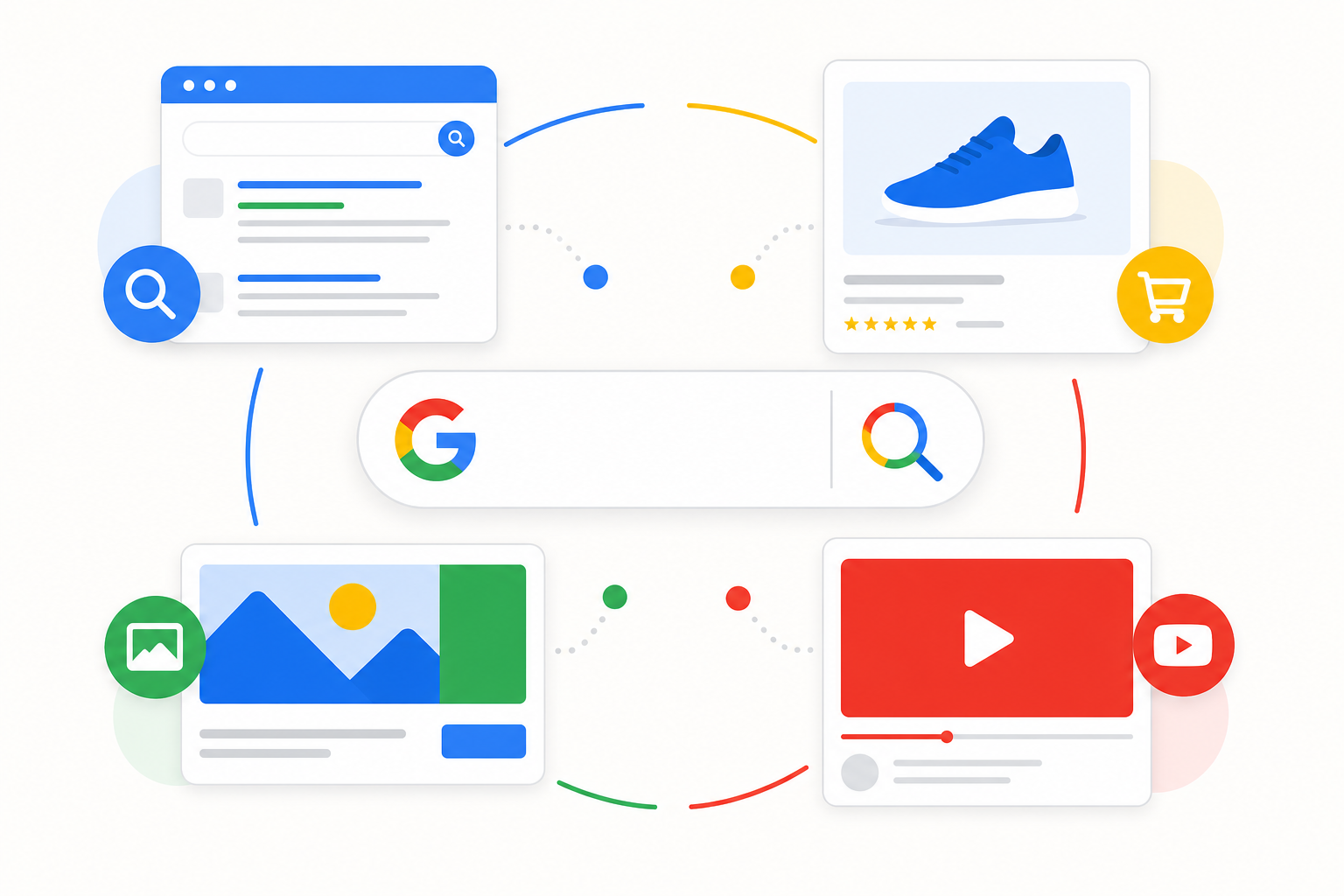
Performance Max (Pmax) is Google's automated campaign type that covers all of Google's channels in one campaign: Search, Shopping, Display, YouTube, Gmail, and Discover. You provide the goal, budget, creative assets, and conversion data, and the algorithm optimizes across channels and audiences automatically.
Pmax is effective in e-commerce (it replaced Smart Shopping) and when you want to maximize conversions broadly without manual per-channel management. Its strength is machine learning and broad coverage; its weakness is the lack of control and transparency — you see less of where results come from.
Pmax works best alongside Search, not instead of it: keep separate Search campaigns for the most important keywords (control) and let Pmax cover the rest. Feed it quality assets, good conversion data, and clear asset groups — automation is only as good as its input.
Demand Gen: building demand visually
Demand Gen (formerly Discovery) is a visual campaign type that shows attractive image and video ads on Google's visual surfaces: YouTube (feed, Shorts), Discover, and Gmail. It is Google's answer to demand-generating social advertising.
Demand Gen reaches the user in a browsing state, before they actively search. It suits demand generation, growing awareness, and showcasing visual products. Unlike Search, it does not capture existing demand but creates it.
Demand Gen complements Search and Pmax: once existing demand is captured, Demand Gen grows demand higher in the funnel. Use high-quality, visual creatives and measure its impact over a longer time frame — demand generation does not produce immediate last-click conversions.
Display and Video (YouTube)
Display campaigns show banner and image ads across Google's vast display network (millions of sites and apps). Display is cheap reach and suits remarketing especially (reach site visitors again) and broad awareness. Its weakness is often low intent and variable placement quality.
Video campaigns show ads on YouTube in various formats: skippable and non-skippable in-stream, bumper (6s), and in-feed. YouTube is effective for building awareness and consideration, and its storytelling power suits brand building in a way text or image ads cannot.
Both Display and Video are primarily upper-funnel tools: they build demand and awareness, they do not capture existing buying demand. Measure them accordingly — reach, brand searches, and assisted conversions, not just last-click ROAS.
- Display: cheap reach, strong in remarketing
- Video (YouTube): awareness and consideration, storytelling
- Both: upper funnel — build demand, do not capture it
- Measure: reach, brand searches, assisted conversions
How to choose the right campaign type
Start from the goal and the stage of the buying journey. If you want to capture existing demand and have buying keywords: Search. If you are e-commerce and want to maximize conversions broadly: Performance Max (alongside Search). If you want to build demand visually: Demand Gen or Video. If you want remarketing and cheap reach: Display.
Most accounts benefit from a combination: Search captures existing demand, Pmax expands conversions, and Demand Gen/Video build demand higher up. Do not try to do everything with one type — give each its inherent role.
Start with the most profitable (Search) and expand in stages by budget and goal. Measure each type with metrics appropriate to its role: lower-funnel types by ROAS and CPA, upper-funnel types by reach and demand growth.
Common mistakes in choosing a campaign type
We see these mistakes repeatedly in Google Ads account audits.
- Performance Max only, without Search → you lose control of key keywords
- Measuring Display/Video by last-click ROAS → you underrate their role
- Wrong type for the goal → building demand with Search or vice versa
- Missing negative keywords in Search → budget leaks into irrelevant searches
- Feeding Pmax weak data/assets → automation optimizes poorly
- Forcing everything into one type → each has its inherent role
Frequently asked questions
Which Google Ads campaign type should I start with?
Search is almost always the best starting point because it captures existing demand at the highest intent. Start with brand searches and generic buying terms with negative keywords, then expand to other types.
What is the difference between Performance Max and a Search campaign?
Search shows text ads on chosen keywords with precise control. Performance Max covers all of Google's channels (Search, Shopping, Display, YouTube, Gmail, Discover) automatically. They work best together, not as replacements.
What is Demand Gen for?
Demand Gen is a visual campaign type (YouTube, Discover, Gmail) for building demand and growing awareness. It reaches the user in a browsing state before active search — complementing Search, which captures existing demand.
How do I measure Display and Video campaigns?
They are upper-funnel tools, so do not measure them by last-click ROAS alone. Track reach, brand-search trends, and assisted conversions — they build demand rather than capture it immediately.
Can I use only Performance Max?
You can, but you lose control of key keywords and transparency into results. The recommendation is to keep separate Search campaigns for the most important keywords and let Pmax cover the rest — they work best together.