Why is Performance Max Google's priority?
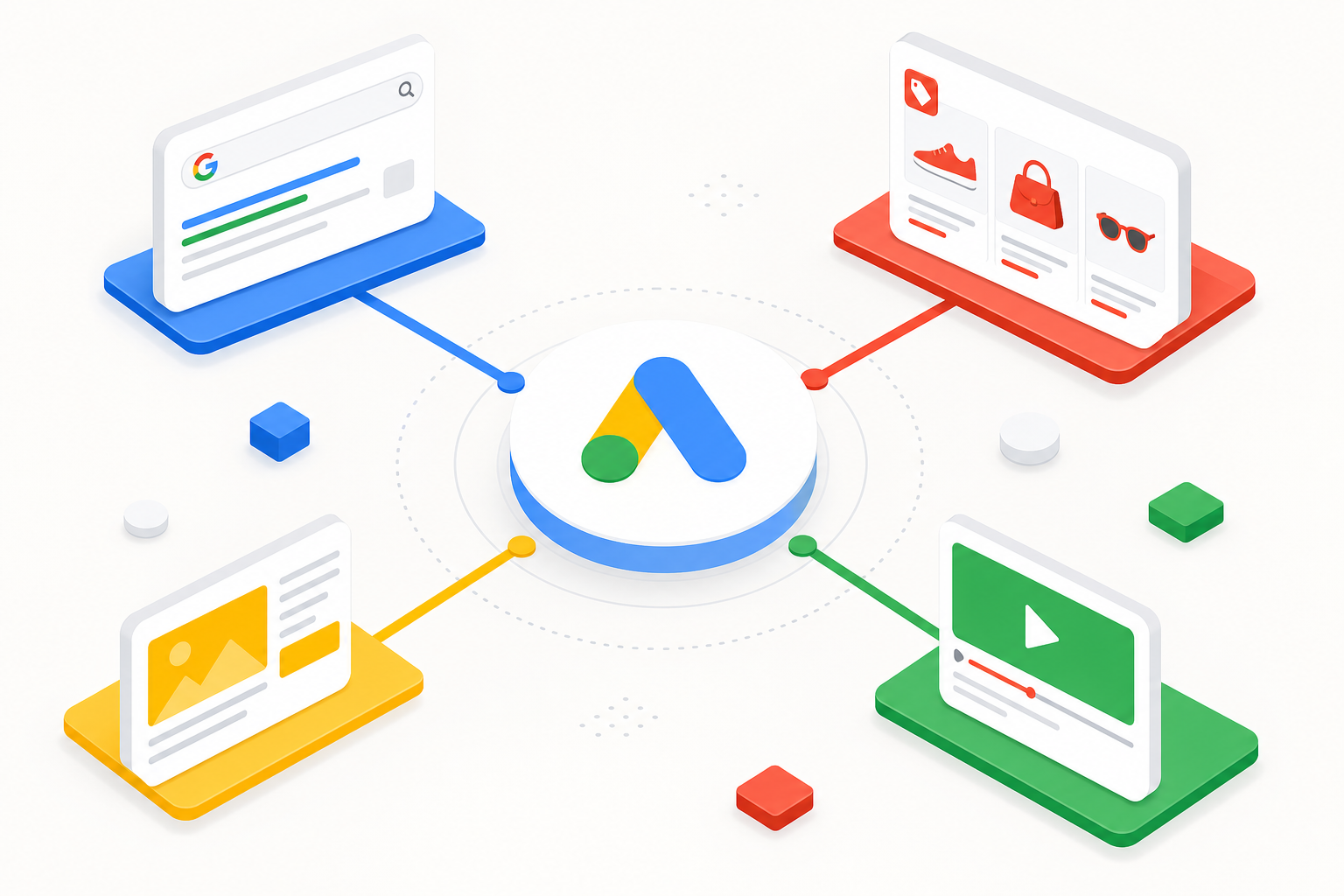
Google has shifted significant development focus to Performance Max campaigns. PMax uses machine learning to distribute budget across channels in real time — Search ads, YouTube videos, Display banners, Discover cards, and Gmail ads compete in the same auction.
For B2C e-commerce, PMax is often the best way to scale Shopping advertising across broader inventory. For B2B, the picture is more complex: long sales cycles and low conversion volumes make algorithm training harder. PMax doesn't replace Search campaigns in every scenario — it complements them.
The key advantage is scalability. When asset groups are built correctly and conversion tracking is reliable, PMax finds customer segments that manual campaigns miss. The downside is reduced control: you don't see keyword-level data — you trust Google's algorithm and your own signals.
The right campaign structure from day one
A good PMax campaign starts with a business goal, not a campaign type. Before creating your first PMax campaign, ensure working conversion tracking, clear conversion values, and enough historical data — ideally at least 30 conversions per month per target asset group.
- One campaign per product category or market — don't mix B2B and B2C products in the same campaign
- Turn off Final URL expansion if landing page experience varies significantly
- Use brand exclusions: separate Brand Search campaign + PMax without brand terms
- Location targeting: "Presence" not "Presence or interest" if you only sell domestically
- Audience signals added but not restrictive — they guide the algorithm, not limit it
Asset group strategy that scales
An asset group is PMax's core unit — roughly equivalent to an ad group in manual campaigns. Each asset group has its own product feed or landing page targeting, text and image assets, and audience signals.
Optimal structure depends on catalog size. For small stores (under 200 products), one or two asset groups suffice. For larger catalogs, we recommend segmentation by margin, velocity, or product line — not just Google Merchant Center category.
Text assets: at least 5 headlines, 5 long headlines, and 4 descriptions per asset group. Google tests combinations automatically — weak assets don't stay inactive; they can activate and hurt performance. Remove low performers actively via the Ad Strength report.
Conversion tracking — PMax's lifeline
Performance Max optimizes for what you measure. If your primary conversion action is "Page view" or "Form start," the algorithm delivers exactly that — not necessarily a purchase or lead.
Use Enhanced Conversions for Leads or Web. Server-side tracking (GA4 + GTM server container) significantly improves data quality, especially with iOS and cookie restrictions. Offline conversion import is critical for B2B: if your sales cycle is 30–90 days, the algorithm needs feedback on closed deals.
Bidding strategies and budgeting
Start with Maximize Conversions or Maximize Conversion Value when the campaign has at least 30 conversions in 30 days. Starting with Target ROAS or Target CPA too early often leads to under-delivery because the algorithm hasn't learned conversion patterns yet.
When the campaign is stable (4–6 weeks of consistent data), move to Target ROAS for e-commerce or Target CPA for lead gen. Setting ROAS targets too aggressively cuts visibility — start 10–15% below current ROAS and tighten gradually.
Budget scaling: increase max 20–30% at a time and wait at least 7–14 days before the next change. PMax reacts to budget changes slower than Search because it optimizes across multiple channels.
Reporting: what PMax actually does
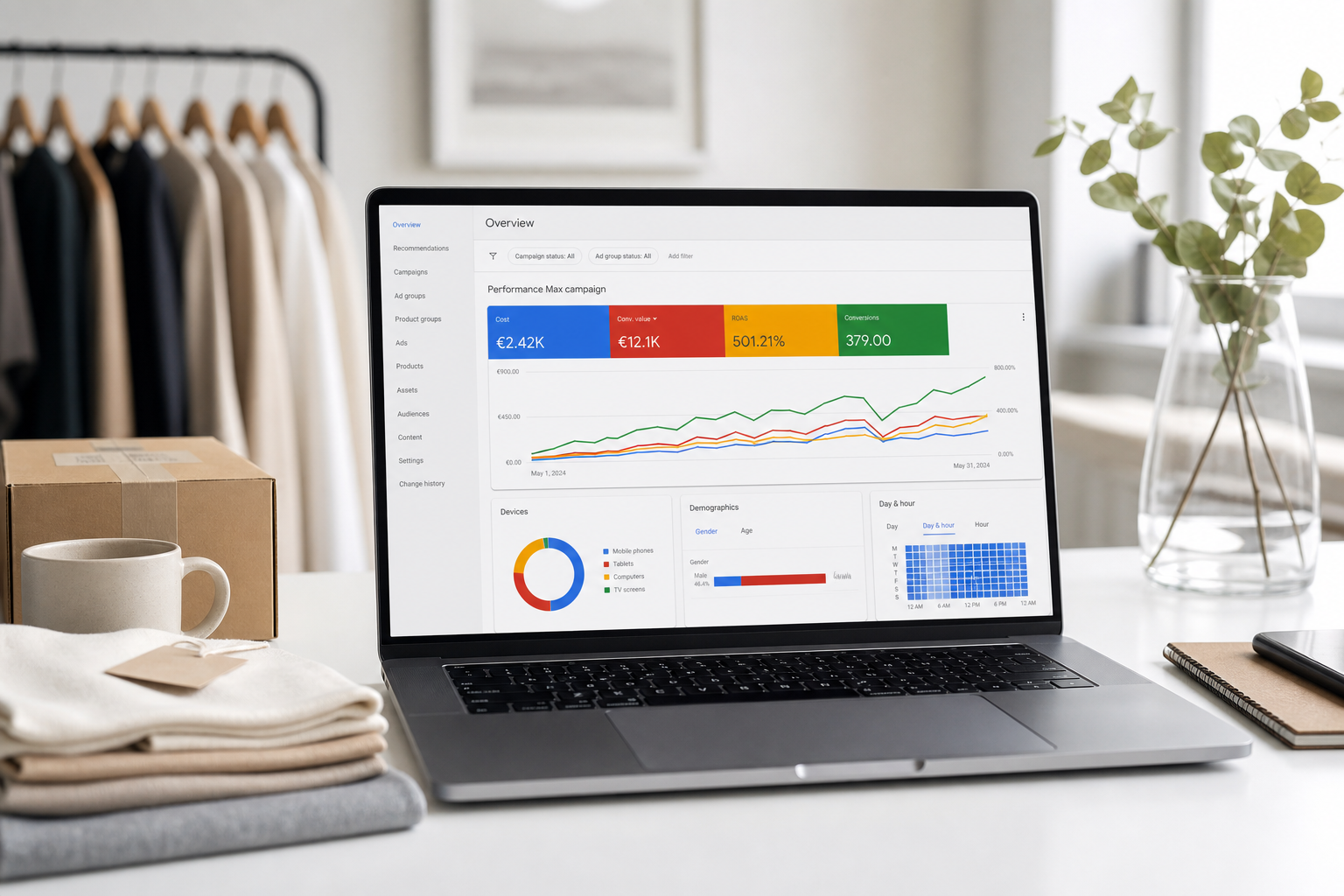
PMax's biggest reporting challenge is fuzzy attribution. A Search terms report exists but covers only a fraction of Search traffic. The Channel performance report shows Search, Display, YouTube split — but not at keyword level.
The Asset performance report shows which headlines, images, and videos get "Best" or "Low" ratings. Replace Low assets monthly. The Listing group report (Shopping) shows product-level performance — use it for margin optimization.
Placement and brand safety: review Display and YouTube placements monthly. PMax can show ads on irrelevant sites, especially when budget is large relative to conversion data.
Five common mistakes (and fixes)
We see these repeatedly in audits — often in the same campaign.
- Too little asset group segmentation → Create clear structure by product line or margin
- Brand traffic mixed into non-brand PMax → Brand exclusions + separate Brand Search
- Micro-conversions as primary action → Set only real business goals as primary
- Too aggressive ROAS target too early → Start Maximize Conversion Value, move to ROAS after data
- Insufficient asset testing → Refresh Low assets and test at least 2 new images/videos monthly
Frequently asked questions
Can Performance Max replace all my Search campaigns?
Not recommended. PMax excels at scaling, but Search campaigns offer keyword-level control and brand protection. A hybrid model usually delivers the best overall results.
How long does PMax campaign learning take?
Google typically cites a 2–4 week learning period. In practice, stable performance requires 4–6 weeks with sufficient conversion data. Avoid major changes during learning.
Why does PMax show poor ROAS even when sales grow?
Attribution can lag and PMax gets partial credit as an assist channel. Compare Google Ads data with GA4 and CRM. Offline conversion import helps in B2B.
Do I need a product feed for PMax?
Shopping integration requires a Merchant Center feed. For lead gen alone, a landing page + assets work without a feed, but Shopping signals significantly improve algorithm performance for e-commerce.