Why marketing organization structure matters
Marketing at a growth company is no longer one person's job or a single agency contract. When revenue sits in the €1–10M range, marketing budget rises, channels multiply, and the board expects predictable return on investment. At this stage the question isn't "hire or outsource" but "which combination delivers strategy, execution, and leadership in the right proportion".
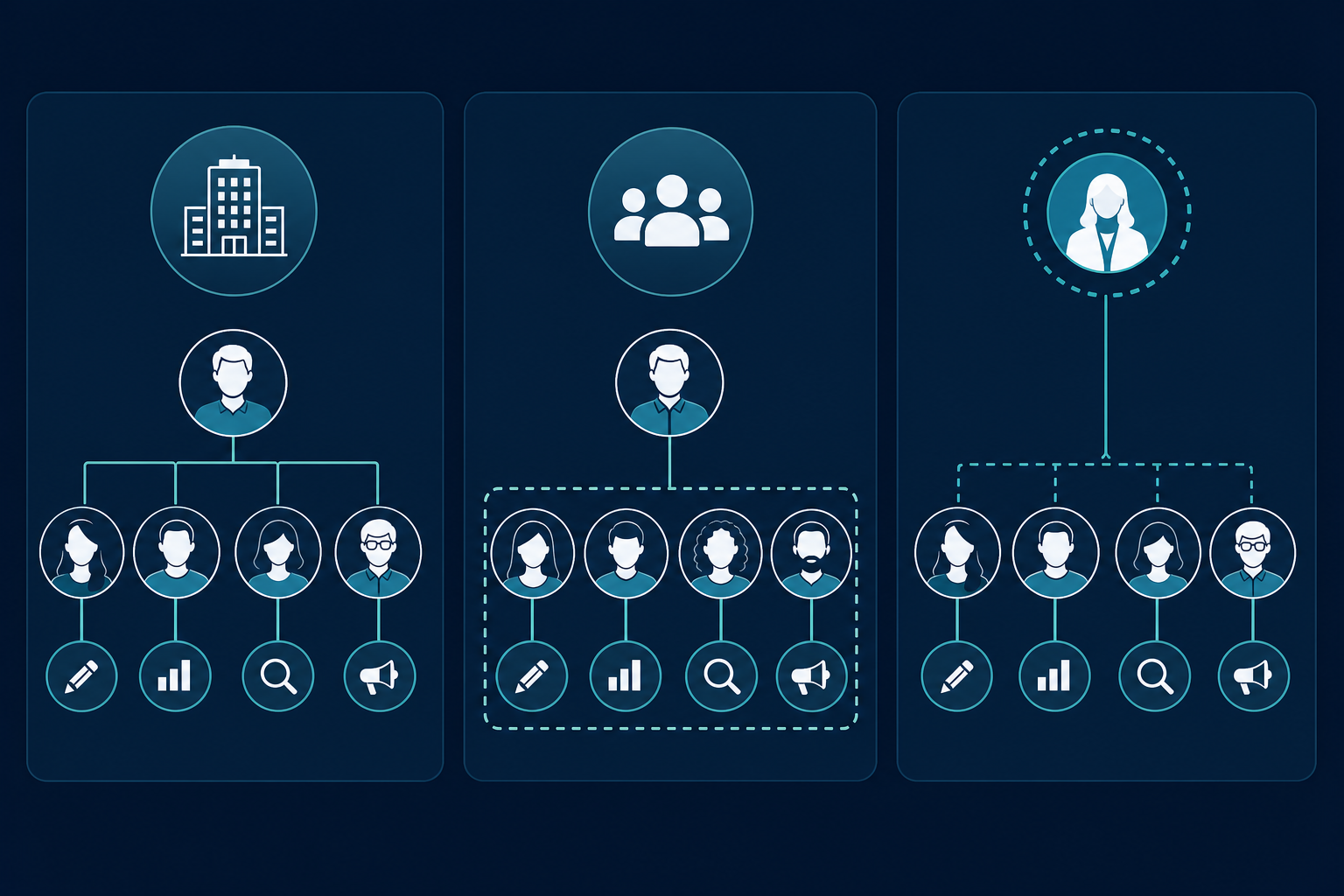
An in-house team brings culture, speed, and ownership. An agency brings scalability, specialist skills, and fast launch. A fractional CMO brings strategic leadership without full-time executive cost. Each model is strong in its role — and weak when used for the wrong job.
The most common mistake is expecting one model to do everything: strategy from an in-house team without a leader, strategic ownership from an agency without an internal sparring partner, operational campaign management from a fractional CMO. This article helps separate roles and build an organization that scales with growth.
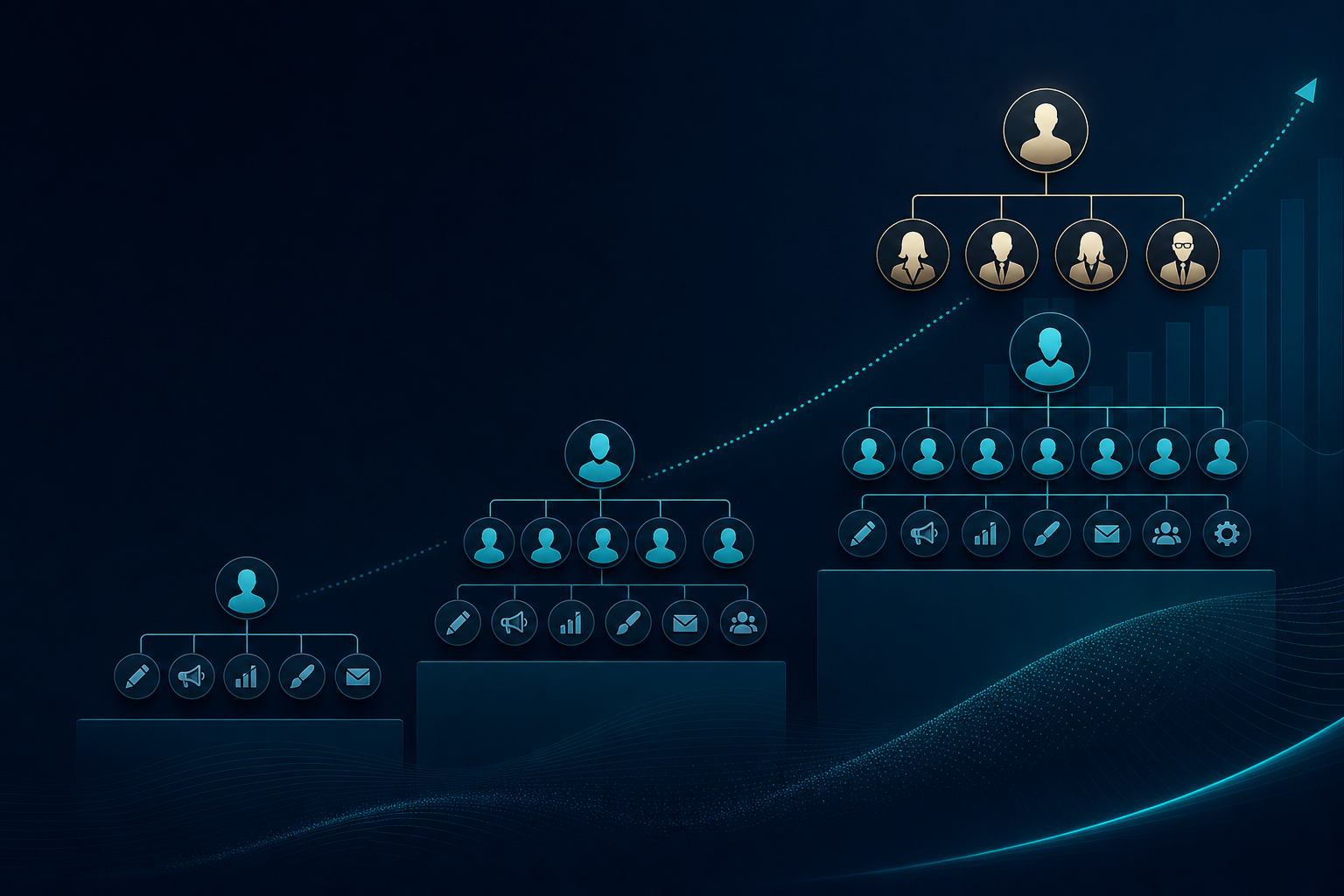
In the scale-up phase, marketing organization often changes three times: first an agency handles everything, then the first internal hire, finally strategic leadership via fractional model or full-time director. Read more in our scale-up marketing guide on transition paths.
In decision-making, separate three questions: who owns strategy, who executes operationally, and who reports to leadership. Answers can come from different models — or one, if you're willing to pay for it. Most growth companies find the best balance when strategy and reporting sit with one party (fractional CMO) and execution with another (agency or team).
In-house marketing team — strengths and limits
An in-house marketing team is the company's own employees: content creators, paid media specialists, CRM owners, brand managers, and possibly a marketing director. They know the product, customers, internal processes, and culture more deeply than an external partner.
In-house is the right choice when marketing is core to the business and requires continuous, deep commitment. Multi-channel B2C brands, fast-scaling SaaS companies, or businesses where marketing owns a large share of customer experience benefit from internal ownership. The team reacts quickly to product updates, pricing changes, and crisis communications.
The challenge is cost and scalability. One marketing generalist costs €4,000–7,000 per month. A three-person team runs €15,000–25,000 per month plus benefits, tools, and training. Recruiting takes 2–4 months per role. Specialist skills (Google Ads, Meta, SEO, analytics) rarely live in one person — an internal generalist does everything adequately, nothing excellently.
An in-house team without strategic leadership is a common scale-up problem: operational execution runs, but who prioritizes channels? Who reports to the board? Who challenges assumptions? Without a leader, the internal team optimizes existing channels but doesn't build the next growth engine.
The recruiting chain slows scaling: first marketing generalist, then paid media specialist, then content creator. Each step takes months. Agency or fractional + agency brings capacity immediately — internal team builds with growth, not before it.
In-house teams are strongest when marketing requires continuous collaboration with product, sales, and customer success. Product update frequency, pricing complexity, and personal brand touch favor internal ownership — but only if strategic leadership is in place.
- Deep product and customer knowledge — fast reaction to change
- Cultural ownership and brand identity maintenance
- Daily operational leadership and team development
- High fixed cost — salaries, benefits, tools
- Limited specialist depth — generalist vs. expert
- Strategic gap without a marketing director
Marketing agency — scalability and specialist skills
A marketing agency (or channel-specific partner) handles operational execution: campaign management, content production, SEO, analytics, or a full Full Stack setup. An agency brings specialist skills, tools, best practices from multiple clients, and fast launch without recruiting.
An agency fits especially when operational execution is the biggest bottleneck and internal skills don't exist yet. Google Ads expertise, Meta creative, technical SEO, or GEO require years of experience — an agency brings that immediately. Budget €50,000–500,000 per year is a typical agency partner range: enough volume, but not yet justified for a full internal team.
The agency limit is strategic ownership. An agency executes strategy if one exists — but it doesn't build it for the board, prioritize by product line, or own business goals. An agency optimizes the channels it manages — not the full marketing portfolio. Multiple agencies without coordination create channel silos: Search optimizes ROAS, Meta scales, SEO drives traffic — but who connects the story?
Agency quality varies significantly. A strong agency is a strategic partner at the operational level; a weak agency reports metrics without business context. Choose an agency that understands your business, reports clearly, and scales with your growth.
Agency commitment to metrics is an advantage: clear KPIs, reporting rhythm, and accountability for channel results. The challenge is agencies often optimize metrics that look best for their contract — Search ROAS, Meta CPA — not overall business growth. That's why strategic ownership (fractional CMO) is critical: they set priorities the agency executes.
A Full Stack agency combines Google Ads, Meta, SEO, and GEO as one system — shared data, shared reporting. This reduces channel silos compared to multiple channel-specific agencies. Still, Full Stack doesn't replace marketing director: it executes, fractional CMO leads.
Fractional CMO — strategic leadership without full-time cost
A fractional CMO (or part-time marketing director) is an experienced marketing leader who commits to the organization typically 2–3 days per week. They bring strategic perspective, leadership experience, and a network without full-time executive cost. The fractional model fits companies that have operational execution (in-house team or agency) but no strategic leader.
A fractional CMO builds marketing strategy, prioritizes investments, leads QBR processes, coordinates internal teams and agencies, and acts as a sparring partner for the board or CEO. They don't replace a content creator, media specialist, or analyst — they lead them and ensure strategy shows up in execution.
A fractional CMO typically costs €3,000–6,000 per month depending on commitment and experience. By comparison, a full-time marketing director costs €10,000–18,000 per month all-in. In the fractional model you pay for strategic leadership, not operational work — and that's exactly how the model scales cost-effectively.
Important: distinguish fractional CMO from consultant. Fractional commits to results and the organization long-term, not just delivering reports or workshops. Contracts are usually 6–12 months. Read more in our fractional CMO vs full-time article on when fractional is enough and when full-time is justified.
Three-way comparison: strategy, speed, and ownership
Strategic impact: fractional CMO and full-time director own strategy. In-house team without a leader executes but doesn't own. Agency executes given strategy but doesn't build it for the board. Best strategic outcome: fractional CMO + operational execution (team or agency).
Speed and flexibility: agency launches fastest (2–4 weeks). Internal recruiting takes 2–4 months. Fractional CMO typically starts in 2–4 weeks. Agency scales up and down fastest; in-house team is slowest but most stable.
Cost and scalability: fractional CMO is most cost-effective for strategic leadership. Agency is cost-effective for operational execution without fixed salaries. In-house team is most expensive in fixed costs but brings deepest ownership.
Culture and brand: in-house team knows the organization deepest. Fractional CMO brings external perspective and challenges assumptions. Agency is furthest from culture but brings best practices from elsewhere.
Our Marketing Director service combines fractional strategic leadership with operational execution: we don't leave strategy on paper — we ensure it shows up in campaigns, reports, and QBR processes.
Reporting differs clearly: internal team reports operational execution, agency channel results, fractional CMO business and strategy. The board needs the last — without it, channel wins can hide overall decline.
Speed reacting to market change: internal team fastest (same day), agency fast (1–2 days), fractional CMO strategically fast but not operationally daily. In crisis communications and product launches, internal team is irreplaceable — fractional CMO for strategic direction.
Cost comparison: numbers across models
In-house team (3 people): €15,000–25,000 per month all-in. Includes salaries, benefits, tools, and training. Does not include strategic leadership — generalists do operational work. Strategic gap can cost more than savings on director salary.
Agency (Full Stack or channel-specific): €3,000–15,000 per month depending on scope. No fixed salaries, fast scalability. Multiple agencies without coordination add cost and reduce efficiency.
Fractional CMO: €3,000–6,000 per month. Strategic leadership without operational execution. Combined with agency or small internal team, total cost €8,000–20,000 per month — often cheaper than in-house team without strategic guidance.
Full-time marketing director: €10,000–18,000 per month. Justified when revenue exceeds €15–20M, marketing budget over €800,000 per year, and internal team needs daily leadership.
Hidden costs: internal team — recruiting, onboarding, tools (CRM, analytics, ad platforms), training. Agency — contract management and coordinating multiple partners. Fractional CMO — contract term and clear scope — fewer surprises, but no operational capacity included in price.
For ROI, the question is: do invested euros produce growth? Weak internal team without leader burns budget on channel optimization without strategy. Weak agency without owner reports metrics without business impact. Fractional CMO without execution leaves strategy on paper. Hybrid model minimizes these risks.
When is each model the right choice?
In-house team fits when: marketing is core to the business, revenue over €10M, internal team over 3 people needing daily leadership, brand requires deep cultural ownership, complex product portfolio or multiple brands.
Agency fits when: operational execution is the biggest bottleneck, no internal skills yet, budget €50,000–500,000 per year, one or two clear growth channels, fast launch matters more than internal ownership.
Fractional CMO fits when: operational execution is in place (team or agency) but no strategic leader, revenue €1–10M, marketing budget €50,000–500,000 per year, growth phase (new market, product launch), board expects QBR-level reporting, budget doesn't justify full-time director.
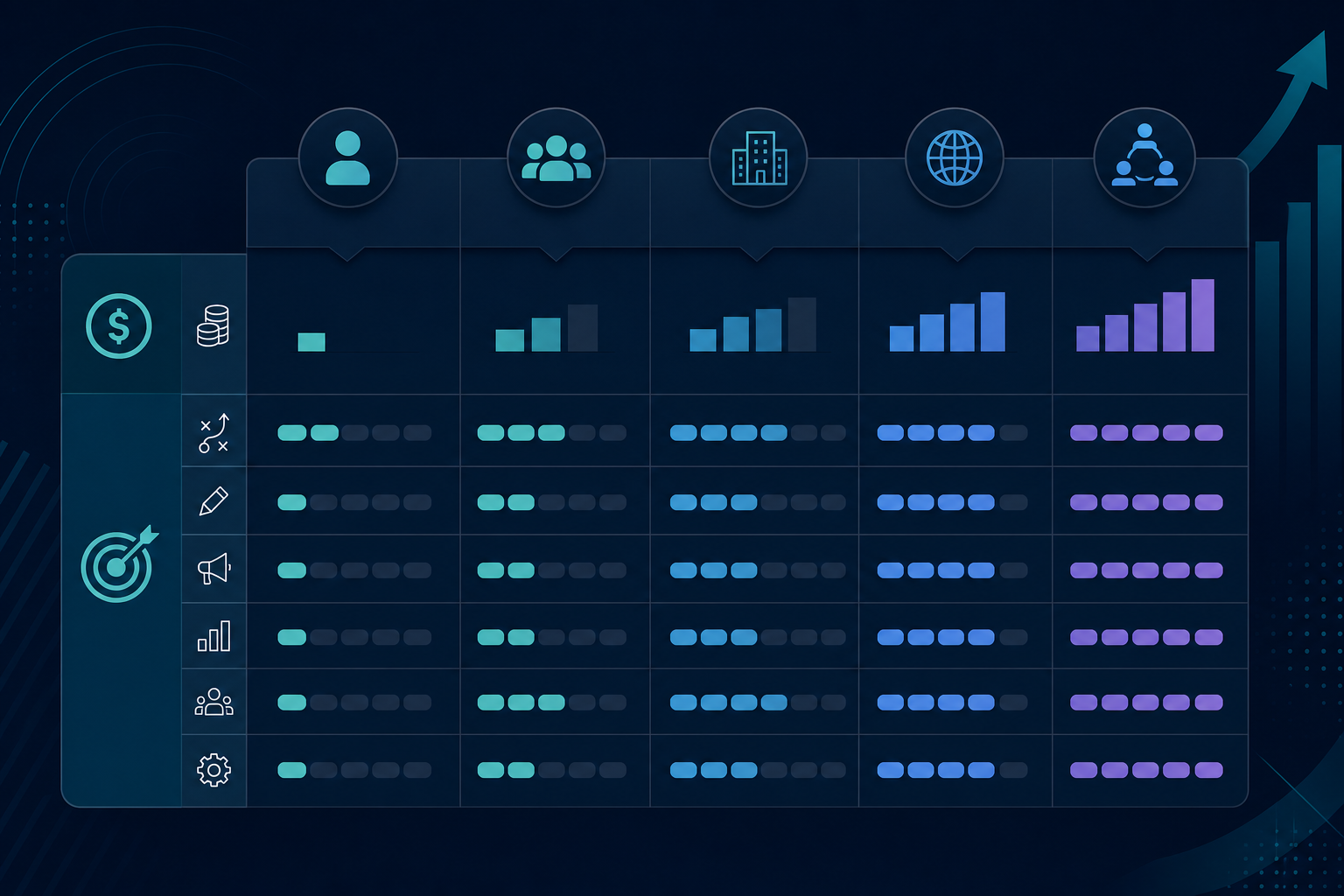
For scale-ups (for scale-ups) the typical path: agency for operational execution → fractional CMO for strategy → internal team as growth continues → full-time director when revenue exceeds €15M.
B2B vs B2C affects choice: B2B often benefits from agency + fractional CMO (long sales cycle, complex attribution). B2C brands may need internal team earlier for brand identity and fast reaction — but strategic leadership is still often missing without fractional CMO or full-time director.
International expansion adds complexity: local agency + fractional CMO may suffice for one market; multiple countries need internal team or local agencies + centralized strategic leadership. Don't copy organization model from another company — copy role split, not structure.
- Under €3M revenue: agency or fractional + agency
- €3–10M: fractional CMO + agency or small internal team
- €10–20M: internal team + fractional or full-time director
- Over €20M: internal team + full-time marketing director
Hybrid model: the best answer for most growth companies
The most common and economically sensible solution is a hybrid: operational execution with agency or small internal team, strategic leadership with fractional CMO. This combines agency scalability, specialist skills, and speed with fractional CMO strategic guidance without full-time director cost.
Fractional CMO coordinates agencies and internal team, prioritizes channels, allocates budget quarterly, and reports to the board. Agency executes campaigns, content, and analytics. Internal team (if any) brings product and customer knowledge and fast reaction.
Transition from hybrid to full-time director happens when revenue exceeds €10–15M, marketing budget is over €800,000 per year, and internal team needs daily leadership. Fractional CMO can help define the role and recruit the right person.
AlgoTerra's Marketing Director service is designed for hybrid model: fractional CMO for strategy and QBR, Full Stack execution for channels. One accountable partner, clear role split.
Practical example: €5M revenue SaaS company — Full Stack agency handles Google Ads, Meta, and SEO (€6,000/mo), fractional CMO for strategy, QBR, and budget allocation (€4,500/mo). Total cost €10,500/mo vs. internal team of three at €20,000/mo without strategic leader. Strategy documented, channels coordinated, board gets quarterly report.
Transition from hybrid forward happens based on data: when internal team grows beyond 3 people and marketing needs daily leadership, fractional helps recruit full-time director and transfer responsibility smoothly — without strategy breaking.
Common mistakes building marketing organization
These mistakes appear repeatedly in growth-company marketing organizations — often in companies whose channels perform but overall growth stalls.
- Internal generalist without strategic leader → operational execution without prioritization
- Multiple agencies without coordination → channel silos, conflicting reports
- Expecting strategic ownership from agency → agency optimizes channels, not portfolio
- Fractional CMO doing operational work → expensive generalist, strategic gap remains
- In-house team too early → fixed costs before product-market fit
- Strategic leadership too late → budget burns on wrong strategy for months
Frequently asked questions
Which is better: in-house team or agency?
Depends on stage and need. Agency fits operational execution and fast scalability. In-house fits when marketing is core and you need deep cultural ownership. For most growth companies, hybrid model (agency + fractional CMO) is most effective.
Can fractional CMO replace an in-house team?
No. Fractional CMO leads strategy — they don't replace content creator, media specialist, or analyst. Operational execution stays with in-house team or agency. Fractional complements, doesn't replace.
How much does marketing organization cost for a growth company?
Typical range: agency €3,000–15,000/mo, fractional CMO €3,000–6,000/mo, in-house team 3 people €15,000–25,000/mo. Hybrid (fractional + agency) €8,000–20,000/mo is often most cost-effective with strategic guidance.
When to move from fractional CMO to full-time director?
When revenue exceeds €10–15M, marketing budget is over €800,000 per year, and internal team needs daily leadership. Fractional CMO can help define the role and recruit the right person.
How to coordinate multiple agencies?
You need strategic owner — fractional CMO or full-time director — who prioritizes channels, allocates budget, and unifies reporting. Without coordination, agencies optimize their channels competitively.