What does the scale-up marketing phase mean?
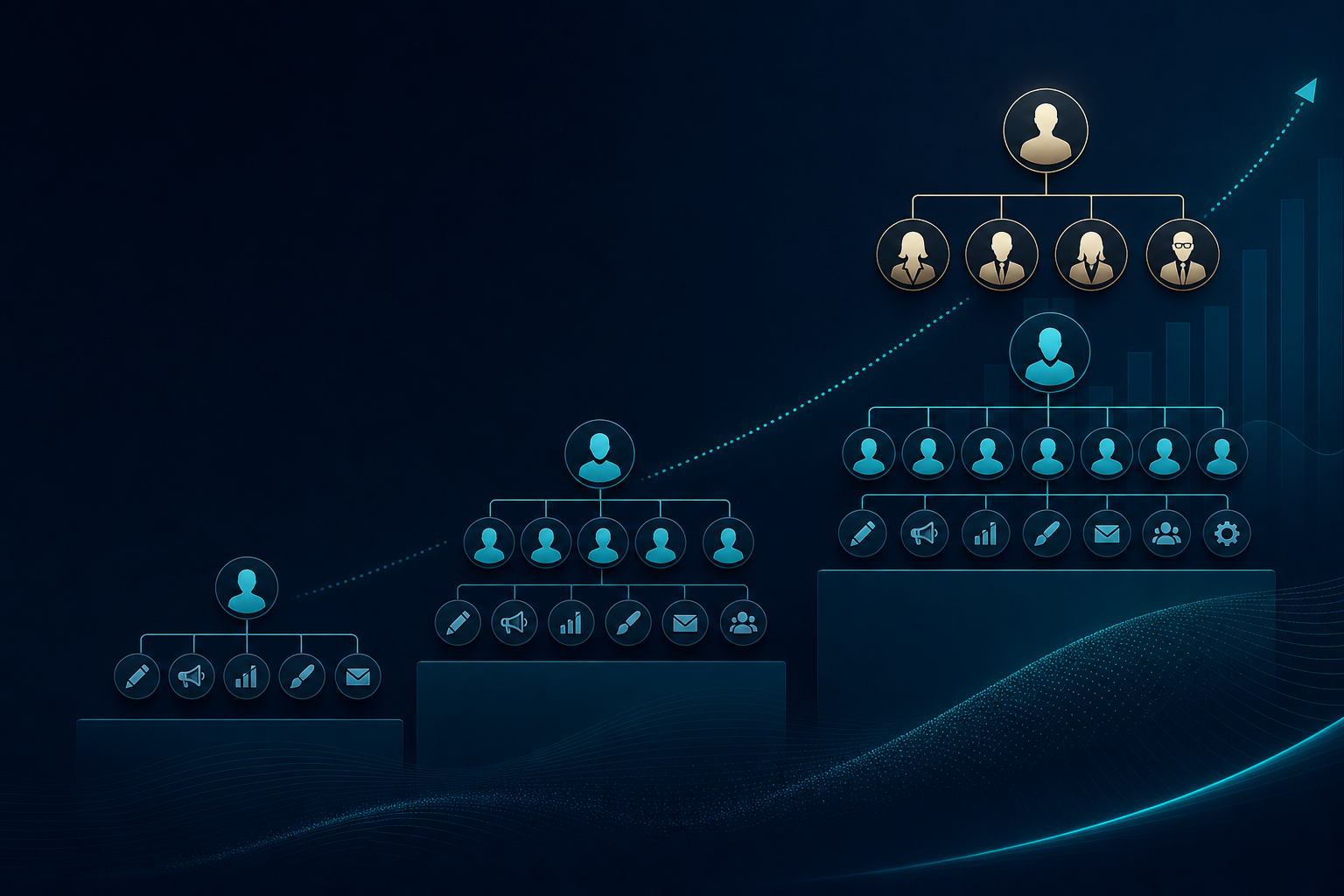
Scale-up is the phase where product-market fit is solid and growth is the goal — not just survival. Marketing shifts from experimentation to system: budgets grow, channels are added, the team expands, and investors or the board expect predictable return on marketing investment.
At this stage the most common challenge is not single-channel expertise but managing the whole. Google Ads delivers, Meta scales, SEO brings organic traffic — but who prioritizes? Who allocates budget? Who reports to leadership as one story? Without strategic steering, channels compete with each other and attribution breaks decision-making.
Scale-up marketing needs two layers: operational execution (campaigns, content, technical SEO) and strategic leadership (prioritization, budgeting, metrics, QBR). Full Stack handles the first excellently. The need for the second grows when revenue passes roughly €3M and marketing budget €100k — often sooner if growth is fast.
Moving from Full Stack to Marketing Director is not failure — it is a sign of growth. The company needs more than channel execution: it needs a leader who sees the whole portfolio and ties marketing to business goals.
Scale-up marketing is also a hiring question: when to hire the first internal marketing generalist, when to outsource, and when to move to director level. Wrong order — e.g. internal generalist before a Full Stack foundation — slows growth. Right order: operational foundation (Full Stack) → strategic steering (fractional director) → internal team and possible full-time director.
What does Full Stack marketing cover in a scale-up?
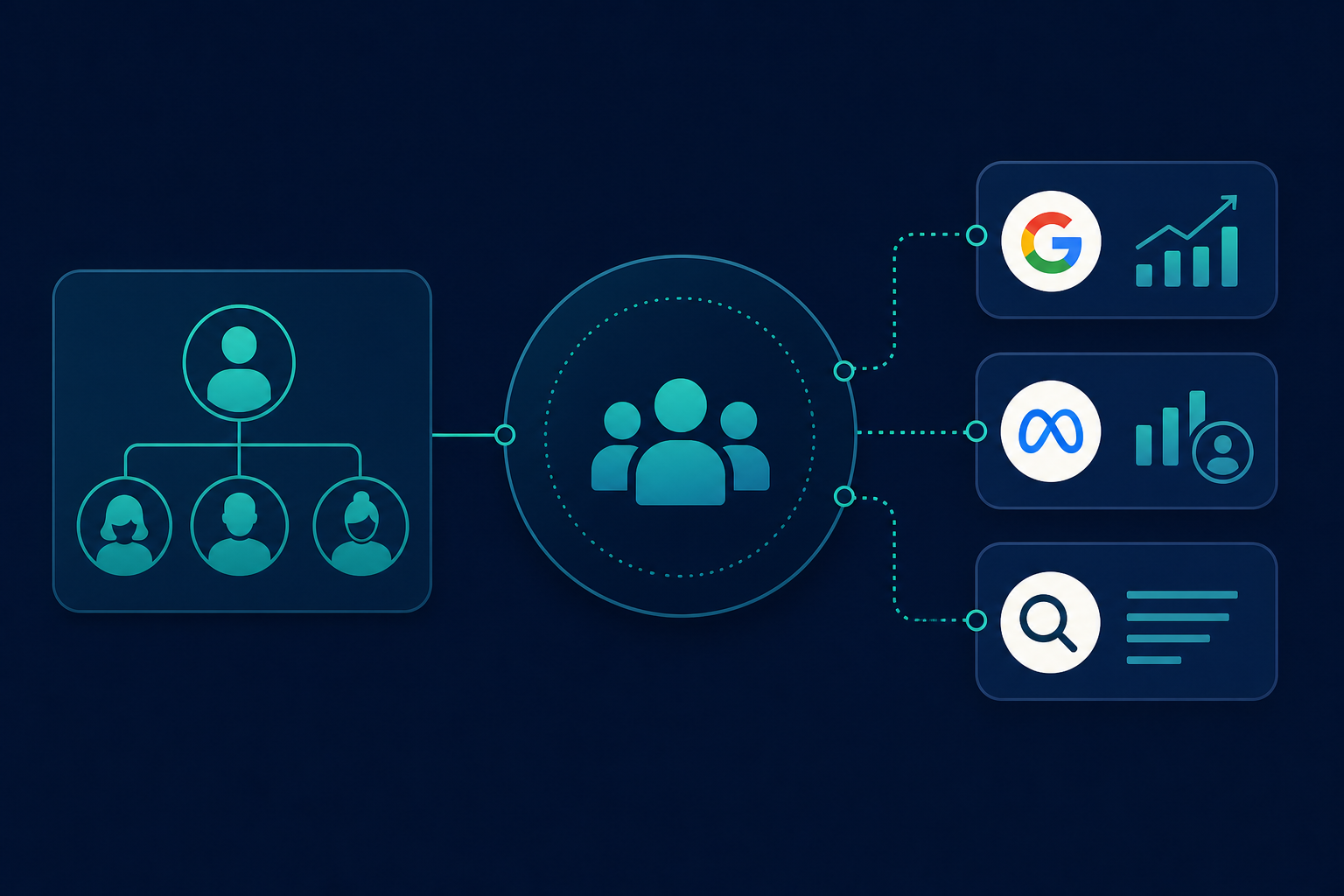
Full Stack marketing means Google Ads, Meta, SEO, and GEO run as one system — shared data, shared reporting, and cross-channel coordination. In a scale-up, Full Stack solves the operational bottleneck: no more four separate vendors with four different dashboards.
Full Stack delivers: cross-channel optimization (Search supports Meta retargeting, SEO supports GEO visibility), shared conversion tracking, budget allocation based on data, and one accountable party for operational execution. This is the scale-up's first major marketing investment — and often enough at €1–5M revenue.
Full Stack is not strategic leadership. It executes strategy if one exists — but it does not build it for the board, prioritize by product line, or lead an internal marketing team. When the strategic gap grows, Full Stack still performs well by channel, but the whole suffers.
Read more in the Full Stack marketing guide on how an integrated model differs from channel silos. For a scale-up, Full Stack is the foundation — not the end point.
- Google Ads + Meta + SEO + GEO as one system
- Shared conversion tracking and attribution
- Operational execution and channel coordination
- Budget allocation across channels based on data
- No strategic leadership for the board or internal team
When is Full Stack enough without a marketing director?
Full Stack is the right choice when operational execution is the biggest bottleneck and a strategic gap is not yet slowing growth. Concrete situations:
Revenue under €3M and marketing budget under €100k per year: Full Stack covers execution, and the CEO or sales lead can own strategic priorities. Marketing is clearly one or two channels — not a complex portfolio.
One clear growth channel works: e.g. Google Search delivers predictably and Meta scales. Full Stack optimizes both; the strategic question is "do we scale?" not "which channel first?". When the answer is simple, leadership need is low.
No internal marketing team: outsourced Full Stack is the entire marketing function. A marketing director is needed only when an internal team grows and needs daily leadership, coordination, and development.
Investors expect growth, not yet QBR-level reporting: Full Stack reports by channel and as a whole. A marketing director brings quarterly reporting, scenarios, and strategic dialogue with the board — need grows when due diligence requirements tighten.
Signals: you need a marketing director
These signals mean Full Stack alone is no longer enough and Marketing Director-level steering is justified. One signal may not be enough — several together confirm the need.
Budget over €200k per year and growing: allocation decisions (Search vs Meta vs SEO vs GEO) need strategic view, not just last month's ROAS. Who decides the next €50k shift? Without a director, the decision falls to the CEO without marketing expertise.
Multiple products, markets, or brands: prioritization gets complex. Full Stack can execute all, but who decides where growth investment goes? A marketing director builds portfolio strategy and a QBR process.
Internal marketing team of 2–5 people: needs a leader, sparring partner, and prioritizer. A Full Stack partner executes but does not lead the internal team daily. A fractional marketing director fills this role without a full-time salary.
Board or investors ask for documented marketing strategy: CAC trends, channel strategy, scenarios, and metrics. Full Stack reports execution; a marketing director owns strategy and its communication to leadership.
Growth has stalled despite channel optimization: a signal the problem is strategy, not execution. A new leadership layer brings external perspective, challenges assumptions, and builds a new growth model.
The CEO spending more than 5 hours per week on marketing decisions is a practical threshold: if the CEO owns budget allocation, channel priorities, and reporting, a fractional marketing director frees time for product and sales leadership. This does not show on a dashboard — but it shows in growth rate.
What does a marketing director bring to a scale-up?
A fractional marketing director (or part-time CMO) brings strategic leadership without full-time executive cost. In a scale-up the role focuses on growth steering, not operational campaign management — execution stays with the Full Stack partner or internal team.
Strategy and prioritization: the marketing director defines channel priorities, quarterly budget allocation, and growth targets aligned with the business. They build a marketing strategy document the board and investors can follow.
QBR and reporting: quarterly reports, CAC/LTV analysis, scenarios, and next quarter priorities. This is the level scale-up boards expect — Full Stack reports channels, a marketing director reports the business.
Team leadership: spars with internal marketing, coordinates the Full Stack partner, prioritizes projects, and ensures strategy shows up in execution. They do not write ads — they ensure the right ads are made at the right time.
Compare in fractional CMO vs full-time when fractional is enough and when a full-time director is justified. In a scale-up, fractional is often the right first step.

Full Stack vs Marketing Director: separating roles
Clear role separation prevents overlap and ensures both deliver value. Full Stack = operational execution and channel coordination. Marketing Director = strategy, prioritization, leadership, and reporting to leadership.
Full Stack owns: campaign management, conversion tracking, cross-channel optimization, technical SEO/GEO, creative testing, operational reporting. Marketing Director owns: marketing strategy, quarterly budget allocation, QBR, team sparring, board reporting, recruitment support when moving to a full-time director.
Cost comparison: Full Stack €2,000–8,000/month depending on scope. Fractional marketing director €3,000–6,000/month. Together €5,000–12,000/month — still below a full-time marketing director (€10,000–18,000/month) and separate channel vendors combined.
Both are needed in a scale-up when revenue is €3–15M and marketing budget €200k–800k. Full Stack without a director delivers channels; a director without execution delivers slides. The optimal combination is strategy + execution.
Transition process: Full Stack → Marketing Director
The transition does not happen overnight — it is a 2–3 month process with clear roles and responsibilities. Goal: strategic steering improves without operational disruption.
Phase 1 — audit (weeks 1–2): marketing director audits current state — channels, metrics, budget, team, reporting. Documents gaps in strategy and prioritization. Full Stack continues operational execution.
Phase 2 — strategy (weeks 3–6): marketing director builds marketing strategy, channel priorities, and QBR framework. Presents to the board. Full Stack implements strategy operationally — e.g. budget shifts between channels.
Phase 3 — rhythm (weeks 7–12): first QBR, monthly rhythm established, team sparring begins. Full Stack reports operationally to the marketing director; marketing director reports to leadership. Roles clarify in practice.
Sign of a successful transition: budget allocation is based on strategy not reaction, leadership gets one coherent story, and Full Stack produces more because priorities are clear. Failed transition: two vendors, two strategies, no owner.
Document a role card during transition: who owns strategy, budget, reporting, and operational execution. The role card prevents overlap and helps both the Full Stack partner and fractional director work efficiently in the same organization.
Hybrid model: Full Stack + fractional director
The most common and economically sensible model in a scale-up is hybrid: Full Stack handles operational execution, Marketing Director strategy and leadership. This is AlgoTerra's recommendation for companies at €3–15M revenue.
Hybrid benefits: one strategic owner (fractional CMO), one operational executor (Full Stack), shared data and reporting. Not four channel vendors plus a separate strategy consultant. Cost efficiency and clarity.
The fractional model scales: when revenue passes €15M and budget €1M, fractional helps recruit a full-time marketing director and transfer ownership. Full Stack can continue as operational partner — roles do not change, ownership deepens.
Read the service bundle for scale-ups and how the hybrid model is built in practice. The fractional → full-time transition is a natural next step, not a mandatory reorganization.
Common mistakes in scale-up marketing
These mistakes slow growth or burn budget in the scale-up phase — often when the move from Full Stack to leadership happens too late or wrong.
- Full Stack alone too long → strategic gap, budget allocated reactively
- Marketing director without operational execution → strategy stays on paper
- Full-time CMO too early (<€5M) → expensive, orientation slows growth
- Channel silos remain under Full Stack → integration missing
- No QBR rhythm → board does not trust marketing
- Scaling without metrics → CAC rises unnoticed
- Investors expect strategy, get only channel reports
- Transition without role separation → two vendors, no owner
Decision checklist: do you need a marketing director?
Go through these questions. If you answer "yes" to three or more, a fractional marketing director is likely justified in your scale-up.
1) Is marketing budget over €200k per year and growing? 2) Are there three or more channels (Ads, Meta, SEO, GEO)? 3) Is there an internal marketing team that needs leadership? 4) Do the board or investors ask for documented marketing strategy? 5) Has growth stalled despite channel optimization? 6) Do you need QBR-level reporting quarterly?
If yes: start with a fractional marketing director at 2–3 days/week commitment. Keep Full Stack as operational partner. Do not replace Full Stack with a director — complement.
If no to most: Full Stack is likely still enough. Focus on operational quality, conversion tracking, and unified reporting. Return to the checklist in 6–12 months or when revenue passes €3M.
Scale-up marketing is a journey: Full Stack builds the engine, the marketing director steers direction. Both are needed at different stages — the key is recognizing the right moment to transition and doing it in a controlled way.
Frequently asked questions
When does a scale-up need a marketing director instead of Full Stack?
When marketing budget exceeds roughly €200k per year, there are three or more channels, the internal team needs leadership, or the board expects QBR-level strategy. Full Stack handles execution — a marketing director handles strategy and prioritization. Often both are needed together.
Can Full Stack and a marketing director work at the same time?
Yes — and in a scale-up that is often the best model. Full Stack handles operational execution (campaigns, SEO, GEO), a fractional marketing director handles strategy, QBRs, and team leadership. Role separation is critical.
How much does a fractional marketing director cost in a scale-up?
Typically €3,000–6,000 per month with 2–3 days/week commitment. Together with Full Stack, total cost is €5,000–12,000/month — below a full-time marketing director and separate channel vendors.
When to move from fractional to full-time marketing director?
When revenue exceeds €10–15M, marketing budget is over €800k per year, and an internal team of 5+ needs daily leadership. Fractional helps define the role and recruit the right person.
Is Full Stack a "temporary solution" before a marketing director?
No — Full Stack is the operational foundation that continues alongside a marketing director. Transition means adding strategic leadership, not replacing Full Stack. The hybrid model is the long-term solution for scale-ups at €3–15M revenue.