Why does a marketing QBR exist?
A QBR is not an operational report or campaign walkthrough. It is a strategic review where marketing shows its impact on the business quarterly. Without a QBR, marketing lives in an operational bubble: the team optimizes campaigns, but leadership does not see the link to revenue, profitability, and growth targets.
CEOs and boards do not want CTR or impressions. They want an answer to: does marketing return euros and should we invest more or less? The QBR is the moment to answer with data, trends, and a plan — not opinion.
A good QBR builds trust: marketing is not a cost but a growth engine managed like a business. A bad QBR reinforces doubt: too many metrics, too little link to euros, no clear plan. This guide helps you avoid the latter.
A QBR differs from a monthly report in depth and audience. The monthly report is operational: what was optimized, what was tested. The QBR is strategic: does marketing deliver growth profitably, should we invest more, what risks threaten targets. You need both — but do not mix them.
The quarterly rhythm gives marketing time to show trend: one bad week does not define the QBR, but a three-month CAC trend does. That is the timeframe CEOs and boards use to evaluate marketing — not daily campaign data staring.
Our Marketing Director service includes QBR preparation and delivery as part of strategic leadership — especially for scale-ups where marketing budget grows fast and the board expects predictable growth.
Who the QBR is for — and what each person wants to hear
QBR audience defines depth and angle. The CEO wants a summary: growth, profitability, risks, and next decisions. The CFO wants CAC, LTV, payback, and budget efficiency. The board wants strategic direction: market position, competitive edge, and investment rationale.
The operational team (sales, product) wants lead quality, conversion trends, and collaboration working. The marketing team wants recognition and resources — but the QBR is not an internal praise session but a business conversation.
Rule: one presentation, multiple layers. Start at the top layer (north star, growth, profitability), open funnel and channels if needed, end with the plan. Details in appendix — not the main deck.
In the scale-up phase the QBR is especially important: budget grows, channels get complex, and the board wants to see marketing scaling in a controlled way — not just spending more.
QBR structure: three layers, one story
An effective QBR follows a three-layer structure: (1) results — what was achieved vs. targets, (2) profitability — does growth produce profit, (3) plan — what next and why. This story runs 60–90 minutes and leaves room for discussion.
Always open with last QBR commitments: what was promised, what was delivered, what was learned. This builds trust and prevents the "new deck every quarter with no continuity" problem. Leadership remembers — especially unfulfilled promises.
In the middle, data: trends, not point-in-time numbers. Compare to last quarter, last year, and target. Context is everything: +15% leads without CAC context says nothing.
End with three clear items: budget recommendation for next quarter, 2–3 priorities, and one risk to watch. The CEO wants to know what will be done — not only what happened.
- Open: last QBR commitments and delivery
- Layer 1: results vs. target (north star, growth)
- Layer 2: profitability (CAC, LTV, payback)
- Layer 3: channels and funnel (summary, not detail)
- Close: recommendation, priorities, risks
North star and business goals in the QBR
The QBR starts with the north star metric — one number that best reflects marketing's value. It may be profitable new customer acquisition, MRR growth, demo requests, or activated customers. What matters is that it is shared with leadership before the QBR — not introduced for the first time in the QBR.
Under the north star come supporting metrics: conversion rate, lead quality, pipeline value. These explain why the north star moved or did not. Without supporting metrics, the north star is a black box.
Connect the north star to business goals: if the company target is 30% growth, the marketing QBR shows how much of that marketing delivers and at what cost. That is the bridge the CEO expects.
Deeper coverage of choosing a north star is in our marketing KPIs article. In the QBR the north star is settled — not a debate about its definition.
Funnel results: where growth comes from and where it leaks
The funnel section of the QBR answers: where marketing impact shows up and where the bottleneck is. Do not present every stage equally — highlight stages where the trend changed significantly.
Awareness: brand searches, organic traffic, reach — is visibility growing? Interest: traffic, engagement, returning visitors — do people come back? Consideration: leads, demo requests, lead quality — does marketing produce sales-ready demand? Decision: conversions, deals, revenue — is revenue moving?
Bottleneck analysis is the funnel's most valuable QBR part: if leads grow but deals do not, the problem is not marketing volume but quality or sales conversion. That honesty builds trust — and directs resources to the right place.
Avoid funnel diagrams without numbers. One slide per significant change: "Leads +22%, lead-to-deal conversion -3 pp — quality shifted to a better segment."
Quarter-over-quarter funnel comparison is mandatory: absolute numbers without change do not show progress. Show arrow and percent: reach +8%, leads +15%, deals +12% — and explain why deals grew slower than leads if that is the case.
In B2B the funnel is longer: MQL → SQL → deal. In the QBR show conversion at each transition — not just lead volume. Sales cycle length affects when marketing impact shows in revenue; tell the CEO this so Q1 marketing is not judged by Q1 revenue alone.
CAC, LTV, and profitability: what the CFO wants to see
The profitability layer is the QBR's most critical part for the CFO and board. CAC (customer acquisition cost) as a quarterly trend: falling, rising, why? LTV:CAC ratio: is growth healthy or unprofitable? Payback: how fast does acquisition cost pay back?
Blended CAC (all channels) matters more than channel CAC in the QBR — the board wants the whole picture. Channel breakdown belongs in appendix or deeper discussion, not the main deck.
Compare CAC to sales cost and total acquisition cost (CAC + sales cost). Marketing alone can look good, but total acquisition tells the truth.
If CAC rises, explain why: scaling into a new segment, competition, seasonality — and what you will do. Without explanation, rising CAC triggers panic. With data and a plan, it is a managed investment.
LTV development belongs in the same layer: if you acquire cheaper customers who buy less, CAC can look good but LTV:CAC weakens. In the QBR show both — the CFO notices one-sided CAC presentation immediately.
Scenario analysis strengthens the QBR: "If CAC stays at current level and conversion improves 1 pp, we hit the growth target in Q3." This turns the QBR from backward-looking report into forward-looking planning.

Channel summary: summary, not report
The channel section of the QBR is a summary — not a campaign-by-campaign walkthrough. For the CEO: which channel produced the most marginally, where budget moved, which channel was tested, and what was learned.
Present channels with portfolio thinking: Search captures ready demand, Meta builds demand, SEO lowers long-term CAC. Show blended ROAS and incrementality — not platform ROAS cheerleading.
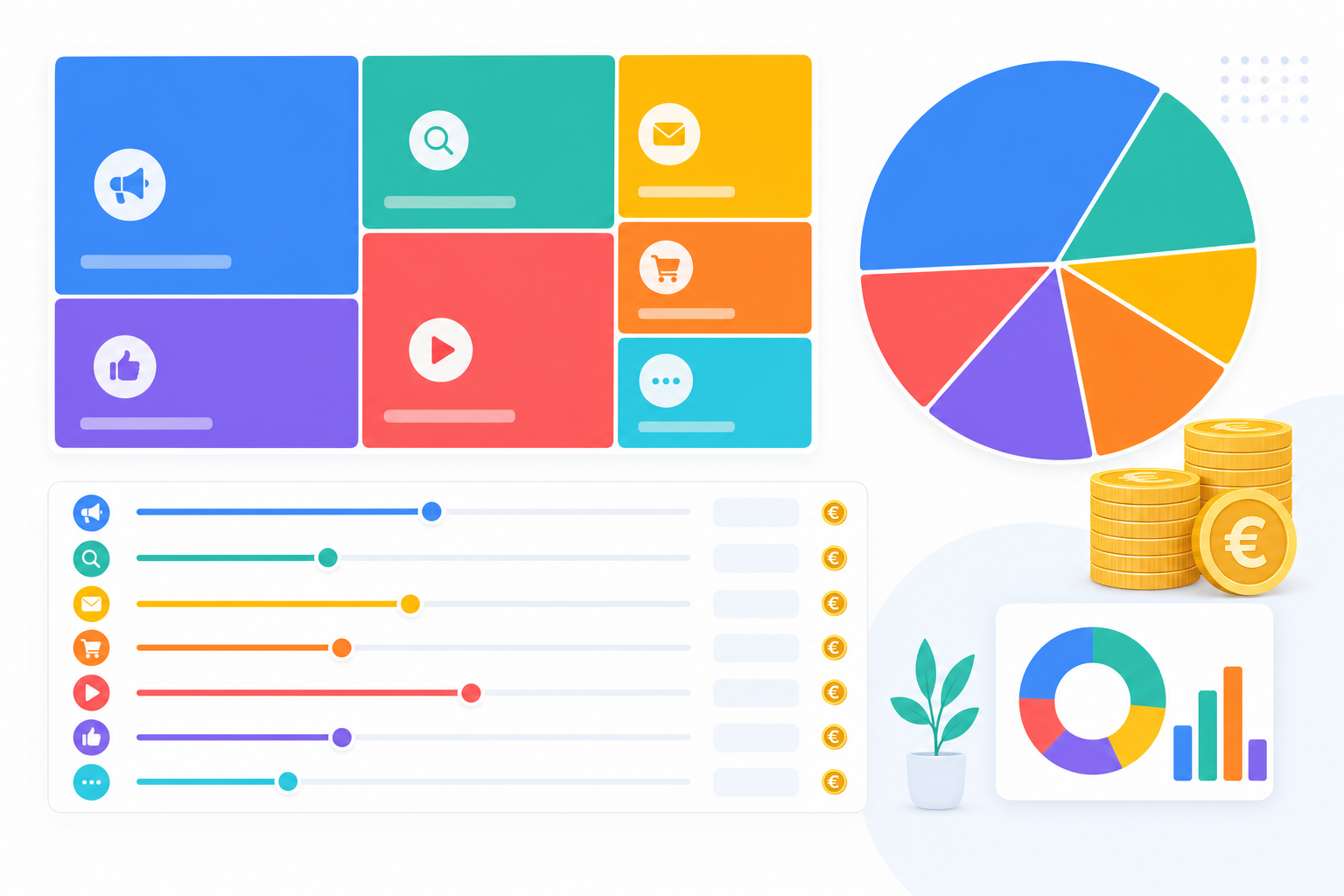
Budget allocation belongs in the QBR: how much went where, why, and what it produced. Our budget allocation article has a deeper model; in the QBR the quarter split and next recommendation are enough.
If a channel was cut or scaled, explain with data: "Meta scaled +40% because brand searches grew 18% and Search CAC fell." That is the synergy story — the board understands why channels are managed together.
Learnings, tests, and next steps
Often the QBR's most valuable part: what was tested, what was learned, what did not work. Leadership values honesty more than perfect success. A failed test with data and learning beats silent failure.
Present 2–3 tests from the quarter: geo test for Meta incrementality, new segment, content strategy change. Result: what happened, what happens next.
Next quarter priorities: three at most. More than three priorities means nothing gets finished. For each priority: goal, budget, metric, risk.
Risks and dependencies: one channel too dominant, CAC rises with scale, competitor more aggressive. Proactive risk presentation shows leadership — not weakness.
How to present to the CEO and board
Presentation technique in the QBR: start with a summary (30 seconds), tell the story with data, end with a recommendation. Do not read slides — slides support speech. The CEO wants discussion, not a monologue.
Language: business, not marketing jargon. "Conversion rate" → "how many leads bought". "ROAS" → "each euro produced X euros in revenue". "Attribution" → "which channel influenced sales".
Prepare answers to three questions: why CAC changed, why growth slowed/accelerated, why budget should grow/stay/cut. If you cannot answer, the QBR is not ready.
For the board: emphasize strategic direction — market position, competitive edge, long-term investment (SEO, brand). Operational detail stays in appendix.

QBR rhythm and preparation: how to build the QBR
Prepare the QBR 1–2 weeks before presentation. Week 1: gather data, update dashboard, check last QBR commitments. Week 2: write the story, tighten slides, rehearse the presentation.
Operating rhythm supports the QBR: weekly optimization, monthly whole-picture review, quarterly QBR. The QBR should not be the only moment leadership sees marketing — but it is the deepest.
Document QBR decisions and commitments in writing. The next QBR starts from them. This rhythm builds marketing as a strategic function — not just a vendor.
A fractional marketing director or Marketing Director service brings QBR structure and presentation skill to organizations that measure marketing but do not yet lead it at executive level.
Pre-QBR checklist: (1) dashboard updated to previous day, (2) last QBR action items checked, (3) CFO CAC definition matches marketing, (4) sales confirmed pipeline numbers, (5) max 15 slides in main deck. Appendix separate.
Rehearse out loud: a 90-minute QBR with 20 minutes discussion means ~70 minutes of talk. If you do not fit the time, the deck is too long. Tighten before you add.
QBR example: a scale-up quarter
Imagine a scale-up, €8M revenue, €600k/quarter marketing budget. North star: profitable new customers. QBR opens: "Q1 target 120 new customers, achieved 108 (-10%). CAC fell 8%, LTV:CAC 3.4:1. Reason for miss: sales cycle lengthened in new segment — 40% of leads moved to Q2."
Funnel section: leads +18%, MQL→SQL 62% (target 65%), SQL→deal improved 2 pp. Bottleneck: lead quality in new segment — fix scoring in Q2. Channel section: Search 45% of budget, blended ROAS 4.2x; Meta scaled +30%, brand searches +22%; SEO produced 28% of leads organically.
Q2 plan: (1) improve lead scoring in new segment, (2) scale Meta +20% if brand searches keep growing, (3) publish two pillar pages for SEO. Budget recommendation: +10% total budget because CAC trends down and LTV:CAC is healthy.
This is a 15-minute summary — the rest in appendix. The CEO got the answer: where we are, why, what we do. The board saw profitability and direction. Not a single CTR slide.
Tools and dashboard for the QBR
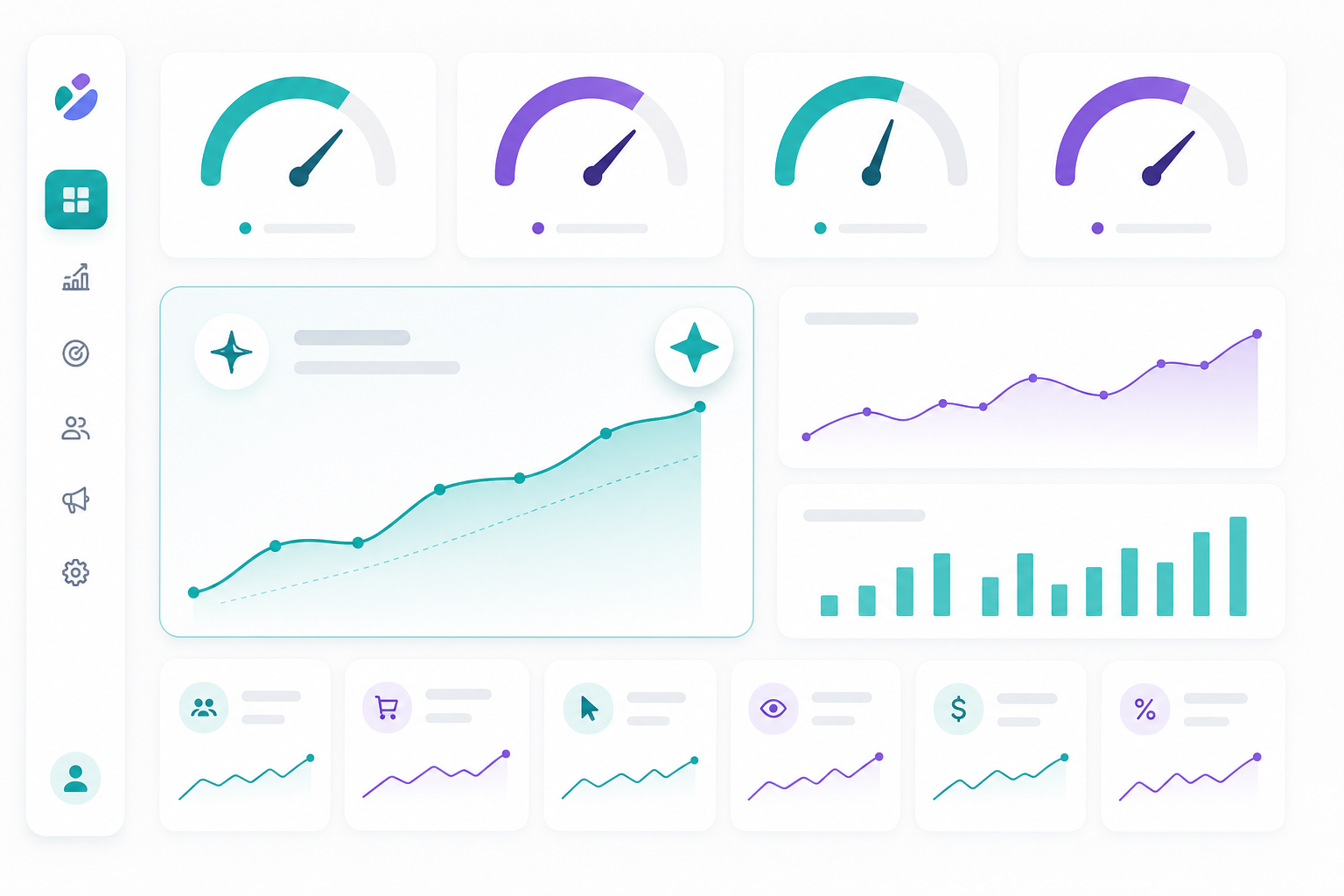
A QBR dashboard is not built by copying ad platforms. It connects GA4, CRM, ad platforms, and business systems in one view. Looker, Power BI, or simple Google Sheets works — what matters is numbers match the CFO's.
Required dashboard elements: north star trend 4–8 quarters, CAC trend, LTV:CAC, funnel transitions, channel blended ROAS, budget actual vs. plan. Update automatically weekly, check manually before QBR.
Avoid a dashboard that needs 2 hours of updates before the QBR — it does not scale. Invest once in the measurement stack (per our marketing KPIs article) and QBR prep shrinks from hours to minutes.
Appendix deck for campaigns, keywords, and creative — the operational team needs it, the CEO does not. Keep the main deck at business level.
Common QBR mistakes
These mistakes make the QBR useless or even harmful — they reinforce marketing as a cost, not an investment.
- Too many metrics → focus disappears, CEO remembers no number
- Vanity metrics (impressions, likes) → no link to revenue
- No comparison to target → data without context
- Channel cheerleading → platform ROAS without blended picture
- No plan → "here is what happened" without "what we do"
- Surprise north star → leadership not committed to the metric
- Hiding failures → trust erodes when truth surfaces
Frequently asked questions
What does a marketing QBR mean?
QBR (Quarterly Business Review) is a quarterly review where marketing presents results, profitability, and plan to leadership. It connects marketing to business goals — not reporting campaigns in isolation.
What does the CEO want to see in a QBR?
The CEO wants a summary: whether marketing delivers profitable growth (north star, CAC, LTV), where budget flows, what happens next and why. Operational detail stays in the background.
How many metrics should a QBR have?
Five or fewer primary metrics: north star, CAC (trend), LTV:CAC, conversion/pipeline, and blended ROAS or equivalent. Rest in appendix. Less is more — every metric must drive a decision.
How often should a QBR be held?
Quarterly is standard. Monthly whole-picture review supports the QBR operationally; the QBR is the strategic deeper review for board and CEO.
Does a QBR require a marketing director?
QBR quality depends on the presenter. A fractional or full-time marketing director brings structure, data integration, and presentation skill. Without a director, the QBR often stays an operational report leadership does not use for decisions.