How do AI search engines read content?
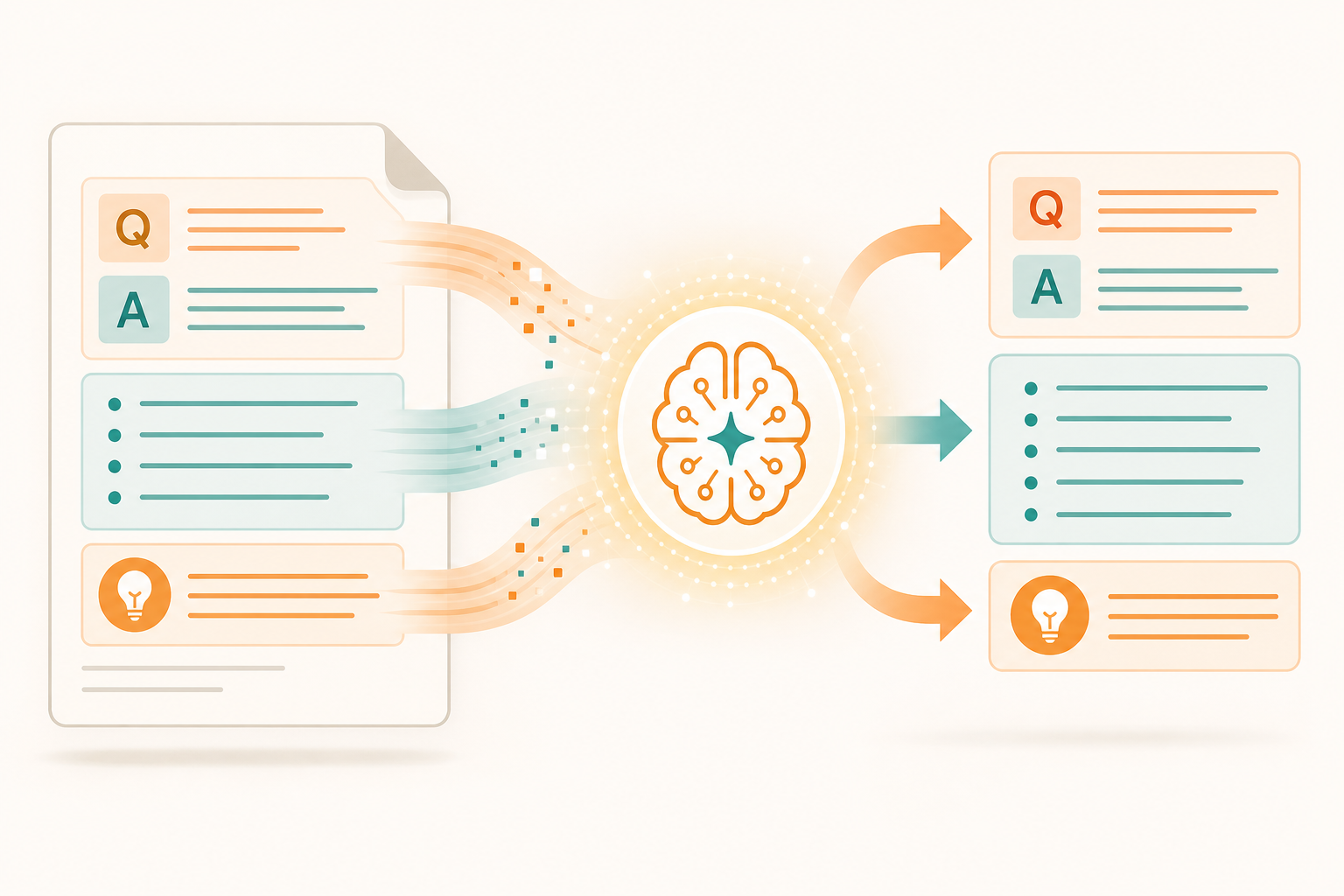
AI search engines do not read content linearly like a human. They parse content structurally: looking for clear answers to questions, extracting facts, definitions, and lists, and composing a synthesis from them. Content that offers these elements clearly is easier to pick as a source.
This means long, meandering text without clear structure is poor GEO content, even if it is expert. The AI cannot easily find an extractable answer in it. By contrast, content that answers the question directly and presents facts clearly is machine-usable.
Writing GEO content is therefore a balance: keep the expertise and depth (which build authority), but structure the content so answers and facts are easily extractable. You are not writing for a robot — you write for a human with a structure that also serves the machine.
Direct answer first
The single most effective GEO technique is to answer the question directly at the very start. Open every section and article with a concise, direct answer to the main question — AI models often extract the first sentence or paragraph as the answer.
This is the opposite of the traditional "build tension and reveal at the end" writing style. In GEO (and modern web writing generally), the inverted pyramid works: answer first, reasoning and depth after. The reader gets what they seek immediately, and the machine gets a clear extraction.
In practice: if the heading is the question "What is X?", the first sentence must answer "X is...". Do not start with background or an introduction — go straight to the answer, then expand.
Citable structure
Structure makes content extractable. Use descriptive, preferably question-form H2/H3 headings that answer real search questions. Each heading is a signal to both the search engine and the AI about which question the section answers.
Lists and tables are especially citable: they present information in a structured way that AI extracts easily. Numbered steps, feature lists, and comparison tables are effective. Break complex information into clear parts.
The FAQ section is GEO's single most effective structure: each question-answer pair is a ready, self-contained extraction that answers exactly one question. Build a 4–6 question FAQ into every article that covers real search questions.
- Question-form H2/H3 headings that answer searches
- Lists and numbered steps — structured, extractable information
- Comparison tables for complex information
- FAQ section (4–6 questions) as self-contained extractions
- Short paragraphs — one idea per paragraph
Fact density and concreteness
AI search engines favor concrete, fact-based content. Numbers, percentages, dates, definitions, and concrete claims are citable — they offer precise information the model can use in an answer. Generic, vague talk ("marketing is important") offers nothing to extract.
Replace vagueness with concreteness: "many companies" → "about 60% of companies"; "a fast page" → "under 2.5s LCP"; "many channels" → "four channels: Google Ads, Meta, SEO, GEO". Concreteness makes content both more credible and more citable.
Original data and perspective are especially valuable: your own research, observations based on customer data, and concrete examples set your content apart from generic mass. AI (and humans) prefer to cite an original source over a repetition.
Entities and schema
AI search engines understand the world as entities: brands, people, products, places, and concepts. For your brand to appear as a source, it must be a recognizable entity. This is built from consistent naming, structured data, and brand mentions in external sources.
Schema markup helps AI identify entities and content structure: Organization defines your brand, Person the authors (E-E-A-T), Article the content, and FAQPage the question-answer pairs. Connect them into a coherent knowledge graph with @id references.
Name things clearly and consistently: use the official names of your brand, services, and concepts in the text. Link definitions (e.g. a glossary) and use the same terminology throughout the site. Consistency helps AI build a reliable picture of your entities.
Authority and freshness
Structure alone is not enough — AI favors authoritative, trustworthy sources. E-E-A-T (experience, expertise, authoritativeness, trustworthiness) is as central in GEO as in SEO. Named expert authors, source references, and brand mentions in external sources build authority.
Freshness matters especially in fast-moving topics: AI search engines favor up-to-date content. Update articles, show the date (dateModified), and keep numbers current. Outdated content loses both SEO and GEO visibility.
Authority is also built off-site: brand mentions in industry publications, expert articles, and citations on other sites strengthen your standing as an entity. GEO is not just on-page work — it is building brand authority.
Common mistakes in GEO content
These mistakes prevent content from becoming a source in AI answers — often in content that is otherwise expert.
- Hiding the answer inside the text → models extract the opening, not the middle
- Generic, vague talk → no extractable facts
- Lack of structure → no headings, lists, or FAQ to extract
- Neglecting schema markup → entities are not identified
- Thinning content "for AI" → depth and authority still decide
- Outdated content → freshness is a source-selection signal
Frequently asked questions
How do I write content that ChatGPT cites?
Answer the question directly at the start, use question-form headings, add concrete facts and numbers, build an FAQ section, and mark content up with schema. Keep expertise and authority — structure makes deep content extractable.
Does GEO content need to be different from SEO content?
Not fundamentally — good GEO content is good SEO content built to be citable. The same content can rank on Google and serve as a source in an AI answer. Emphasize direct answers, fact density, and clear structure.
What is the inverted pyramid structure?
It means presenting the answer first, with reasoning and depth after. AI models often extract the first sentence as the answer, so a direct answer at the start improves citability.
Why are entities important in GEO?
AI search engines understand the world as entities (brands, people, concepts). For your brand to appear as a source, it must be a recognizable entity — built from consistent naming, schema, and external mentions.
Is content structure alone enough for GEO visibility?
No. Structure makes content extractable, but AI also favors authoritative, fresh sources. E-E-A-T, named expert authors, and brand mentions in external sources are as important as structure.