What is Google AI Overviews?
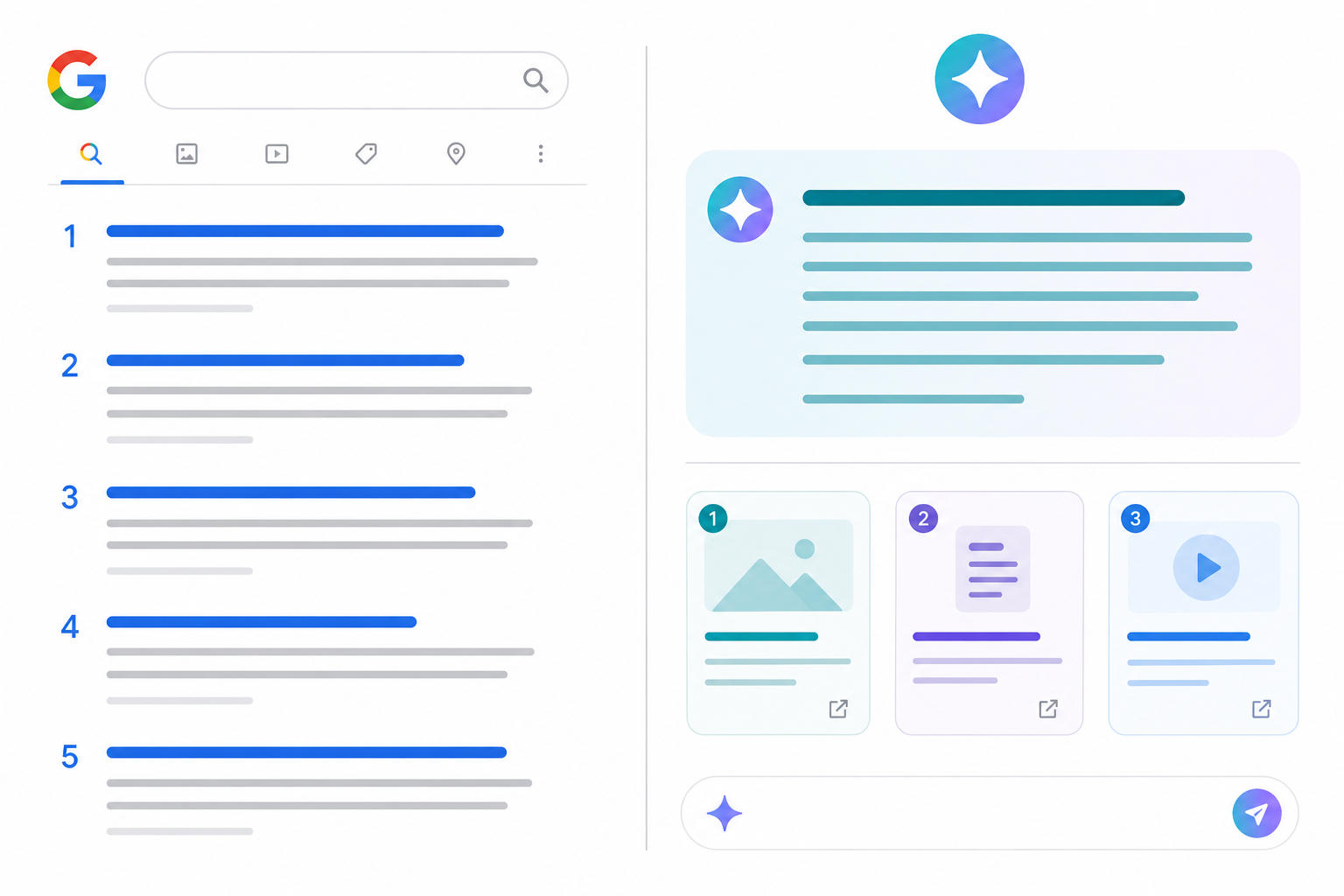
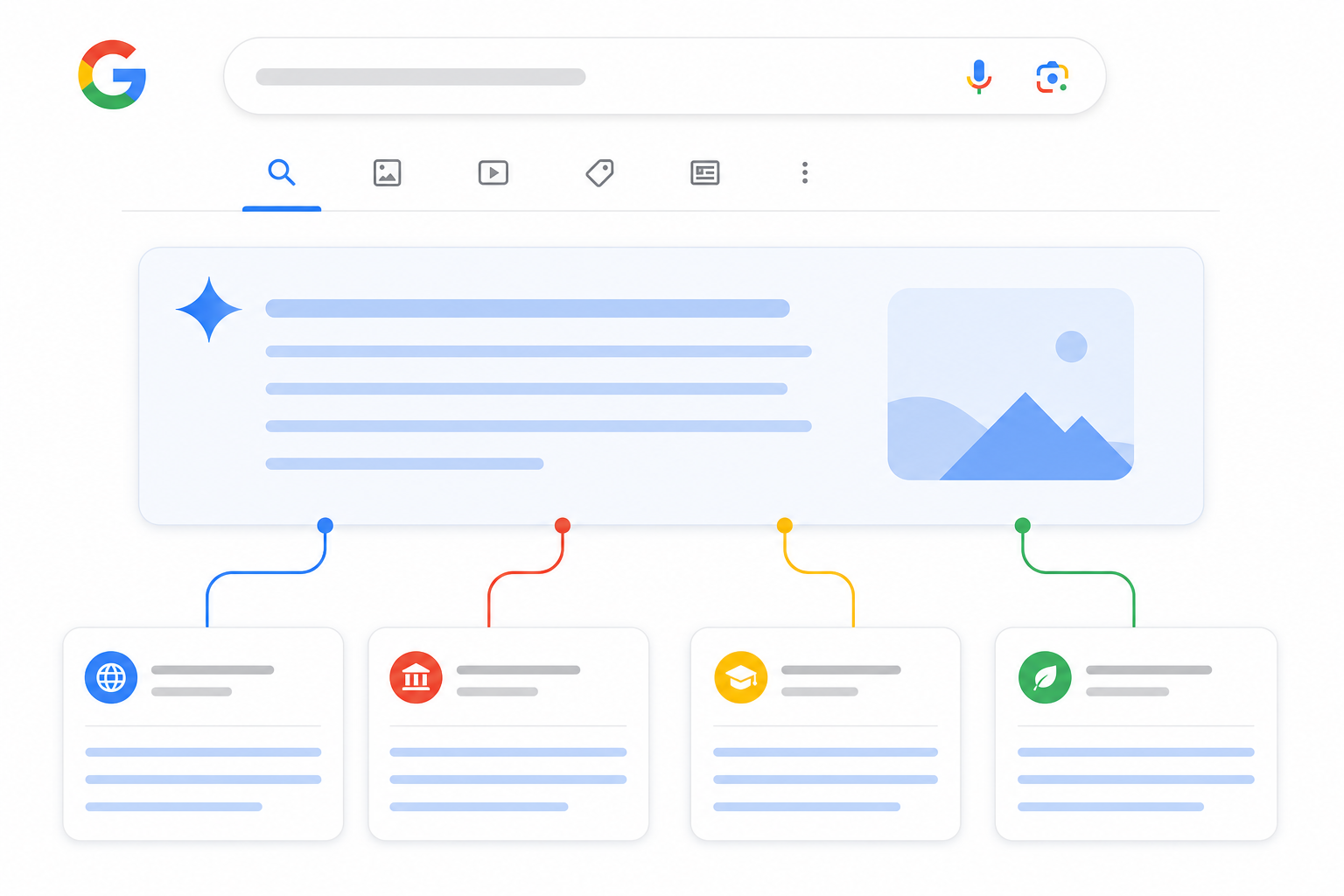
AI Overviews is Google's generative search answer that appears at the top of the results page as an AI-composed summary. Instead of browsing links, the user is shown a synthesis of several sources directly — with the sources the answer was composed from listed.
AI Overviews is Google's response to generative search engines like ChatGPT and Perplexity. It combines Google's traditional search index and the Gemini model: relevant sources are retrieved from the index, and the model composes an answer from them. This means traditional SEO and AI visibility are intertwined within Google.
Importantly, AI Overviews does not replace organic results entirely — they are still below. But the answer takes the space and attention at the top of the page, which changes click behavior. Brand visibility as a source is a new goal alongside traditional ranking.
How AI Overviews works technically
AI Overviews triggers on certain searches — typically informational, multifaceted, or "how/why" questions where a synthesis adds value. In transactional and navigational searches it appears less often.
The process roughly goes: Google identifies the search intent, retrieves relevant and trustworthy sources from the index, and the Gemini model composes a concise answer from them. Source links are shown alongside the answer, so the user can dig deeper. The sources are often, but not always, the same as the top organic results.
An important difference from traditional search: AI Overviews favors content that answers the question clearly and in a structured way. Well-built, fact-based content with clear answers and structure is more likely to be picked into the synthesis.
How does AI Overviews select sources?
AI Overviews favors sources that are authoritative, trustworthy, and answer the question directly. E-E-A-T (experience, expertise, authoritativeness, trustworthiness) is central: Google prioritizes content with a clear expert background and a trustworthy source.
Structure decides selection: content that answers the question clearly right at the start, uses structured headings, and contains facts, lists, and definitions is easier to compose into a synthesis. FAQ sections and question-answer structures are especially effective.
Freshness and comprehensiveness also matter: AI Overviews favors up-to-date content especially in fast-moving topics, and comprehensive content that covers a topic thoroughly is a more likely source than a thin article.
- Authority and E-E-A-T: clear expert background and trustworthiness
- Direct answer: the question is answered clearly right at the start
- Structure: headings, facts, lists, definitions, FAQ
- Freshness: up-to-date content, updated dateModified
- Comprehensiveness: the topic covered thoroughly, not superficially
- Structured data: schema helps identify the content structure
Optimizing content for AI Overviews
AI Overviews optimization builds on good SEO but emphasizes citability. The goal is not just to rank but to be an easily extractable source for the synthesis. This means building content to answer real questions clearly.
A practical recipe: open every section with a direct, concise answer to the question (models often extract the first sentence). Use question-form headings. Add concrete facts, numbers, and comparisons — they are extractable material. Build a comprehensive FAQ section where each pair is a potential source.
But avoid thinning content: AI Overviews does not reward superficial "AI-optimized" content. Depth and expertise are still decisive — clear structure simply makes expert content easier to compose.
Technical foundation: schema and crawlability
AI Overviews relies on Google's index, so traditional technical SEO is a prerequisite: the page must be indexed, fast, and mobile-friendly. If content is not indexed, it cannot appear as a source in AI Overviews.
Structured data helps Google understand the content: Article, FAQPage, Organization, and Person schemas clarify what the content is, who produced it, and how it is organized. This supports both rich snippets and AI Overviews' ability to interpret and compose content.
Also make sure you do not block Google's AI features in robots.txt. Google-Extended rules affect how your content is used in generative features — check that you are not accidentally restricting your visibility in AI Overviews.
Impact on traffic and click-through rate
AI Overviews changes click behavior: when the answer is shown directly, some users get what they need without a click (zero-click). This can lower the click-through rate in informational searches, especially for simple questions.
On the other hand, appearing as a source brings visibility and brand value, and for multifaceted questions users still click to dig deeper. The key is that visibility as a source is a new form of value — even when a click does not always follow, a brand mention in an authoritative context builds trust and awareness.
The strategic conclusion: do not measure only organic clicks. Also track visibility as an AI Overviews source and the brand-search trend — they reveal the true value of generative visibility.
Tracking visibility in Google AI search
Measuring AI Overviews visibility is new and not as straightforward as traditional rank tracking. Start with manual testing: search relevant questions where an AI Overview appears, and document whether your brand appears as a source and in what context.
Also follow Google Search Console data: although GSC does not separate AI Overviews impressions specifically, changes in the impression-to-click ratio in informational searches can indicate the impact of AI Overviews. Combine this with manual tracking.
Tools that track AI Overviews visibility automatically are emerging. For now, a combination of manual testing, GSC data, and brand-search tracking gives the best picture of your generative visibility.
Common mistakes in AI Overviews optimization
We see these mistakes repeatedly as brands try to adapt to Google's generative search.
- Assuming organic ranking guarantees being a source → AI Overviews assesses partly by different criteria
- Thinning content in the name of "AI optimization" → depth and E-E-A-T decide
- Missing a direct answer → models extract clear, concise answers
- Neglecting structured data → harder to interpret and compose
- Accidentally blocking Google-Extended → you restrict your own visibility
- Measuring only clicks → visibility as a source goes unnoticed
Frequently asked questions
What is Google AI Overviews?
AI Overviews (formerly SGE) is Google's generative search answer that appears at the top of the results page as an AI-composed summary of several sources. It combines Google's search index and the Gemini model.
Does a top organic ranking guarantee visibility in AI Overviews?
No. You can rank #1 and still be missing from AI Overviews sources — or vice versa. AI Overviews assesses content partly by different criteria, so visibility must be optimized and tracked separately.
How do I optimize my content for AI Overviews?
Build citability on top of good SEO: answer the question directly at the start, use question-form headings, add facts and lists, build an FAQ section, and mark content up with schema. Keep depth and E-E-A-T — do not thin the content.
Does AI Overviews reduce my website traffic?
It can lower the click-through rate in simple informational searches (zero-click), but visibility as a source brings brand value and for multifaceted questions users still click. Measure visibility in addition to clicks.
How do I track my AI Overviews visibility?
Start with manual testing: search questions where an AI Overview appears and document whether your brand appears as a source. Complement with Search Console data and brand-search tracking. Automated tracking tools are emerging.