Why competitive analysis before strategy
Competitive analysis answers: who competes for the same customer, with what message, in which channels, and where they are weak. Strategy without competitive review is inward — optimizing own activity on assumptions.
Include indirect competitors and substitutes: buyers may choose status quo, spreadsheets, or agencies instead of your product. Messaging against "do nothing" is often as important as beating named rivals.
Analysis does not copy competitors — it finds differentiation: segment, message, channel, or GEO visibility where competitor is weak. Updated quarterly — competition changes.
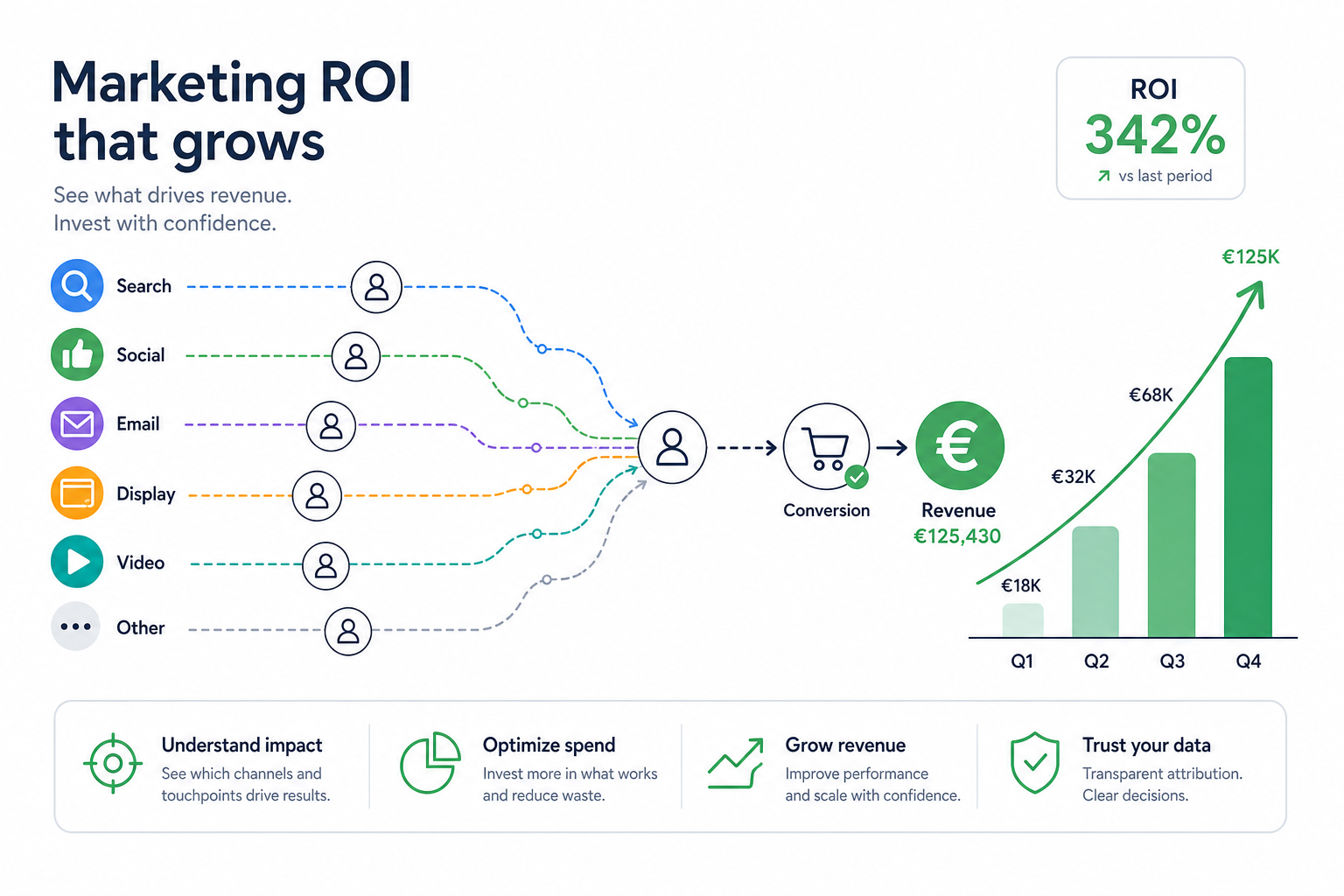
Link to strategy and ROI measurement — competitive analysis feeds priorities.
Pick 5–10 direct competitors plus 2–3 aspirational brands outside your region — they show where the category is heading. Exclude irrelevant giants that share keywords but not customers.
Competitive analysis output should be action items: "Competitor A dominates comparison queries — publish three comparison pages Q2," not a 40-slide deck with no owner.
Competitor ads: Google and Meta
Meta Ad Library and Google Ads Transparency Center show competitor ads — messages, creative, formats. Analyze: what they promise, which segments, how often they change.
Search: Auction Insights shows overlap, outranking share, and position above rate. High overlap = direct competition for same queries — differentiate with message or long-tail.
Document 5–10 competitors, messages, and observations. Update quarterly — new campaigns signal strategy shifts.
Screenshot ad variants monthly: headlines, offers, and creative format (video vs static). Patterns emerge — everyone claiming "AI-powered" means differentiation moves to proof and specificity.
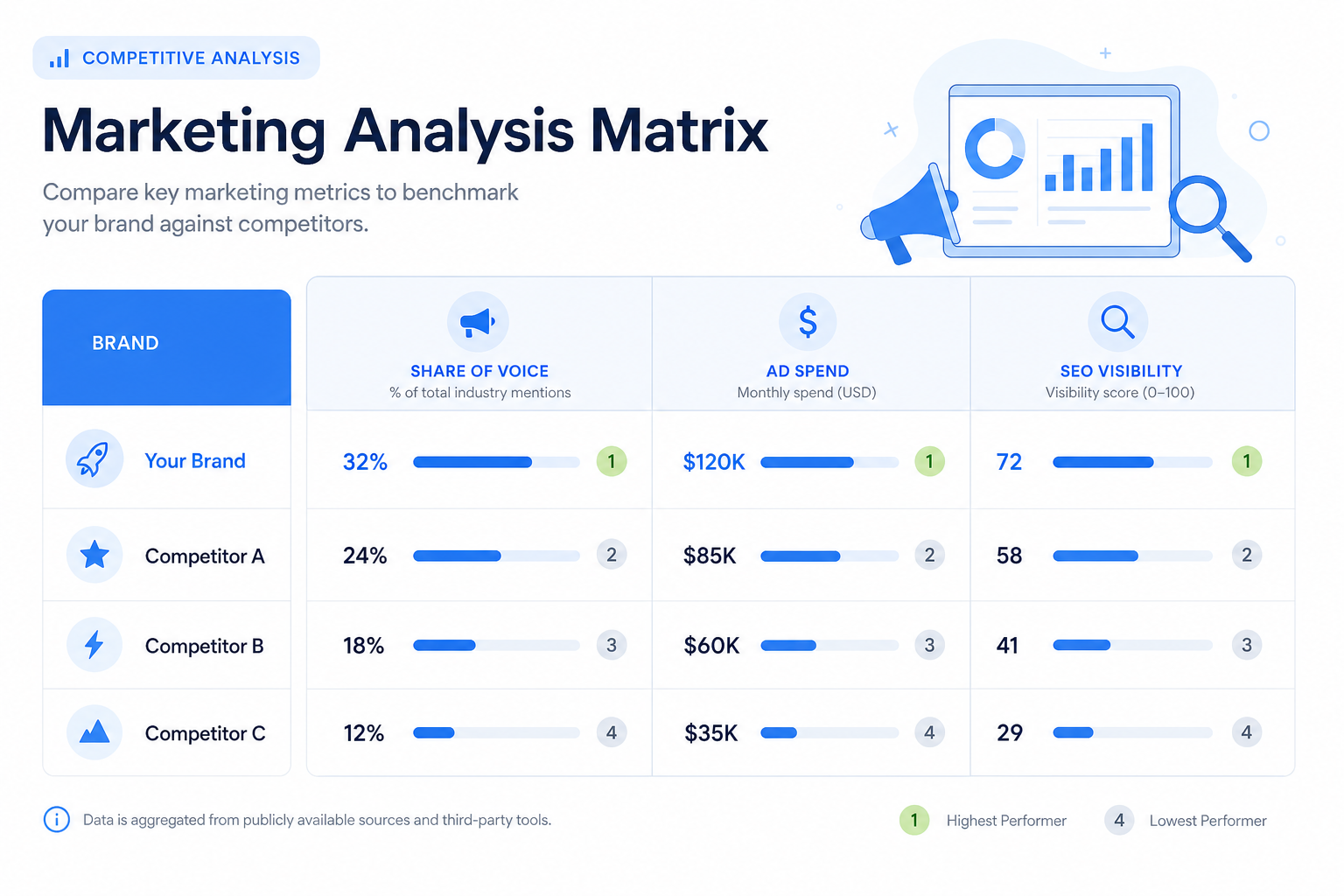
Estimate spend directionally with Auction Insights and Meta Ad Library frequency — you do not need exact budgets to know a competitor doubled Search presence or shifted to video.
- Meta Ad Library + Google Transparency
- Auction Insights for Search competition
- Messages, creative, segments
- Quarterly update
SEO share of voice
Share of Voice (SOV) in SEO = organic visibility on key queries vs competitors. Tools: Ahrefs, Semrush, Search Console — ranking distribution and traffic estimate.
Analyze: which keywords competitor dominates, where you are close (page 2 → optimization), where gaps exist (no content). Prioritize high-intent queries where SOV is improvable.
SEO services combine technical, content, and links — competitive analysis guides which keywords and pages first.
Content gap analysis: keywords where competitors rank top 5 and you rank below 20 — prioritize by search volume and business intent. Technical parity alone rarely closes SOV gaps; you need better pages and links on high-intent topics.
Track SOV trend quarterly, not snapshot once: improving from 8% to 14% SOV on commercial terms is a win even if you are not #1 yet.
GEO and AI citations
GEO (Generative Engine Optimization) — visibility in AI answers (ChatGPT, Perplexity, Google AI Overviews). Competitors are cited or not — GEO share of voice is a new competitive metric.
Test: ask AI industry questions — who is mentioned, in what context, what sources cited. Compare your visibility. GEO audit maps the landscape.
Track AI citations alongside traditional backlinks: a competitor cited in Perplexity may not rank #1 in Google yet still steers buyers. GEO and SEO competitive analysis should run in parallel, not as either/or.
GEO competitive analysis: structured data, FAQ, expert content, brand mentions in trusted sources — what does competitor do better?
Build a prompt matrix: 20–30 questions your ICP asks AI tools (pricing, comparisons, best vendor, how-to). Score mention rate, position, and citation source for you vs five competitors. Repeat monthly — GEO shifts faster than traditional rankings.
Improve GEO visibility with entity clarity on site: who you serve, what you do, proof, and consistent NAP and brand mentions externally. Competitors cited by AI often have stronger third-party validation — reviews, directories, and PR.
Win themes from competitive review should feed strategy: if three rivals claim "fastest implementation," either prove you are faster with data or own a different pillar — expertise, support, or niche vertical focus.

Audit approach
Competitive analysis is part of marketing audit: own state + competition = priorities. AlgoTerra's free audit maps channels, SEO, GEO, ads, and competitive review.
Audit output: strengths, weaknesses, competitive gaps, quick wins, and 90-day roadmap. Full Stack executes priorities — not just a report.
Share competitive findings with sales: objection handling improves when reps know which alternatives buyers compare and which claims competitors repeat in ads.
Quarterly rhythm: QBR includes competitive update — new ads, ranking changes, GEO visibility.
Prioritize findings in three buckets: quick wins (this month), structural (this quarter), and strategic bets (requires budget or product). Tie each to OKR so competitive work does not stall in Slack threads.
Free audit includes competitive snapshot across ads, SEO, and GEO — then Full Stack executes the roadmap, not just the report.
Common competitive analysis mistakes
We see these in audits — teams know competitors' ads by heart but have no SOV, GEO, or action plan. Tie every finding to an OKR owner.
- Copy competitor ads → no differentiation
- SEO only or Ads only → incomplete picture
- GEO forgotten → AI visibility unmapped
- Once a year → data goes stale
- Analysis without action → deck gathers dust
- Competitive work needs the same quarterly rhythm as ROI reporting — slot it into QBR, not ad hoc when someone asks "what are competitors doing?"
Frequently asked questions
What does competitive marketing analysis include?
Competitor ads (Meta, Google), SEO share of voice, GEO visibility, messages, and gaps. 5–10 competitors, quarterly.
How do I analyze competitor ads?
Meta Ad Library, Google Ads Transparency, Auction Insights. Messages, creative, segments — document and update.
What is SEO share of voice?
Organic visibility on key queries vs competitors. Ahrefs, Semrush, Search Console.
Why GEO in competitive analysis?
Visibility in AI answers is a new competitive metric — who is mentioned on ChatGPT and Perplexity.
How does AlgoTerra help with competitive analysis?
A free audit includes competitive review. Full Stack and GEO execute priorities.