Why do topic clusters work?
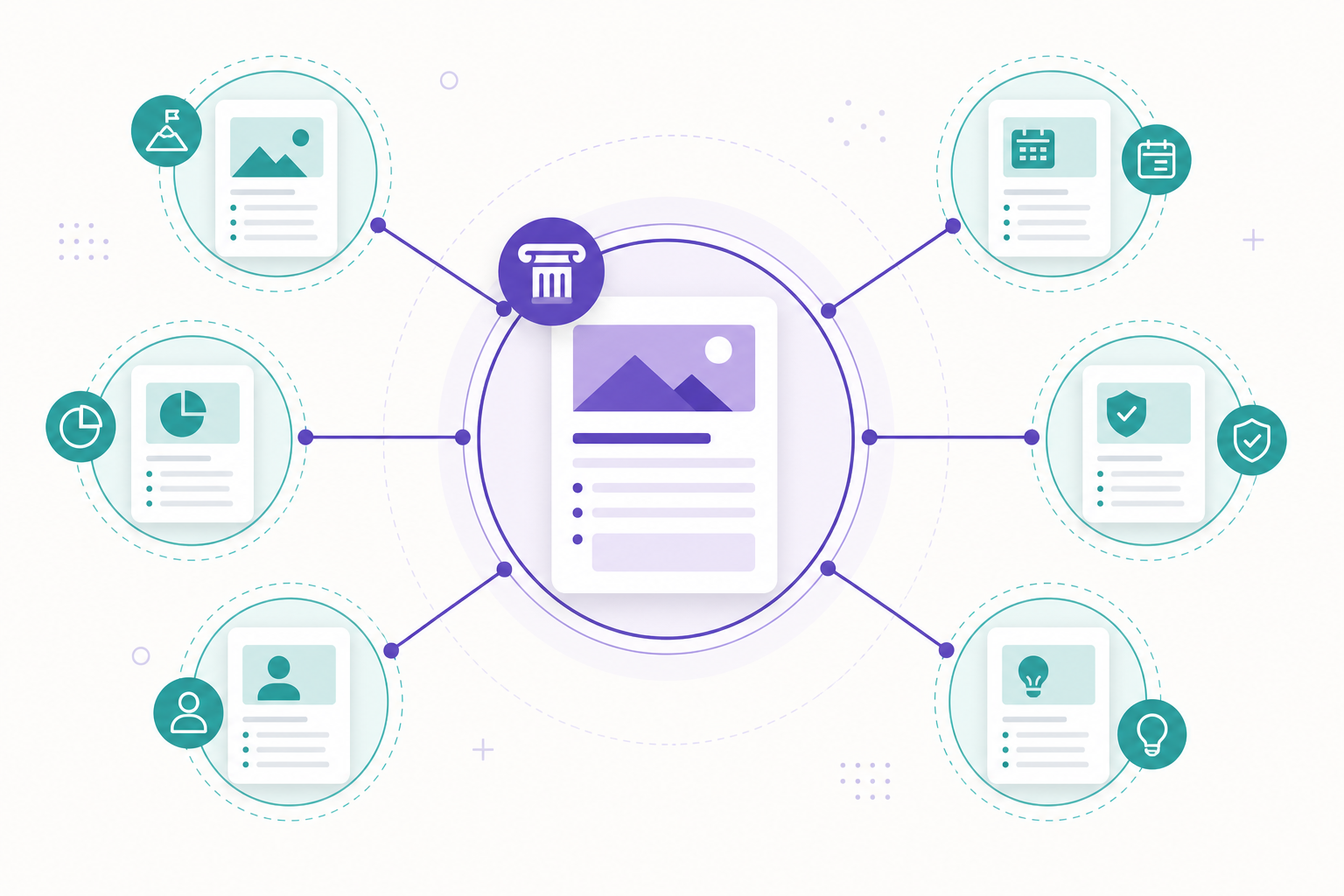
A topic cluster is a content structure where one comprehensive pillar page covers a broad topic and several supporting articles go deeper into its sub-areas. All supporting articles link to the pillar, and the pillar links to the supporting articles. This structure tells Google the site has deep expertise on the topic.
Individual, disconnected articles often compete for the same keywords (keyword cannibalization) and fail to concentrate authority in one place. The cluster structure focuses signals on the pillar page, which can rank for competitive head terms, while supporting articles capture long-tail searches.
Clusters also serve GEO: AI search engines recognize consistent, deep topic coverage as a sign of authority. A site that covers a topic from ten different angles as a linked whole is a more likely source in an AI answer than a single article.
The structure of a topic cluster
A cluster consists of three parts. The pillar page is a comprehensive, broad overview of the topic — it answers the main question and links to all supporting articles. The supporting articles (cluster content) go deeper into individual sub-areas and link back to the pillar. Internal linking ties it all together.
Example: a "Technical SEO" pillar page covers the topic broadly, and supporting articles go deeper into "Core Web Vitals optimization", "fixing indexing issues", "schema markup", and "site structure design". Each supporting article links to the pillar with descriptive anchor text.
- Pillar page: broad overview, targets the head keyword
- Supporting articles: deepen sub-areas, target long-tail searches
- Internal linking: support → pillar and pillar → support
- Descriptive anchor text (not "read more")
- Consistent URL structure and navigation
Planning a cluster: from keyword research to structure
Start by choosing the main topic — it must be commercially relevant and broad enough to cover several articles. Do keyword research: identify the head keyword for the pillar and the related long-tail searches for the supporting articles.
Group keywords by search intent: informational ("what is", "how to") suit supporting articles, while the broad main intent belongs to the pillar. Avoid overlap — every article must have a clear, distinct target keyword.
Plan the structure before writing: one pillar, 3–8 supporting articles, and a clear linking map. This prevents keyword cannibalization and ensures the cluster covers the topic comprehensively.

Internal linking: the glue of the cluster
Internal linking is what turns individual articles into a topic cluster. Every supporting article must link to the pillar page, and the pillar page must link to all supporting articles. Supporting articles can also link to each other where relevant.
Use descriptive anchor text that conveys the target page's topic — not "read more" but "technical SEO guide" or "Core Web Vitals optimization". Anchor text is a strong relevance signal to Google.
Link to commercial pages too: from an article to the service page and case studies. This guides the reader toward conversion and shares authority with sales pages. Linking content to services is the goal of the whole strategy.
Content production and maintenance
Quality beats quantity. One comprehensive, expert article delivers more than ten thin ones. Invest in depth, original perspective, and concrete examples — they separate your content from generic AI-generated mass.
Content is not finished after publishing. Update articles regularly: fresh numbers, new angles, updated dateModified. Google and AI search engines favor up-to-date content, especially in fast-moving topics like marketing technology.
Measure and iterate: track which articles drive traffic and conversions, reinforce winners, and update underperformers. A topic cluster grows and improves over time.
Common mistakes in content strategy
These mistakes prevent a content strategy from delivering results — often even when a lot of content is being produced.
- Producing disconnected articles without a cluster structure → authority does not concentrate
- Keyword cannibalization → multiple articles compete for the same keyword
- Mass-producing thin articles → quality beats quantity
- Neglecting internal linking → the cluster does not form
- Publish-once with no updates → freshness is a ranking signal
Frequently asked questions
What is a topic cluster?
A topic cluster is a content structure where a comprehensive pillar page covers a broad topic and several supporting articles deepen sub-areas and link to the pillar. It concentrates SEO authority and covers the topic comprehensively.
How many supporting articles does a cluster need?
Typically 3–8 supporting articles per pillar. More important than the number is that each covers a clear sub-area without overlap and links to the pillar.
How do I avoid keyword cannibalization?
Plan a distinct target keyword for each article. The pillar targets a broad head keyword, supporting articles target long-tail searches. Do not write multiple articles for the same search intent.
How long does it take to see results?
Topic clusters deliver significant results typically after 3–6 months of consistent work. Organic growth is a long game, but the cluster structure accelerates how quickly authority accumulates.