Gemini vs. Claude: how AI engines differ for GEO
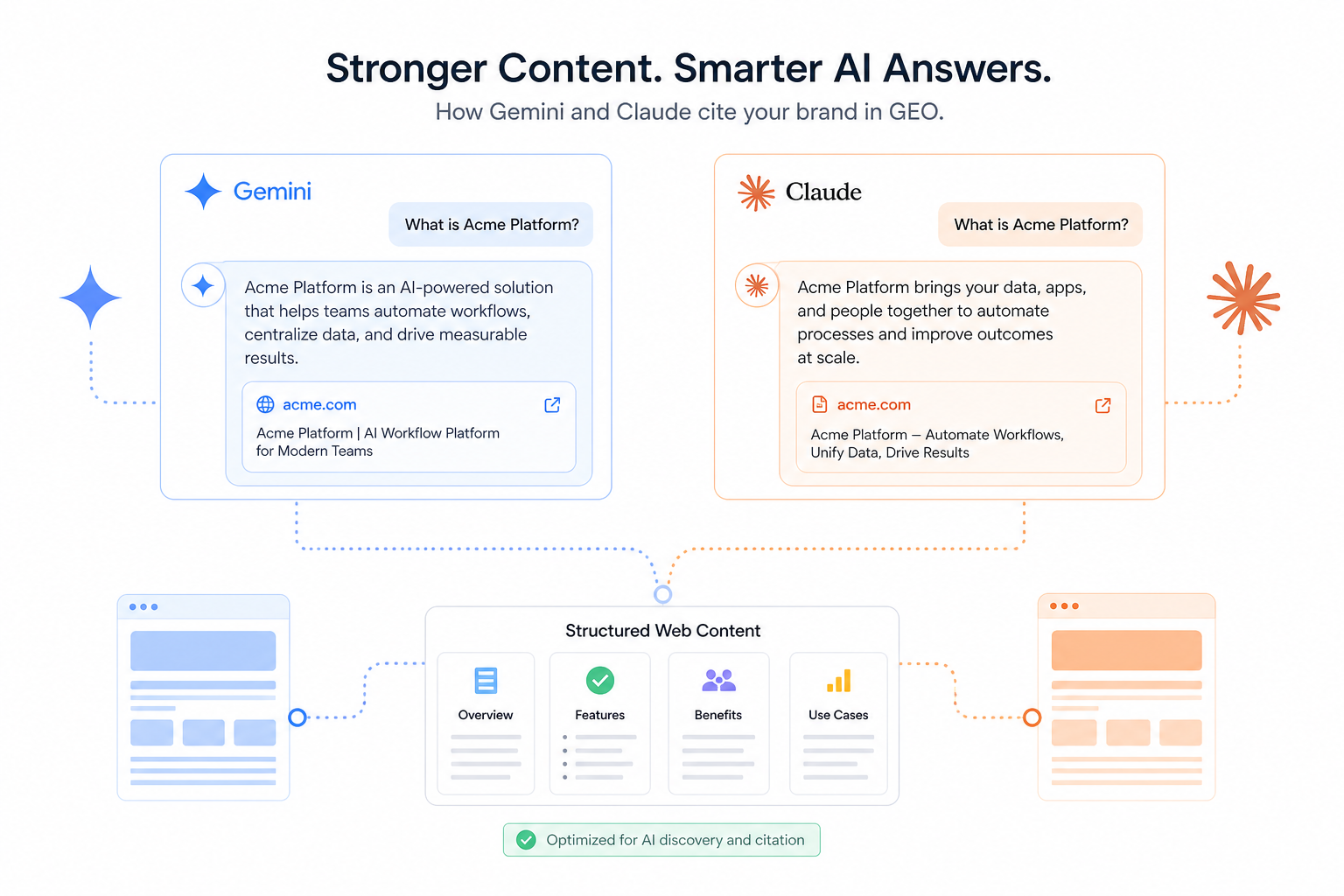
Google Gemini is Google's generative model — integrated into Google Search, Android, Workspace, and APIs. It uses Google's index for real-time search (Gemini Advanced / AI Mode) and Knowledge Graph data. Gemini favors sources with strong Google SEO foundations and structured data.
Anthropic Claude is Anthropic's model — available on claude.ai, via API, and in integrations (Slack, Notion). Claude emphasizes long context, safety, and trustworthy sources. It doesn't index the web like Google — training data plus real-time search (Claude with search) determine sources.
GEO strategy isn't one-size-fits-all: Gemini needs strong Google visibility and schema markup; Claude needs authoritative sources, clear expert content, and brand mentions in external publications. Test both separately.
Google Gemini GEO: optimizing for Google's ecosystem
Gemini leverages Google search results and AI Overviews data. If your site ranks well in Google and appears in AI Overviews, Gemini citation likelihood increases. Technical SEO, E-E-A-T, and structured data are the foundation.
Gemini Advanced and Google AI Mode search the web in real time — fresh, citable content (lists, facts, clear headings) outperforms stale blogs. FAQ pages, HowTo schema, and Organization/Person markup support Gemini visibility.
Google Workspace integration means Gemini can reference Google Docs and Drive content in organizations — for B2B brands this is a new channel when content is public and indexed.
Anthropic Claude GEO: authority and trustworthy sources
Claude selects sources with different logic than Gemini. It favors expert content, academic and professional publications, and brands with strong industry reputation. Claude with search queries the web — but selection is more selective than Perplexity.
Claude prefers long, thorough content (whitepapers, deep guides) over short blog posts. B2B and expert brands can perform better in Claude than generic consumer content.
Claude API integrations (Slack, Notion, custom apps) mean your brand can appear in enterprise contexts — when organizations use Claude as a tool, sources come from their queries.
- In-depth expert guides (not surface-level content)
- Publications in industry journals and guest posts
- Clear brand entity (Organization schema, About page)
- Mentions in external authoritative sources
- Fresh content — Claude with search favors recent data
Brand entity in Gemini and Claude GEO
Both engines recognize brands as entities — Knowledge Graph (Gemini) and training data plus web search (Claude). If your brand isn't clearly defined, it's easily left out of answers.
Entity work: consistent brand name, logo, description, and Organization schema. Person pages for key people. Wikipedia/Wikidata mentions (if relevant). Consistent mentions on LinkedIn, Crunchbase, and industry directories.
See the brand entity GEO guide for the full picture. Entity supports all AI engines — Gemini, Claude, ChatGPT, and Perplexity.
Prompt testing and visibility measurement
GEO measurement starts with prompt testing: what do Gemini and Claude answer when you ask brand- or topic-related questions? Build a prompt matrix: brand queries, product/service queries, comparison queries, "best X" queries.
Test the same prompts weekly in both engines. Record: is your brand mentioned, are you a source, who are competitors as sources. Share of Voice (SOV) in AI answers is GEO's KPI — see the Perplexity visibility guide for measurement methods.
Automate part of testing via API (Gemini API, Claude API), but manual review still matters — engine answers vary and update.
Common Gemini and Claude GEO mistakes
These mistakes show up repeatedly in GEO audits.
- Focus only on ChatGPT — Gemini and Claude untested
- No brand entity — AI doesn't recognize the brand
- Stale content — engines favor fresh data
- No prompt testing — you don't know current visibility
- Generic content without expert profile — Claude filters out
- Forget Google SEO for Gemini — Gemini depends on Google's index
Frequently asked questions
Do Gemini and Claude need separate optimization?
Foundation (E-E-A-T, entity, quality content) is shared. Gemini benefits from strong Google SEO; Claude emphasizes authoritative sources and deep expert content. Test both with a prompt matrix.
How does Gemini differ from ChatGPT for GEO?
Gemini integrates with Google Search and uses Google's index. Strong Google visibility and AI Overviews presence support Gemini citations. ChatGPT uses Bing search with different logic.
Will my brand show in Claude without specific optimization?
Depends on brand authority and content quality. Claude favors expert sources — B2B brands can appear if content is deep and the brand is a recognized entity.
How do I measure Gemini and Claude visibility?
Prompt testing: same question set weekly in both engines. Track mentions, sources, and competitor SOV. Automate via API, verify manually.
Does schema markup help Gemini GEO?
Yes. Organization, Person, FAQ, and HowTo schema support Google indexing — and thus Gemini visibility. Claude benefits less directly from schema, but structured content helps both.