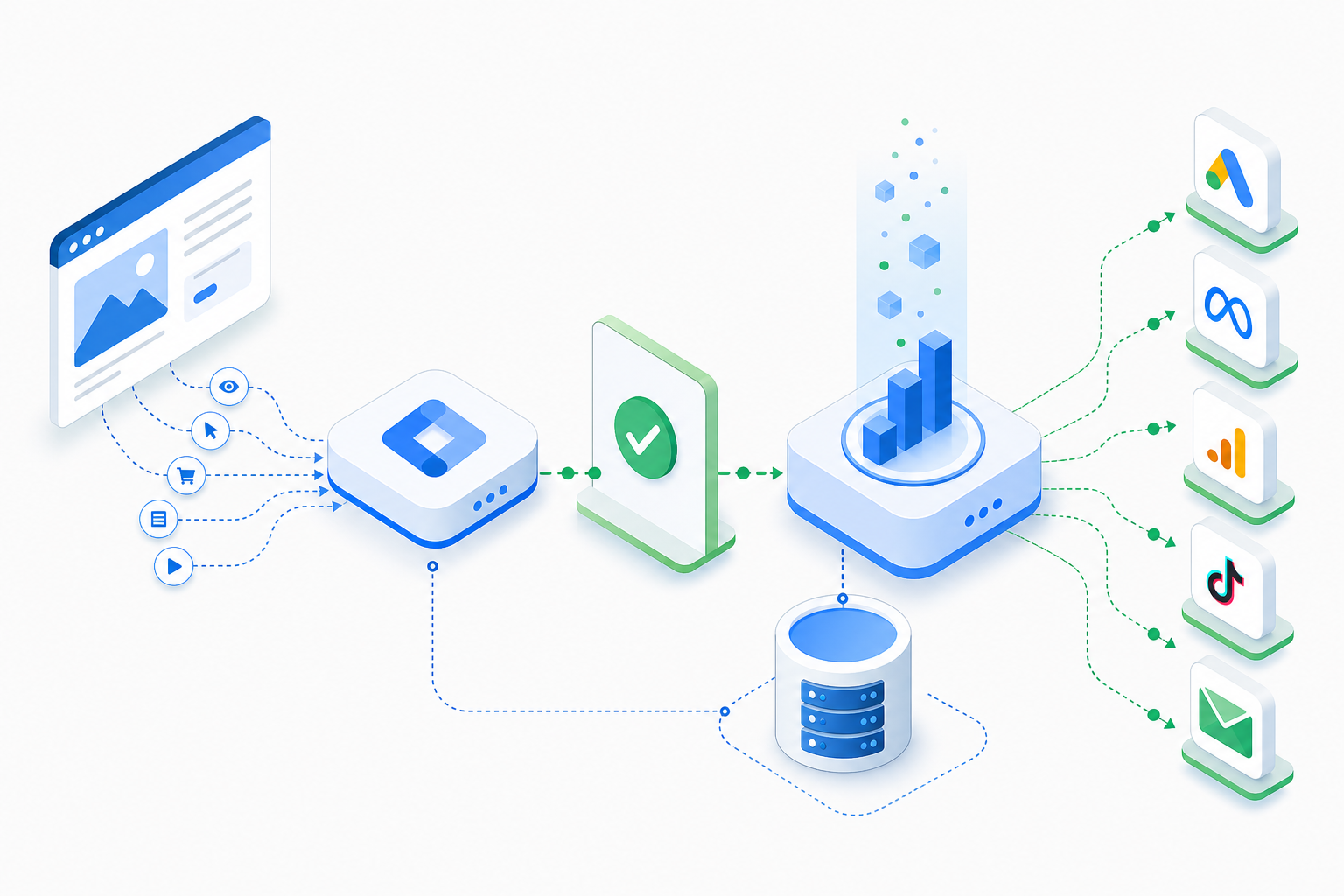
Why audit before raising budget?
Raising marketing budget is a natural response when targets grow. The problem is that most organizations increase budget before the foundation is solid. Broken conversion tracking, overlapping channels, outdated content, and missing attribution mean every extra dollar optimizes toward the wrong signal.
An audit is not bureaucracy — it is risk management. When 15 checkpoints are verified, you know exactly where extra money should go and what to fix first. Without an audit, a budget increase typically produces a 2–4 week spike, then efficiency drops back — because a scaled problem scales with it.
An audit is especially relevant when: leads or sales do not grow with budget, ROAS falls as you scale, channels report conflicting numbers, or leadership cannot understand marketing return. In these cases the problem is almost always in the foundation — not the budget.
A Full Stack approach means the audit covers all channels as one system: measurement, Google Ads, Meta, SEO, and GEO. A single-channel audit is not enough if the problem sits in shared data or attribution.
15 audit checkpoints: the complete checklist
Work through these 15 checkpoints before raising budget. Each is pass/fail — if any critical checkpoint fails, fix it before scaling. Checkpoints are ordered by priority: measurement first, then channels, then strategy.
- 1. Conversion tracking: all key conversions (form, purchase, call) are tracked reliably in GA4 and ad platforms — no double counting, no missing events
- 2. Measurement stack: GTM, GA4, Consent Mode v2, and server-side tracking where needed work as one system (measurement stack)
- 3. Attribution: GA4 attribution reflects the full path — you are not optimizing on last click alone
- 4. Google Ads foundation: conversion import, negative keywords, quality scores, and landing page relevance are solid (Google Ads)
- 5. Meta pixel and CAPI: server-side complements browser tracking — especially on iOS traffic, data does not leak away
- 6. Branded search: you own top positions for branded queries, the knowledge panel, and brand traffic conversions
- 7. Technical SEO foundation: indexability, Core Web Vitals, mobile, and structured data are in order
- 8. GEO visibility: your brand is mentioned in relevant AI answers — test 20 questions monthly (GEO)
- 9. Landing pages: every paid campaign has a relevant, fast landing page with a clear CTA
- 10. Content and messaging: channel messaging is consistent — Meta, Ads, and SEO do not promise different things
- 11. Remarketing: the pixel builds audiences and retargeting campaigns support the conversion path
- 12. CRM integration: leads and sales connect to marketing channels — you see the full path, not clicks alone
- 13. Reporting: one dashboard tells the whole story — blended ROAS, CAC, and assisted conversions by channel
- 14. Budget allocation: spend is allocated intentionally across channels — not by historical habit but by data
- 15. Quarterly review: a process exists to move budget toward marginal return — not locked silos
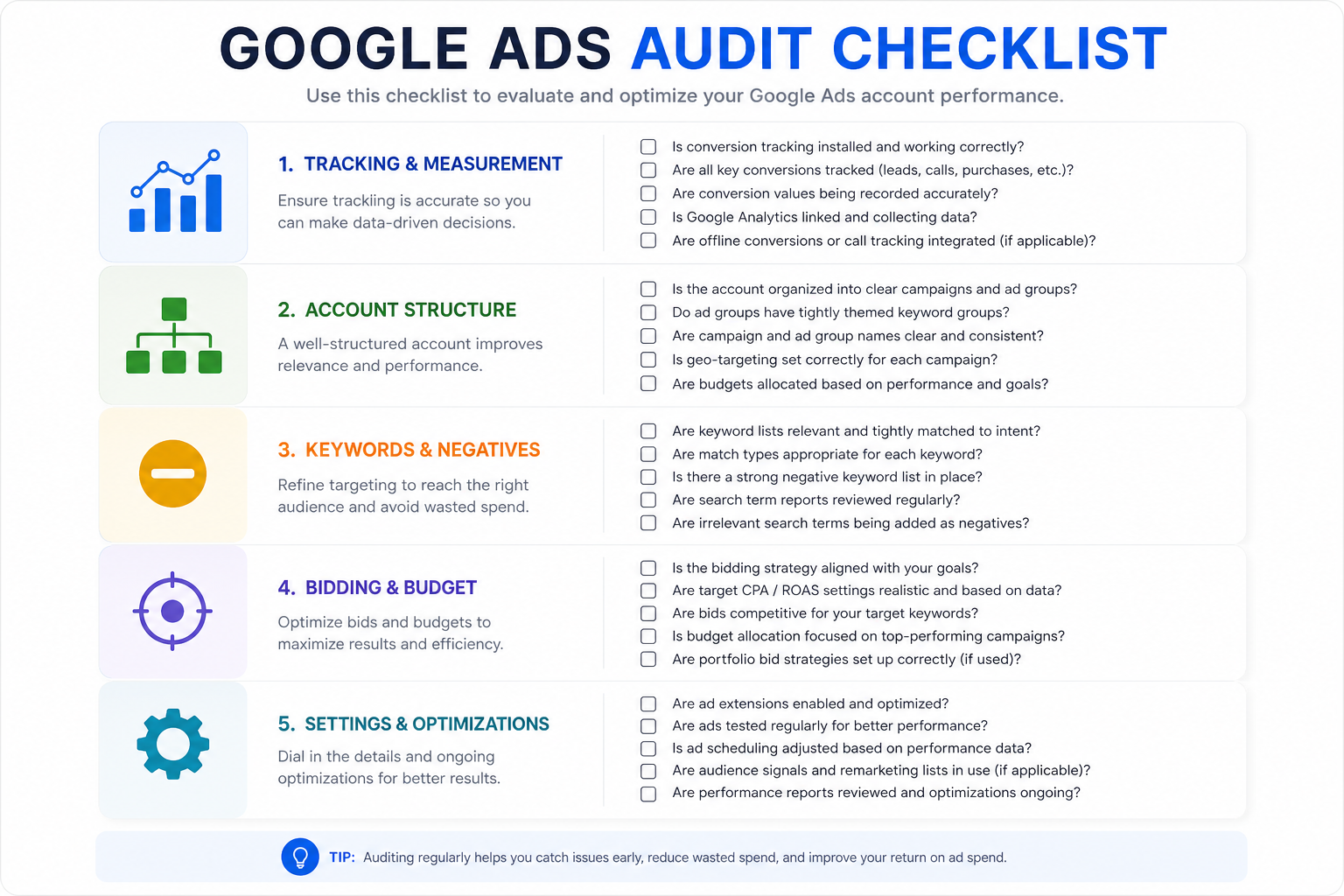
Prioritize fixes: in what order?
You do not need to fix all 15 checkpoints at once — but critical ones must be fixed before raising budget. The first three (conversion tracking, measurement stack, attribution) are non-negotiable: without them, no channel optimization rests on reliable data.
The second priority is channel foundation: Google Ads conversions, Meta pixel/CAPI, branded search, and landing pages. These directly affect acquisition cost. If conversion tracking is solid but the landing page is slow, fix the page before raising Ads budget.
The third priority is strategy and reporting: content consistency, CRM integration, dashboard, and budget allocation. These do not block scaling as fast as broken measurement, but without them scaling creates chaos.
A practical timeline: weeks 1–2 measurement and conversions, weeks 3–4 channel foundation, weeks 5–6 strategy and reporting. After that you are ready to raise budget — or you know exactly what is still missing.

When to raise budget — and by how much?
Raising budget is justified when at least checkpoints 1–9 are solid and conversion data has been stable for at least 4 weeks. Then extra spend scales a working system — not a broken one.
The scaling rule: increase 15–25% at a time in one channel, monitor for 2–3 weeks, and measure incrementality. If ROAS stays acceptable, increase again. Aggressive doubling breaks algorithm learning and attribution.
Prioritize scaling in channels with the highest marginal return: Search if brand and purchase keywords are not yet maxed, Meta if prospecting drives assisted conversions, SEO/GEO if organic potential is unused. Do not raise every channel evenly — the audit shows where room exists.
Quarterly budget review (checkpoint 15) keeps scaling sensible. When one channel is maxed, the next dollar goes elsewhere — not back to the first channel "because it worked before".
Common mistakes before raising budget
These mistakes cause extra budget to disappear quickly without sustainable growth.
- Budget increase before fixing conversion tracking → algorithms optimize to the wrong signal
- Channel scaling without shared attribution → credit goes to the last click
- Only Google Ads scaled, Meta and SEO ignored → branded search does not grow, CAC rises
- Landing pages skipped in the audit → Quality Score falls, CPC rises
- GEO left out → AI visibility weakens, branded search falls long-term
- Audit done once a year → marketing changes faster than an annual review
Frequently asked questions
Why can't I just raise budget and optimize later?
Because extra spend scales the current state. If conversion tracking is 70% correct, a 30% budget increase delivers 70% of the result and burns the rest. A fixed foundation means every dollar does more — optimizing later costs more than auditing first.
How many checkpoints must pass before scaling?
Critical checkpoints 1–9 (measurement, channel foundation, landing pages) must be solid. Strategic checkpoints 10–15 improve sustainability but do not block scaling as quickly. At minimum, conversion tracking, attribution, and one channel foundation must be reliable.
How long does the audit take?
A basic 15-point audit takes 1–2 weeks depending on organization size. Measurement fixes 1–2 weeks, channel foundation 2–4 weeks. Total 4–6 weeks before raising budget is realistic — and saves months of wasted spend.
Do I need external help for the audit?
It depends on resources. An internal team can run the checklist review, but measurement stack, attribution, and technical channel audits often require specialized expertise. A free tools quickly reveals critical gaps — and delivers a prioritized fix plan.