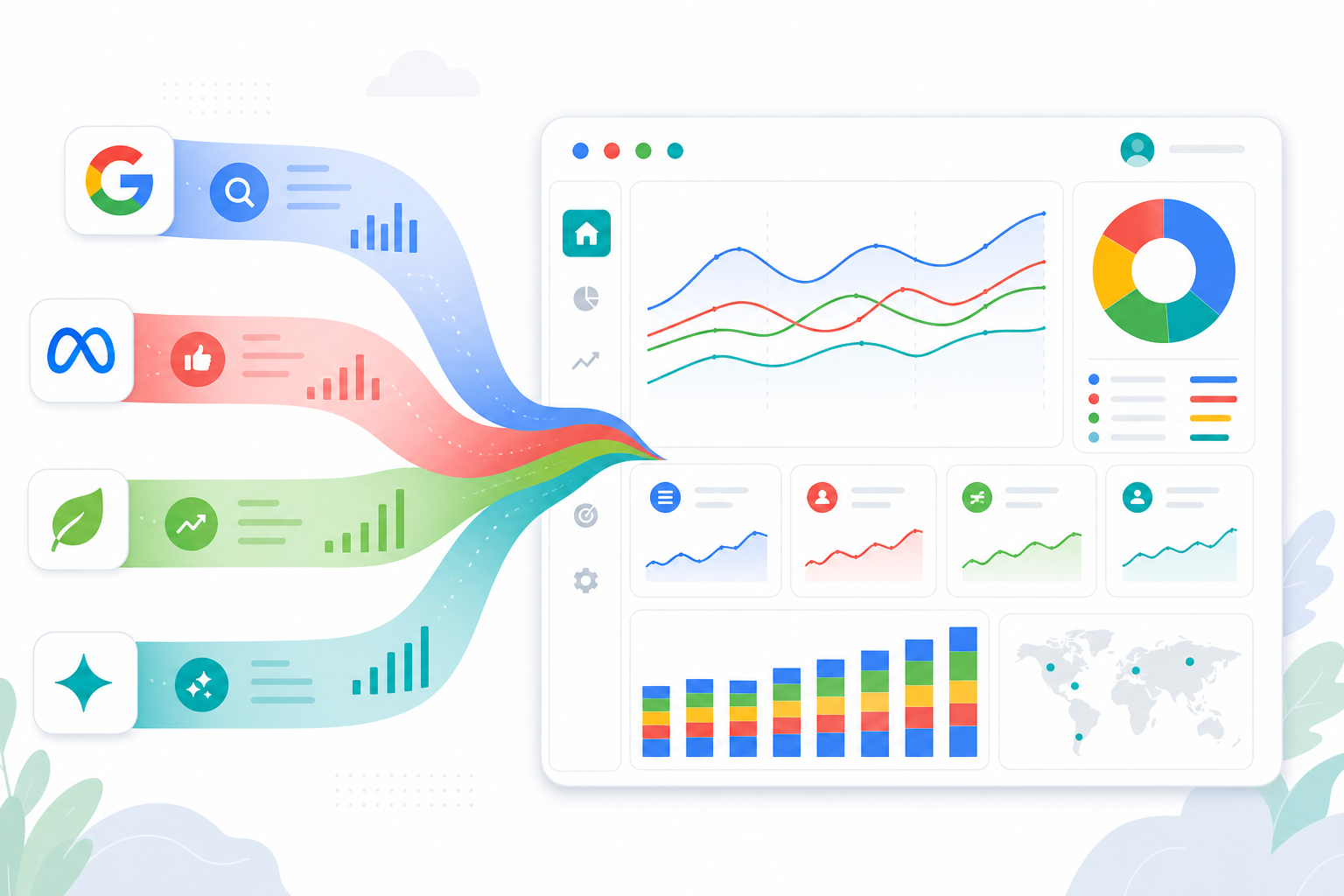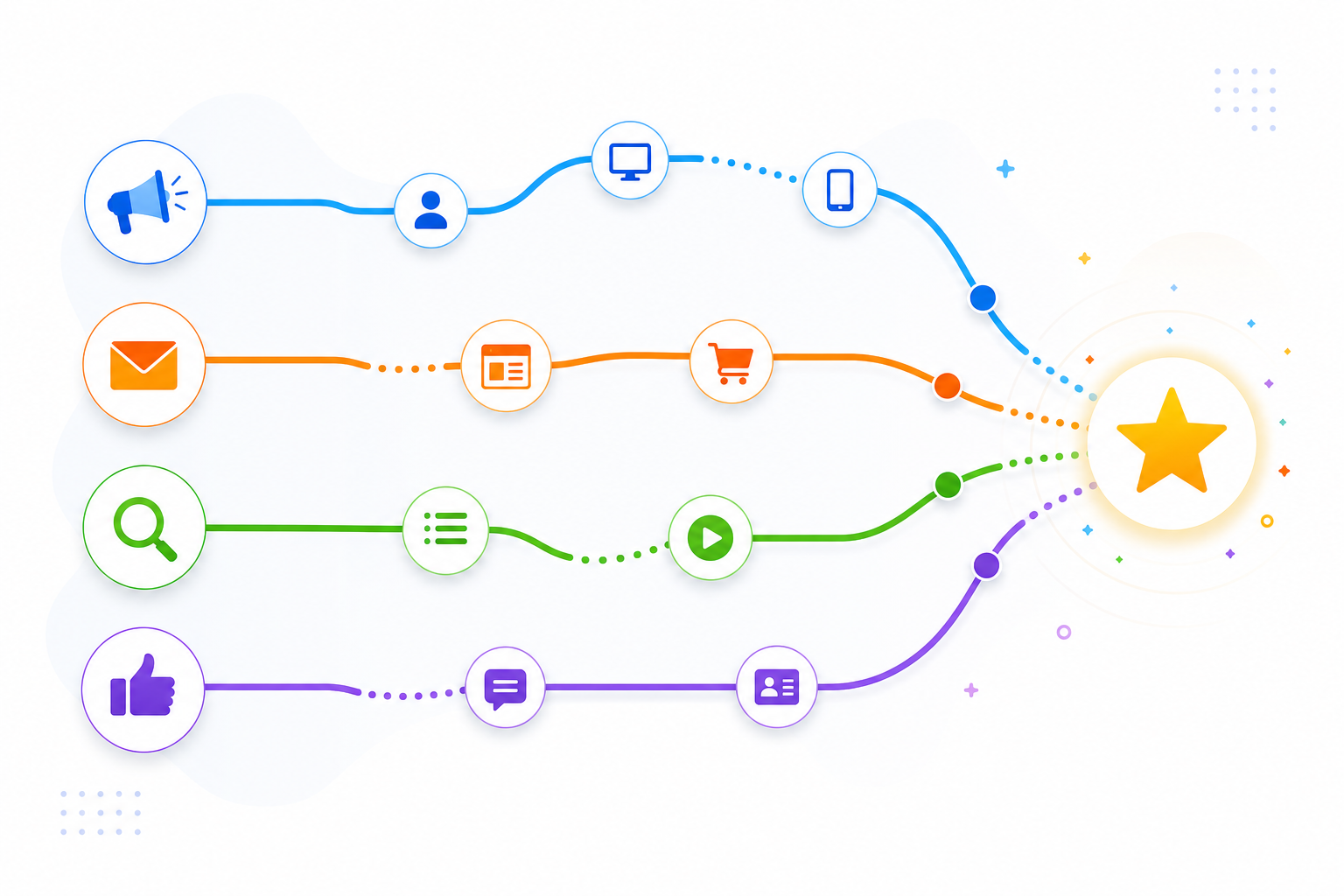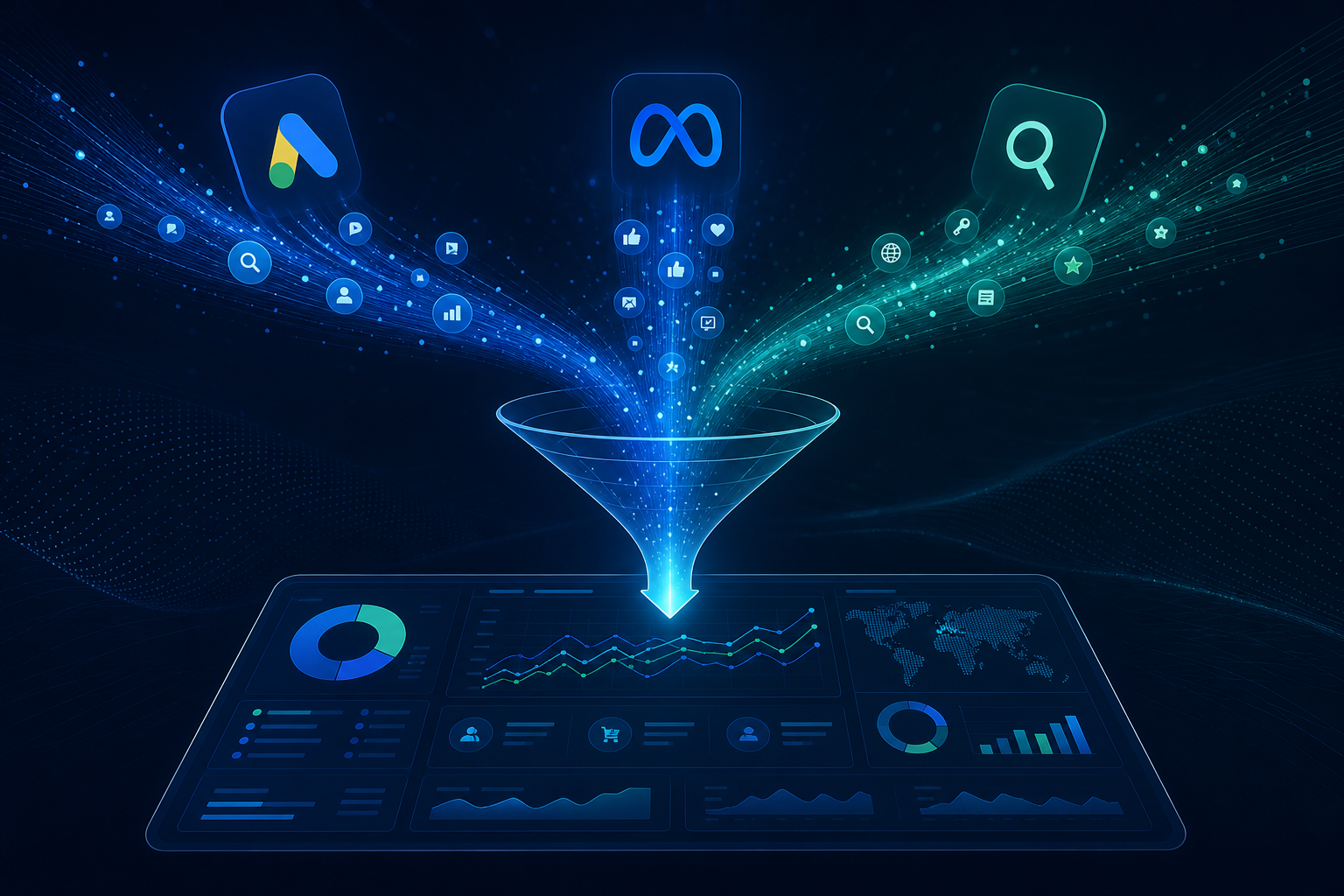
Why channel synergy beats a siloed model
Channel synergy does not mean every channel does the same thing. It means each channel has a clear role in the buying journey and is designed to support the others — not compete for the same euro in the same stage. When Google Ads, Meta, and SEO are run as separate projects, the result is often overlapping reach, broken attribution, and budget flowing to wherever the last click looks good.
The cost of siloing is concrete: Meta advertising builds brand searches that Google Ads captures — but if Meta is cut because standalone ROAS looks weak, Search loses cheap traffic. SEO content improves quality scores and landing pages, which lowers Google Ads costs — but if SEO lives separately, the Ads team never benefits. These connections stay invisible without integration.
Our Full Stack service is built for exactly this: one team, one strategy, one source of truth. When channels work in synergy, the total result is greater than the sum of its parts — typically 20–35% more efficient than a siloed model on the same budget. This is not theoretical: it shows up in blended ROAS, brand search growth, and organic traffic conversion.
The core of synergy is a mindset shift: a channel is not a standalone product but part of a system. Decisions are made with the question "how does this euro affect the whole path?" — not "how does this euro affect this channel?" That requires shared data, shared content, and a shared rhythm. Without them, synergy stays talk.
Practical example: an ecommerce store cuts Meta budget 50% because Meta ROAS is 2x and Search 5x. Three months later Search ROAS drops to 3.5x because brand searches dried up. Synergy would have kept Meta and measured blended ROAS — not channel-specific targets.
Another example: a B2B company invests in SEO without Meta. Organic traffic grows but conversion is slow. Meta retargeting to the same visitors accelerates demo requests — SEO brought traffic, Meta closed the path. In isolation each looks average; together they win.
Google's role: capturing ready demand and closing conversion
Google Ads is most effective when the customer is already ready to buy or actively comparing. Search captures buying keywords and brand queries; Performance Max and Shopping extend capture at product and intent level. Google's strength is intent — but intent does not appear in a vacuum.
Brand searches that Google captures cheaply are often produced by Meta, content, or word of mouth. Generic buying keywords are expensive precisely because demand must be built first. When Meta and SEO do demand building, Google Ads can focus on capture — and do it more cheaply.
Google Ads also affects SEO indirectly. Quality landing pages, fast site speed, and conversion data improve user experience, which Google rewards. Remarketing and YouTube support a path where organic discoverability and paid capture run in parallel.
The mistake is forcing Google Ads to do everything: prospecting, brand, and capture in one campaign without Meta or SEO. The result is expensive CAC and poor scalability. In a synergy model, Google is the decision-stage engine — not the funnel's only channel.
Performance Max and Shopping extend synergy at product level: when Meta has built product awareness and SEO has brought comparison traffic, PMax can scale conversions with broader signal. Without upper-funnel support, PMax optimizes expensive traffic — not the whole.
The Google Ads team must get Meta and SEO reports at the same table: weekly brand search trend, organic conversion development, and content calendar. When Ads is optimized in isolation, Search over-invests in generic keywords and under-invests in brand — even though Meta just built the brand.
- Search: brand and buying keyword capture (high intent)
- Shopping / PMax: product- and catalog-based capture
- Remarketing: path completion and abandoned cart recovery
- YouTube: consideration support and remarketing source
Meta's role: building demand and growing audiences
Meta works best when the customer is not yet searching for a solution — but is in the right demographics, interests, or behaviors. Prospecting builds demand, retargeting ties the path together, and Advantage+ scales when conversion data is solid. Meta's weakness when measured in isolation is ROAS: it often looks weak because its impact shows up later in Google or organic search.
Meta feeds Google concretely: brand awareness grows brand searches that Search captures more cheaply than cold buying keywords. Video and carousel ads build memory that shows up directly in search and indirectly in SEO content clicks. Without Meta, you pay Google Ads prices to build all demand from scratch.
Meta benefits from SEO: blog articles, case studies, and product pages serve as retargeting sources and landing targets. When content is quality, Meta ad relevance improves and CPM drops. The same content serves prospecting (link clicks), retargeting (conversion), and organic discoverability.
In a synergy model, Meta does not compete with Search for the same budget but precedes it in the funnel. Measure Meta with incrementality and brand search growth — not last-click ROAS alone. That changes budget allocation radically.
Meta Advantage+ needs quality conversion data to leverage synergy: when the pixel and CAPI see all conversions — including those Meta only assisted — the algorithm learns the right audience. Broken tracking means Meta optimizes prospecting the wrong way and synergy goes unused.
Creative in Meta supports SEO content: video that works in prospecting can be reused in the blog and YouTube remarketing. The same proof (customer story, demo) across channels strengthens the message. Scattered creative — different messages per channel — is the opposite of synergy.
SEO as infrastructure: organic capture and trust building
SEO is the slowest channel but often the most durable: organic traffic lowers acquisition cost over time and builds authority that benefits every channel. In a synergy model, SEO is not a standalone "blog project" but infrastructure serving the whole funnel.
Organic visibility captures researching demand: comparison, guide, and problem-solution queries where the customer is not yet ready to buy. This content feeds Meta retargeting (visitors into the pixel), improves Google Ads quality scores (relevant landing page), and builds brand that also shows up in AI answers.
Technical SEO is the foundation of synergy: a fast site, clear structure, and conversion tracking benefit all channels. If the site is slow or tracking is broken, neither Google Ads nor Meta optimizes correctly. SEO and paid teams must share the same technical base.
Content strategy links directly to channels: pillar pages support organic capture, supporting content feeds long-tail queries, and FAQ pages improve conversion on every channel. When content is planned for synergy, one article can serve SEO, Meta ads, and Google Ads landing needs simultaneously.
Funnel and channel interaction: how the path is built
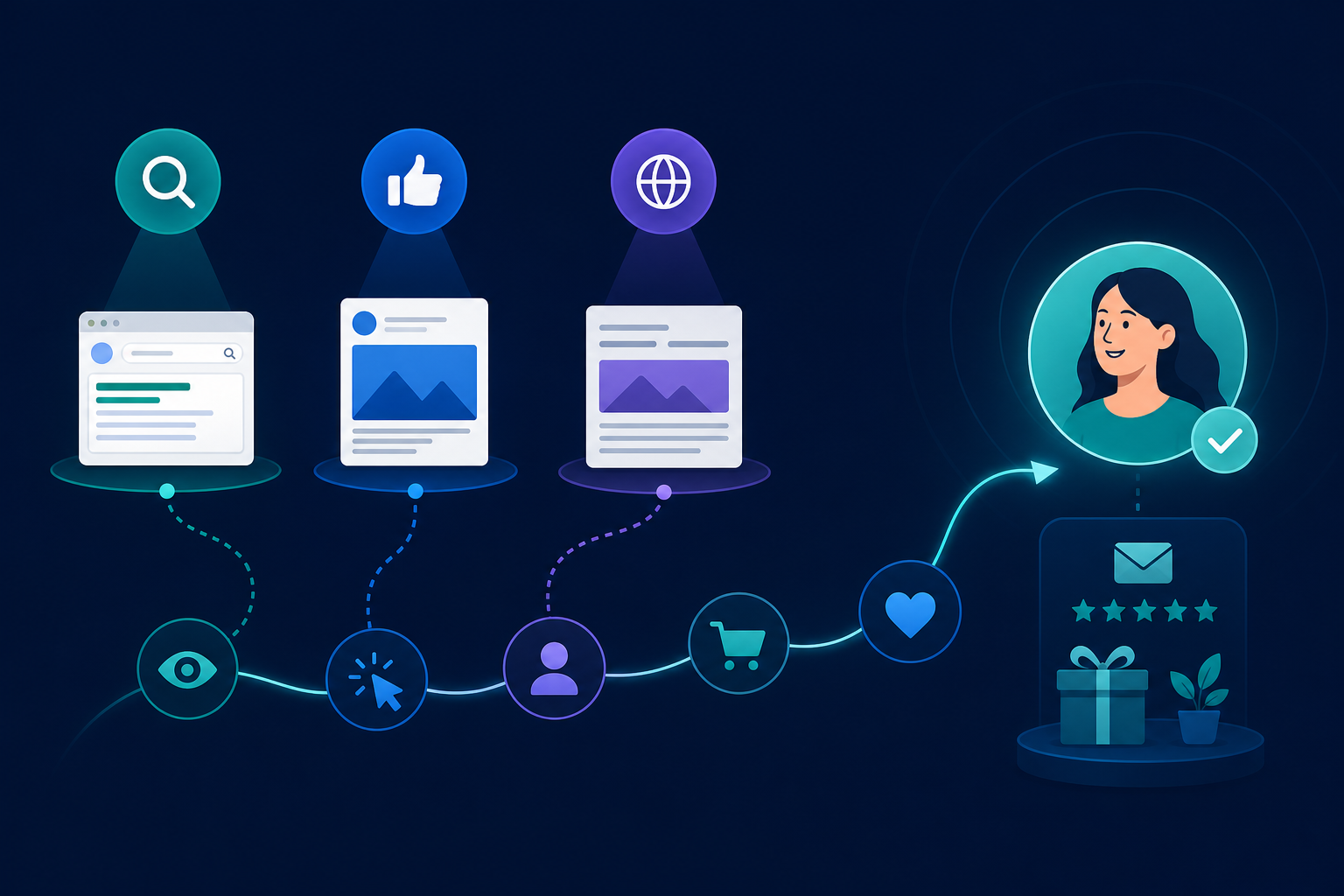
A typical synergistic buying path looks like this: the customer sees a Meta ad (awareness), googles the topic and finds an organic article (consideration), returns via a remarketing ad (consideration → decision), and finally buys through a brand search or Shopping ad (decision). Each stage needs a different channel — and all affect the outcome.
When the funnel is designed as channel interaction, messaging stays consistent: the same value proposition, brand voice, and proof (case studies, reviews). Scattered messaging — Meta promises one thing, the SEO article another, Google Ads a third — creates distrust and weakens conversion on every channel.
Timeline is critical for synergy: Meta and SEO affect weeks and months ahead; Google Ads affects the same day. Short-term optimization often cuts Meta and SEO because their impact is not visible immediately. Synergy requires patience and the right measurement — not just last week's ROAS.
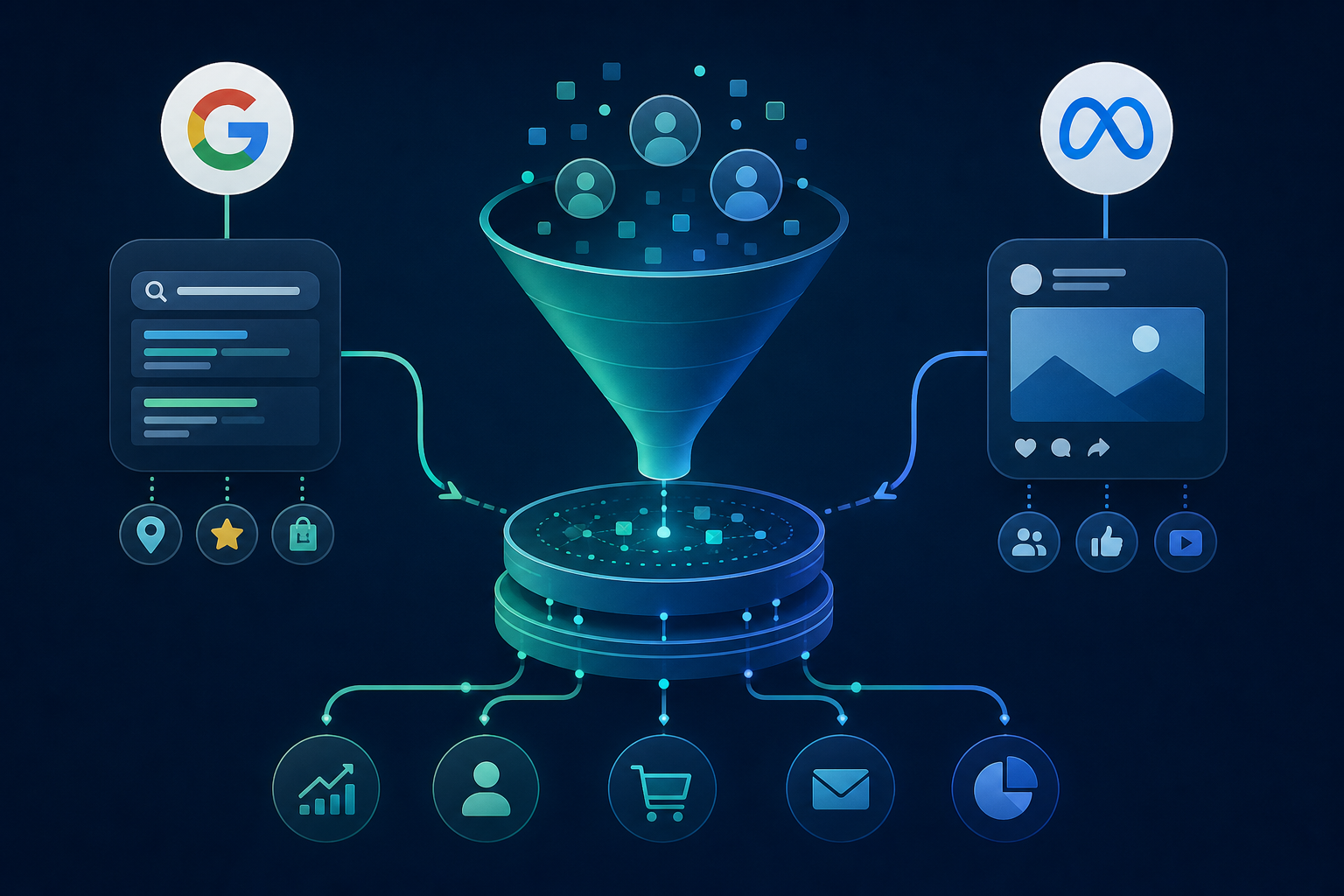
Content as shared engine: one investment, three channels
Content is synergy's cheapest lever: one quality pillar page serves organic search, works as a Meta ad landing page, and improves Google Ads campaign quality scores. Case studies and customer stories work as retargeting material and conversion proof in Search. FAQ pages improve GEO visibility and reduce support questions in sales.
The content calendar must be planned across channels: publish before the Meta campaign, ensure organic indexing before paid use, and test landing pages with Google Ads traffic before organic scale. This rhythm requires coordination — not three separate agencies without a shared meeting.
Topic clusters build authority that benefits every channel. When one topic has a pillar page, supporting content, and FAQs, organic traffic grows, Meta ad relevance improves, and Google Ads can use the same content as a quality landing page.
Do not produce content "for SEO" or "for Meta" separately. The question is always: does this serve the whole path? If yes, the investment is synergistic. If not, it is a silo cost.
Attribution and shared data: one truth for three channels
Synergy is impossible without shared data. If Google Ads, Meta, and SEO each report their own conversions with their own models, the same purchases are counted multiple times and the big picture disappears. One source of truth means GA4 (or equivalent), unified conversion tracking, and an attribution model that reflects the whole path.
Cross-channel attribution is the foundation of synergy measurement. A data-driven or position-based model distributes credit across touchpoints: Meta gets part of the credit for a brand search conversion, SEO part for a researching traffic conversion, Google Ads part for direct capture conversion. Without this, Meta and SEO always look weaker than Search.
The measurement stack connects analytics, ad platforms, CRM, and possible offline data. When the stack is solid, you see blended ROAS, assisted conversions across channels, and incrementality. That is the information used to move budget synergistically — not based on each platform's own reporting.
Conversion data quality directly affects optimization: Smart Bidding and Advantage+ need reliable data. Broken tracking means Google and Meta optimize to the wrong signal — and synergy stays theoretical.
Budget mobility: euros follow marginal return, not silos
In a synergy model, budget is not locked to channels but moves with marginal return. When Search is maxed and brand queries captured, the next euro goes to Meta for demand building or SEO for long-term growth. When Meta produces brand searches, Search budget can grow more efficiently.
Practical allocation starts with ready demand capture (Search + Shopping), continues to demand building (Meta prospecting), and long-term organic (SEO). Ratios vary by industry and maturity — what matters is that the split is intentional and data-driven, not historical habit.
Quarterly budget review maintains synergy: where is marginal return falling? Where is incrementality highest? Where does the next €10,000 produce the most total growth? These questions require one dashboard, not three separate reports.
Our Full Stack marketing article goes deeper on allocating budget across channels. The core of synergy is the same: budget serves the whole, not a single channel.
Operating rhythm: maintaining synergy week to week
Synergy is not born from a strategy deck but from rhythm. Weekly channel coordination (30–60 min) covers: what Meta did to brand searches, what SEO published, how Google Ads campaigns reacted, and whether content is cross-usable. Without this rhythm, channels drift back into silos.
Monthly whole-picture review focuses on blended metrics: total CAC, organic traffic conversion, brand search trend, Meta-assisted conversions in Search. Channel-specific reports are an appendix, not the main presentation.
Campaign timing is coordinated: Meta prospecting before season, SEO content published before paid push, Search budget raised when brand searches grow. This is operational synergy — not just strategic talk.
One owner for the whole is critical: marketing director, growth lead, or full-stack partner with authority to move budget between channels based on data. Without an owner, synergy breaks at the first ROAS crisis.
Measuring synergy: what to track and what to ignore
Synergy is not measured by single-channel ROAS but by total impact. Metrics to track: blended ROAS (all paid / revenue), total CAC, brand search volume and conversion, organic traffic conversion rate, assisted conversions across channels, and incrementality (geo tests, holdout).
Meta metrics for synergy: reach, frequency cap, brand search growth after Meta campaigns, view-through assisted conversions in Search. SEO metrics: organic traffic by intent, conversion from organic traffic, content use in paid campaigns. Google metrics: brand vs. generic split, quality scores, impression share on brand queries.
Incrementality tests reveal true synergy: pause Meta in a region and watch whether brand searches and Search conversions drop. If they do, Meta delivers real incremental value — even if standalone ROAS is low. That is proof of synergy, not opinion.
Avoid comparing channels directly on ROAS. Meta is usually "weaker" and Search "stronger" in isolation — which is exactly why they work better together. Measure the whole.
Build a quarterly synergy report for leadership: blended ROAS, brand search change after Meta investment, organic conversion trend, and incrementality test result. This report connects channels into one story — not three separate decks.
Always compare to last quarter and last year: synergy shows in long trends, not a single week. Seasonal shifts (holiday, B2B Q4) affect channels differently — Meta may grow brand searches for holiday, SEO produces content for Q1.
Remarketing and path binding: synergy's glue
Remarketing is often synergy's forgotten layer: Meta retargeting, Google Ads remarketing, and returning organic traffic complement each other. A customer who found an SEO article, sees a Meta ad, returns via brand search, and converts through a Shopping ad — remarketing ensures the path does not break in between.
A shared audience strategy is critical: pixel, GA4 audiences, and CRM segments must sync. When Meta retargeting and Google remarketing use the same conversion logic, messaging stays consistent and the customer does not see conflicting offers across channels.
Remarketing budget share in a synergy model is typically 15–25% of paid budget — no more without frequency cap control. Over-remarketing kills brand and raises CPM; under-remarketing leaves conversions on the table.
Content in remarketing: case studies, demo offers, social proof. The same content SEO published organically works as remarketing creative — another synergy cross-use.
Scaling through synergy: growing without a CAC crisis
Scaling without synergy often means: raise Google Ads budget until CAC explodes. In a synergy model, scaling happens in layers: first capture all profitable Search, then Meta builds new demand in new segments, SEO provides organic cushion for CAC.
When you scale Meta, track brand searches and Search conversions with a 2–4 week lag. If brand searches grow, Search budget can rise more efficiently — Meta paid for demand building, Search captures more cheaply. This is synergy's scaling engine.
SEO scaling is slowest but most durable: a new topic cluster produces organic traffic months later and lowers blended CAC permanently. Scaling without SEO investment means every new paid euro costs the same or more — not less.
Geo and segment scaling: when synergy works in one market, replicate the model in another — but do not copy budget ratios blindly. Search potential, Meta reach, and SEO competition vary by market. Scaling requires local data, not just a global playbook.
Common mistakes when building channel synergy
These mistakes block synergy benefits — often in organizations with strong single-channel skills but no whole-picture coordination.
- Channel-specific ROAS targets → Meta and SEO get cut, Search loses cheap traffic
- Separate agencies without shared data → each reports its win, the whole disappears
- Content for SEO only → lost Meta and Ads cross-use
- Last-click attribution → demand-building channels undervalued
- Locked budget → euros do not move where marginal return is highest
- Short-term optimization → Meta and SEO cut before impact is visible
- Different messaging per channel → distrust and weak conversion everywhere
Frequently asked questions
What does channel synergy mean in practice?
Channel synergy means Google Ads, Meta, and SEO are planned and managed as one system: each has a role at a different funnel stage, they share content and data, and budget moves with marginal return — not channel-specific ROAS targets in isolation.
Why does Meta look weak when measured separately?
Meta often builds demand that converts later in Google Ads brand search or organic traffic. Last-click attribution gives credit to Search, not Meta. Synergy requires cross-channel attribution and brand search tracking — not Meta ROAS alone.
How does SEO benefit Google Ads and Meta?
SEO produces quality content that works as landing pages, improves site speed and authority, and captures researching traffic as a retargeting source. Organic visibility reduces dependence on expensive paid traffic and improves quality scores in Search campaigns.
Do I need a separate team for each channel for synergy?
Not necessarily, but you need one owner for the whole and shared data. A small company can use a full-stack partner; larger ones need a marketing director or growth lead who coordinates channels and moves budget based on data.
How do I measure whether synergy is working?
Track blended ROAS, total CAC, brand search trend, organic conversion development, and incrementality tests. If brand searches and Search conversions drop after a Meta pause, Meta delivers synergistic value — even if standalone ROAS is low.