Annual plan structure
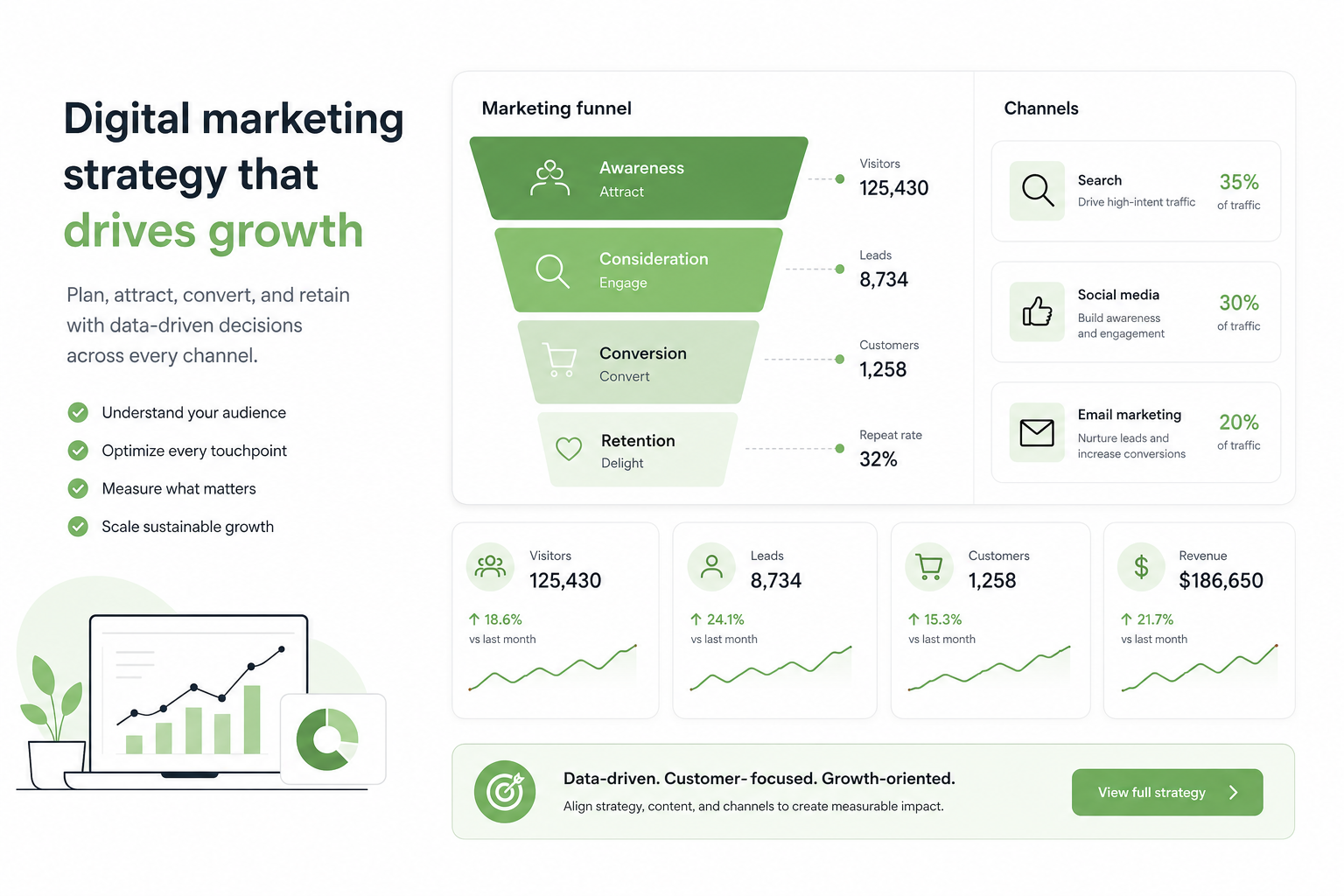
Marketing plan combines strategy, budget, and calendar: goals (north star), channel mix, budget split, campaigns, and metrics. 2–3 pages is enough — a long deck does not become action.
Rolling 12-month view beats a static January plan: each month, extend the horizon and retire completed campaigns so the calendar always shows the next 90 days of committed work.
Structure: Q1–Q4 goals, monthly priorities, campaigns and budgets. OKRs and QBR each quarter. Plan evolves — updated quarterly from data.
Assign a calendar owner with authority to move dates and budgets — not a shared doc everyone edits without decisions. The owner runs the monthly review and escalates blockers to leadership.
Link digital marketing strategy to the plan — strategy is filter, calendar is execution.
Annual plan sections: business context (goals, constraints), channel mix and budget, campaign themes by quarter, measurement and reporting rhythm, and owner roster. Share a one-page summary with leadership; keep the detailed calendar in Sheets or Notion for the team.
Contingency slots matter: reserve 10% of campaign calendar for opportunistic pushes (product launch, competitor move, PR moment) without derailing the core plan.
Seasonality
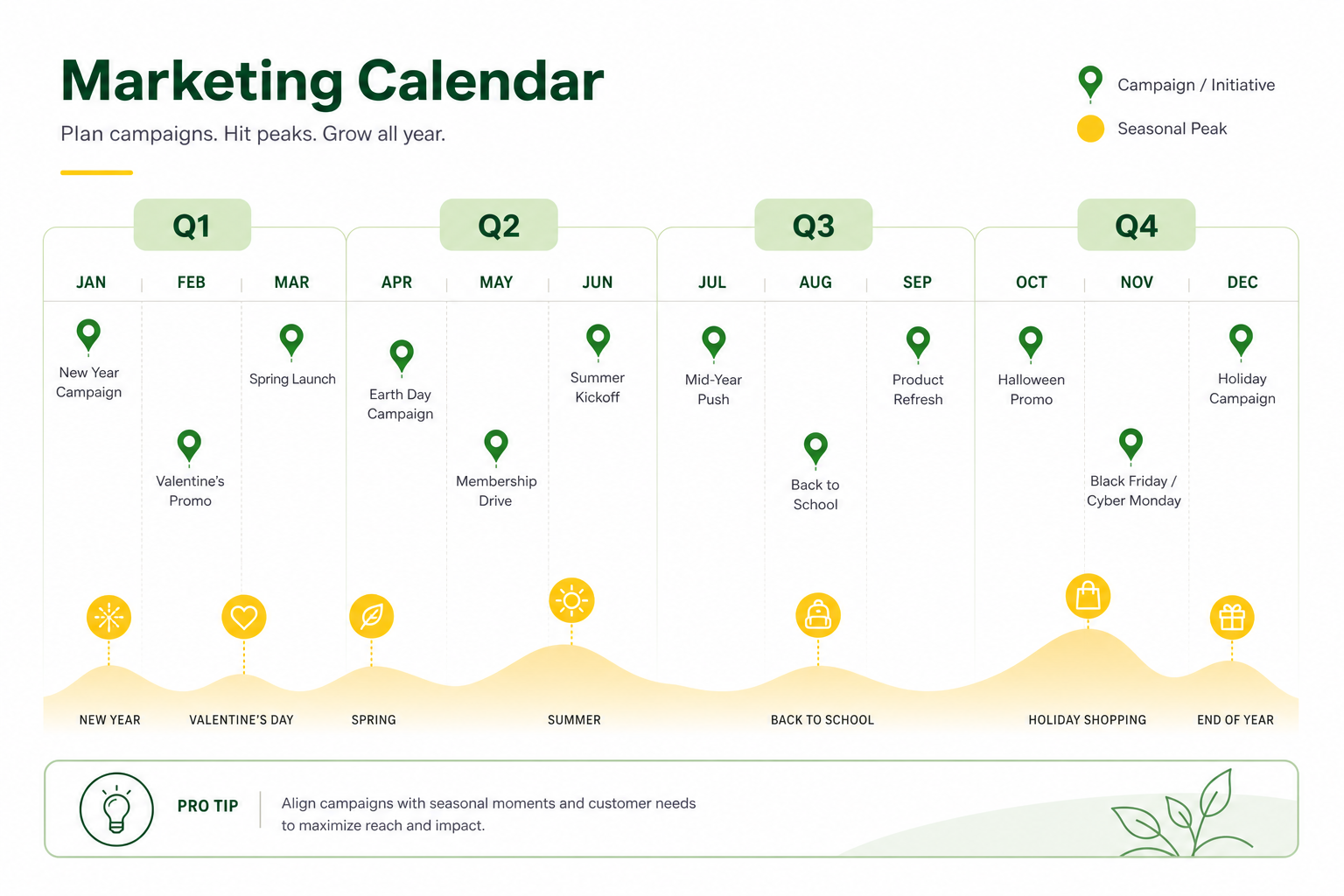
Most businesses are seasonal: B2B Q4 budget pressure, e-commerce Q4 and summer, services spring–fall. Calendar anticipates peaks and troughs — budget and campaigns scheduled in advance.
Season inventory: when demand is high, when low, which products/services sell when. Raise budget for peaks, retention and content for troughs.
Allow prep time: feed, creative, landing pages, and ad variants before peak — not one week before Black Friday.
Document historical performance by month: last year's revenue, CAC, and conversion rate by week. Use that curve to pre-book media and email sends — not gut feel. B2B often sees August quiet and September surge; e-commerce sees November dominate.
Off-peak months are for testing: new creative angles, landing A/B tests, and SEO content builds that peak season has no time for. Calendar troughs should still have defined goals — not empty cells.
- Season inventory: peaks and troughs
- Budget to peaks, content to troughs
- Prep 4–6 weeks before peak
- Post-season: win-back and retention
Campaign calendar and channels
Campaign calendar lists: campaign, channel, budget, goal, timeline, owner. Google Ads, Meta, email, content — all in one view (Sheets, Notion, Asana).
Channel coordination: same message on Search, Meta, and email for seasonal campaign. Retarget seasonal visitors. Google Ads and Meta campaigns in sync.
Monthly review: what shipped, what moved, what we learned. Calendar is a tool — owner and rhythm make it work.
Campaign brief template: objective, audience, offer, channels, budget, creative needs, landing URL, KPI, owner, dates. Every row in the calendar links to a brief — so execution does not depend on one person's memory.
Cross-functional dependencies belong on the calendar: product launch dates, sales promotions, stock availability, and legal approval windows. Marketing campaigns fail when product or ops dates shift without updating the plan.
OKR tie-in and quarterly rhythm
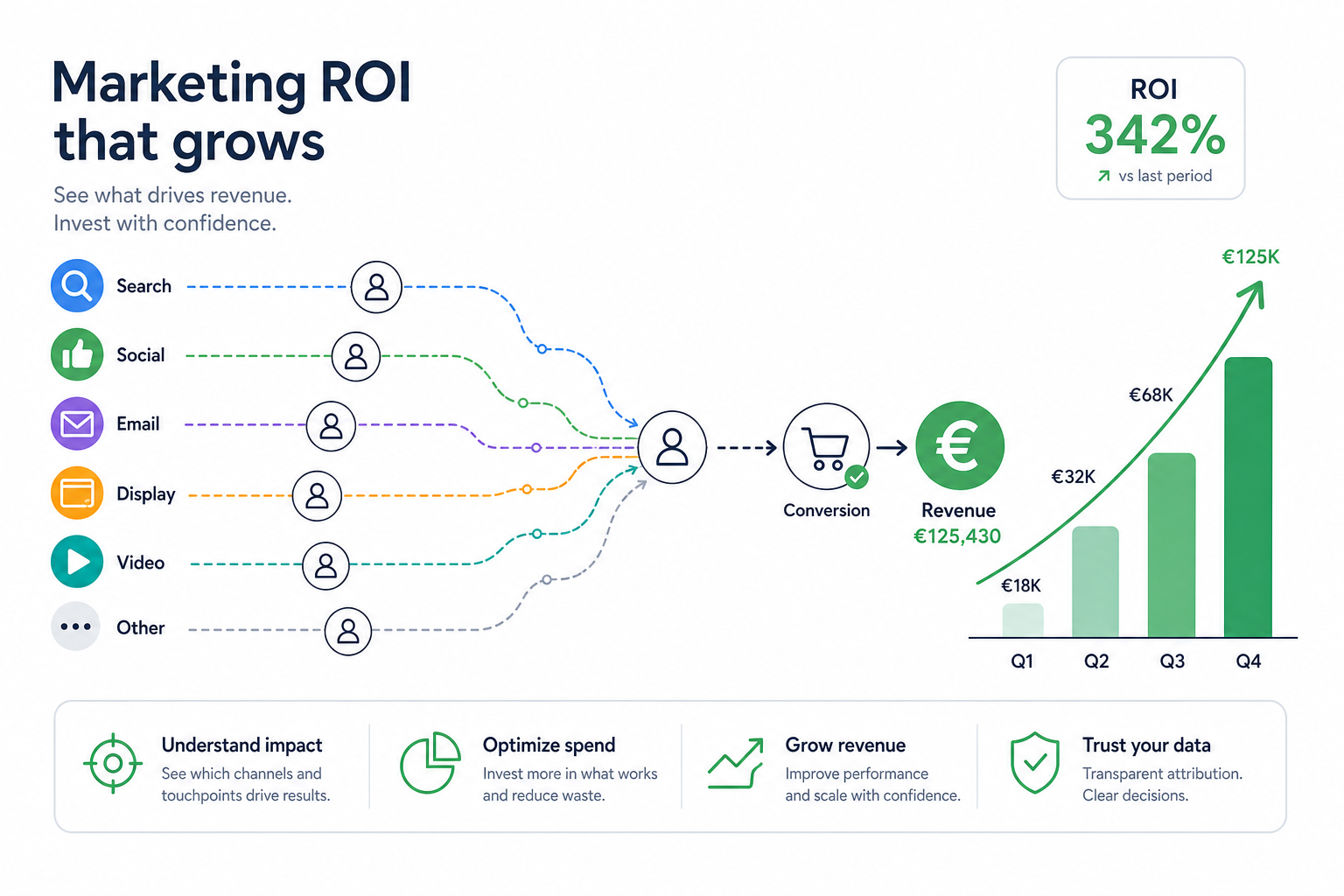
OKR (Objectives and Key Results) ties plan to business: e.g. "Grow pipeline 20%" — key results: MQL +15%, SQL +10%, win rate +5%. Marketing OKRs support sales and revenue.
Quarterly rhythm: OKR setting → monthly tracking → QBR (review, budget reallocation, next Q OKR). Read ROI measurement and QBR.
Budget allocation quarterly: 70/20/10 to proven, growth, and experiments — data guides split.
Marketing OKRs should be few: one objective, 2–3 key results per quarter. Example objective: "Grow qualified pipeline." Key results: MQL +20%, SQL rate +5%, cost per SQL −10%. Tie each key result to calendar campaigns that drive it.
Retro at QBR: which calendar items shipped on time, which slipped, and why. Slippage patterns (creative bottleneck, approval delay) become process fixes for next quarter's plan.
Publish the calendar to stakeholders in two views: leadership sees goals, budget, and OKR ties; the team sees tasks, owners, and deadlines. Same source of truth, different depth — avoids overload and misalignment.

Execution with Full Stack
Plan stays on paper without execution. AlgoTerra Full Stack executes the calendar: campaigns, optimization, reporting, and QBR — one team, one owner.
Rhythm: weekly ads optimization, monthly campaign coordination, quarterly QBR and plan update. Start with a free audit — we map current plan and propose a calendar.
Full Stack execution means the same team that plans Q2 campaigns runs Google Ads, Meta, email, and SEO tasks on the calendar — not a handoff to a separate vendor mid-quarter.
We build 12-month campaign skeletons with seasonal peaks, OKR milestones, and budget envelopes — then refine monthly. Full Stack keeps plan and execution in one rhythm.
Integrate sales and product launches into the calendar early: a campaign date without product readiness or sales follow-up capacity is a placeholder, not a plan.
Common planning mistakes
We see these in audits — reactive firefighting replaces planned campaigns, and seasonality catches teams off guard every year. A living calendar prevents both.
- No calendar → reactive campaigns
- Season forgotten → budget mistimed
- OKR separate from calendar → goals do not guide
- No owner → calendar unused
- Plan locked → no response to data
Frequently asked questions
What does a marketing plan include?
Goals, channel mix, budget, campaign calendar, metrics, and quarterly rhythm (OKR/QBR). 2–3 pages is enough.
How do I account for seasonality?
Season inventory, budget to peaks, prep 4–6 weeks before, post-season to retention.
How does OKR tie to the calendar?
OKRs quarterly, monthly tracking, QBR review and budget reallocation.
What tool for the calendar?
Sheets, Notion, or Asana — campaign, channel, budget, goal, timeline, owner.
How does AlgoTerra help with planning?
A free audit maps current state. Full Stack executes calendar and QBR rhythm.