How has Meta audience targeting changed?
In the past, the core skill of Meta advertising was detailed targeting: choosing precise interests, demographics, and behaviors. Privacy changes (iOS ATT), the decline of signals, and the maturing of Meta's machine learning have changed this. Today the algorithm finds audiences more efficiently than manual targeting.
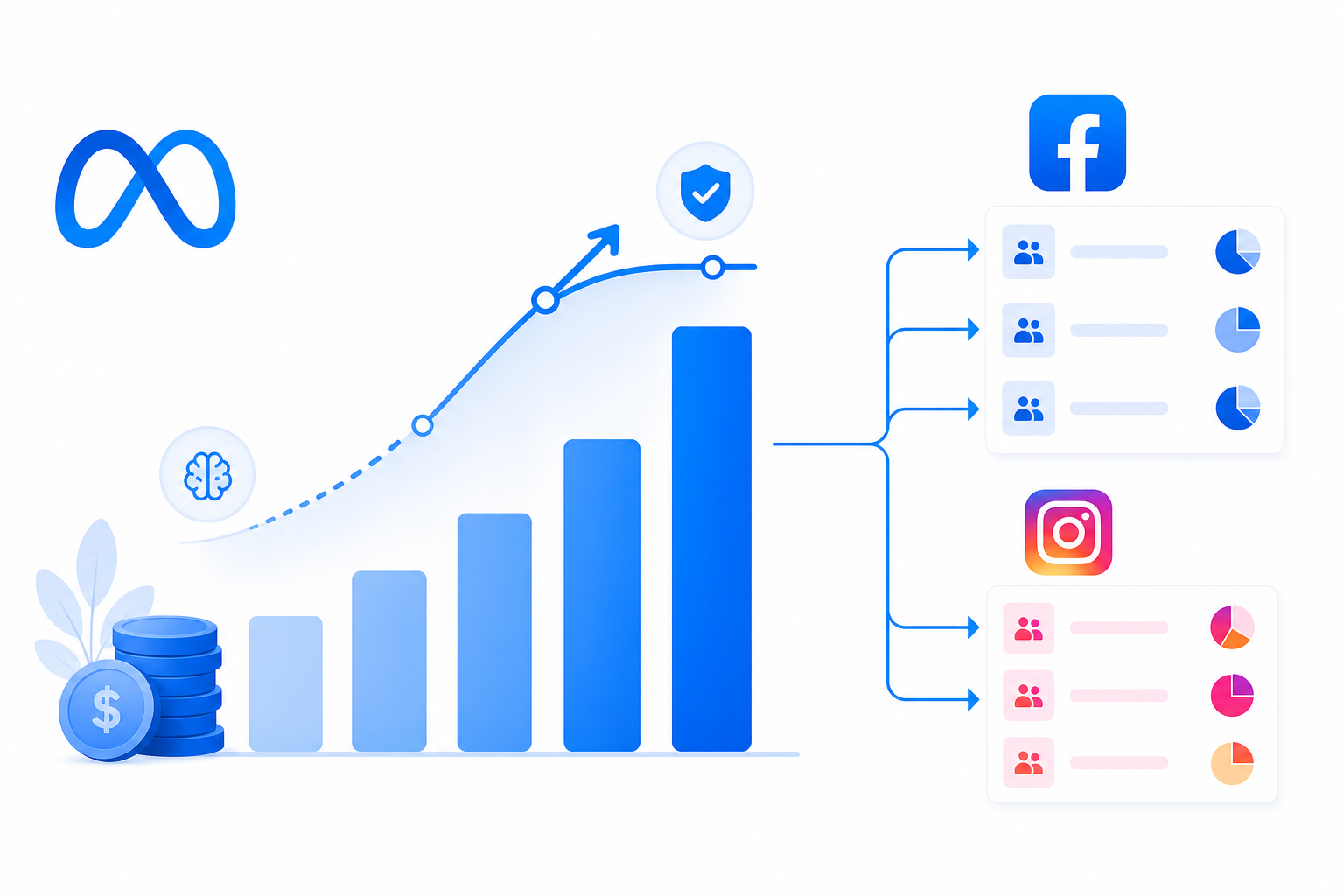
This does not remove audience strategy — it changes its nature. Instead of telling the algorithm who to show, you give it quality signals (conversion data, customer lists, remarketing audiences) and let it optimize. Audience work has shifted from manual targeting to signal and data management.
In practice this means three things: feed the algorithm quality conversion data, build strong first-party audiences (customer lists, site visitors), and let Advantage+ tools do the targeting work. Audience strategy is now data strategy.
Advantage+ Audience: let the algorithm find the audience
Advantage+ Audience is Meta's machine-learning audience tool that finds the best audiences automatically based on conversion data and signals. Instead of restricting the audience tightly, you give the algorithm a hint (audience suggestion) and it expands from there in the most effective direction.
Audience suggestions act as a starting point, not a hard limit: you tell the algorithm the interesting interests or demographics, but it can go beyond them if it finds higher-converting audiences. This is often more effective than tight manual restriction, because the algorithm sees data you do not.
Advantage+ Audience works best when it has quality conversion data to optimize against. That is why conversion tracking and the Conversions API are a prerequisite — without good data the algorithm optimizes on incomplete signals.
Custom audiences: the power of first-party data
Custom audiences are audiences built from your own data: customer lists (emails), site visitors (pixel/CAPI), app users, and those who engaged within Meta (video viewers, page followers, form openers). They are the most valuable raw material of an audience strategy because they are based on a real relationship with your brand.
Custom audiences serve two purposes: they are a direct target for retargeting (reach those who already know you) and a seed for lookalike audiences (find more similar people). The higher the quality of the seed audience, the better the lookalike.
For privacy, customer lists are hashed before sending, and site-data collection requires consent (Consent Mode). The value of first-party data has grown precisely because third-party signals have weakened — your own data is the most durable foundation.
- Customer lists: emails hashed (CRM, purchasers)
- Site visitors: pixel + Conversions API
- Engagement: video viewers, page/profile followers, form openers
- Use: retargeting target AND lookalike seed
Lookalike audiences: scale from your best customers
A lookalike audience finds new people who resemble your existing seed audience. Meta analyzes the shared traits of the seed audience and finds similar users. This is an effective way to scale prospecting advertising based on first-party data.
The quality of the seed audience decides: a lookalike is only as good as its seed. The best seed is often your most valuable customers (e.g. high-lifetime-value buyers), not all visitors. A small but high-quality seed produces a better lookalike than a large but imprecise one.
In the Advantage+ era, lookalike audiences often work best as audience suggestions for Advantage+ Audience, not as tight restrictions. You give the algorithm a quality seed and let it expand. Test different seeds (purchasers, high LTV, certain product categories) and let the results guide you.
Retargeting structure: tie the buying journey together
Retargeting (remarketing) reaches those who have already engaged with your brand but have not yet converted. It is typically the most effective advertising because the audience already knows you — but it requires an effective structure and a fresh audience.
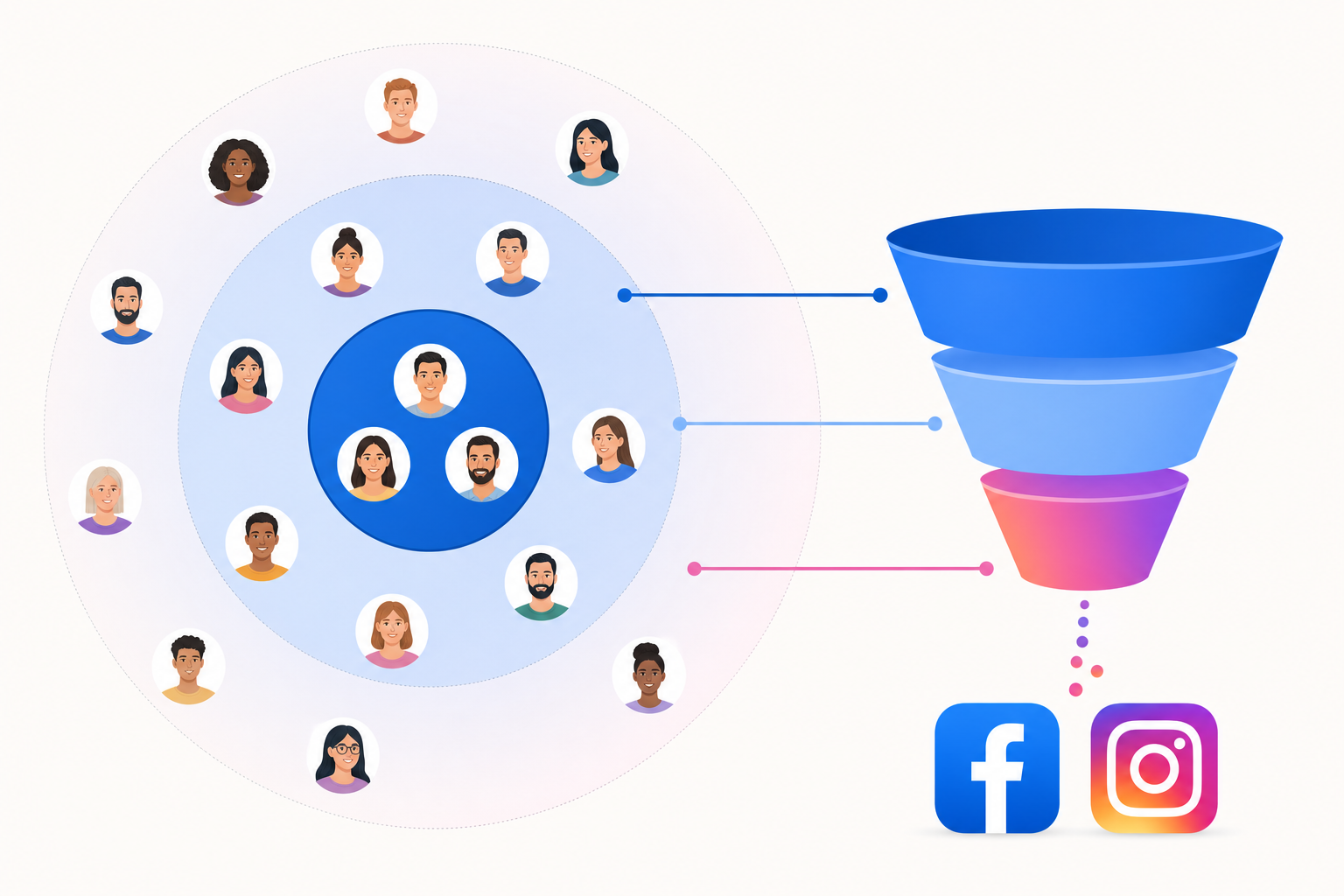
Build retargeting in tiers by engagement: the warmest (added to cart, visited pricing) get the most direct message and offer; the cooler (site visitors, content readers) get a softer, trust-building message. Different stages, different messages.
Avoid over-exposure: cap frequency and exclude converters from retargeting audiences so you do not waste budget on those who already bought. Freshness matters — an old retargeting audience (e.g. 180 days) is often less effective than a fresh one (7–30 days).
Conversions API: better data quality
The Conversions API (CAPI) sends conversion events from the server to Meta alongside the browser pixel. This significantly improves data quality and coverage — especially in iOS and Safari traffic where browser-based tracking leaks.
CAPI is the foundation of audience strategy because it feeds the algorithm better data: more accurate conversion data → better Advantage+ optimization → better audiences. Without CAPI, the algorithm optimizes on incomplete signals and audience discovery degrades.
Implementation works via a direct integration or through server-side GTM. Combine the pixel and CAPI with deduplication (the same event is not counted twice). Consent Mode still applies — CAPI does not bypass consent but improves the quality of consented data.
An effective audience strategy structure
Combine the pieces into an effective whole. Prospecting (new customer acquisition): Advantage+ Audience with quality audience suggestions and lookalike seeds, fed by CAPI data. Retargeting: tiered remarketing by engagement, with converters excluded. Together they cover the whole path from unknown to purchaser.
Give the algorithm room to learn: avoid too many overlapping, tight audiences that fragment budget and data. Broader, well-signaled audiences give the algorithm more to optimize. Consolidate rather than fragment.
Measure the whole: prospecting brings new customers, retargeting converts — do not judge them by the same metrics. Retargeting's high ROAS does not mean all budget should move there; without prospecting, the retargeting audience dries up.
Common mistakes in Meta audience strategy
We see these mistakes repeatedly in Meta account audits — often on accounts using outdated logic based on manual targeting.
- Over-tight manual targeting → prevents the algorithm from finding the best audiences
- Missing CAPI → the algorithm optimizes on incomplete data, audiences degrade
- Low-quality lookalike seed → all visitors instead of valuable customers
- Leaving converters in the retargeting audience → budget wasted on buyers
- Too many overlapping audiences → budget and data fragment
- Staring only at retargeting ROAS → prospecting withers and the audience dries up
Frequently asked questions
Is manual targeting still worth doing on Meta?
Mostly no. Advantage+ machine learning finds audiences more efficiently when given quality signals. Audience work has shifted from manual targeting to data and signal management: conversion data, customer lists, and remarketing audiences.
What is Advantage+ Audience?
Advantage+ Audience is Meta's machine-learning audience tool that finds the best audiences automatically. You give it a hint (audience suggestion), and it expands toward higher-converting audiences. The hint is a starting point, not a hard restriction.
How do I make a good lookalike audience?
A lookalike is only as good as its seed audience. Use your most valuable customers as the seed (high lifetime value, purchasers), not all visitors. A small but high-quality seed produces a better lookalike than a large but imprecise one.
Do I need the Conversions API?
In practice, yes. CAPI significantly improves conversion data quality and coverage (especially iOS/Safari), which improves Advantage+ optimization and audience discovery. Combine the pixel and CAPI with deduplication; Consent Mode still applies.
How do I build retargeting audiences?
Tier by engagement: the warmest (cart, pricing) get a direct offer, the cooler (visitors) get a softer message. Exclude converters, cap frequency, and favor fresh audiences (7–30 days).