What content decay means
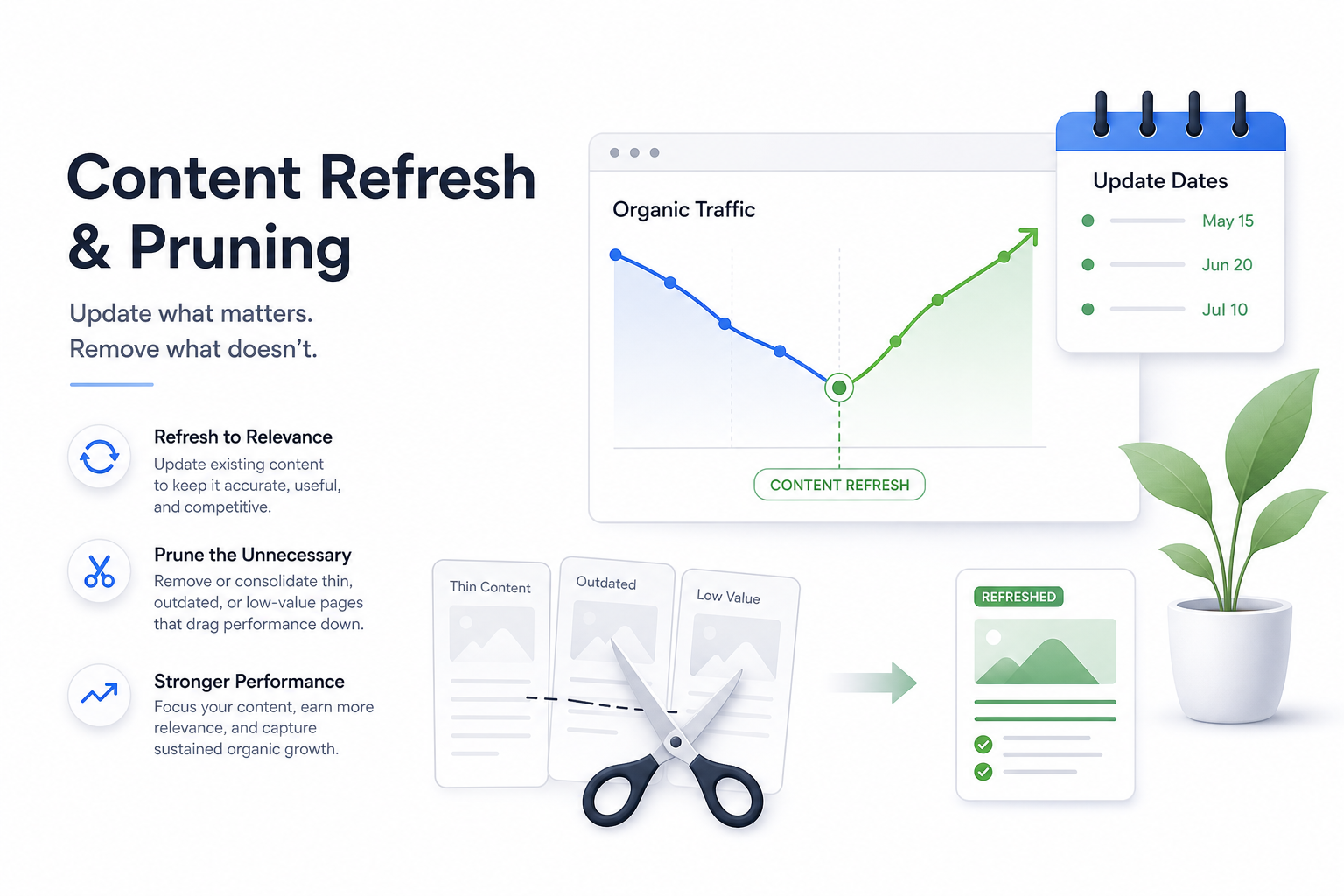
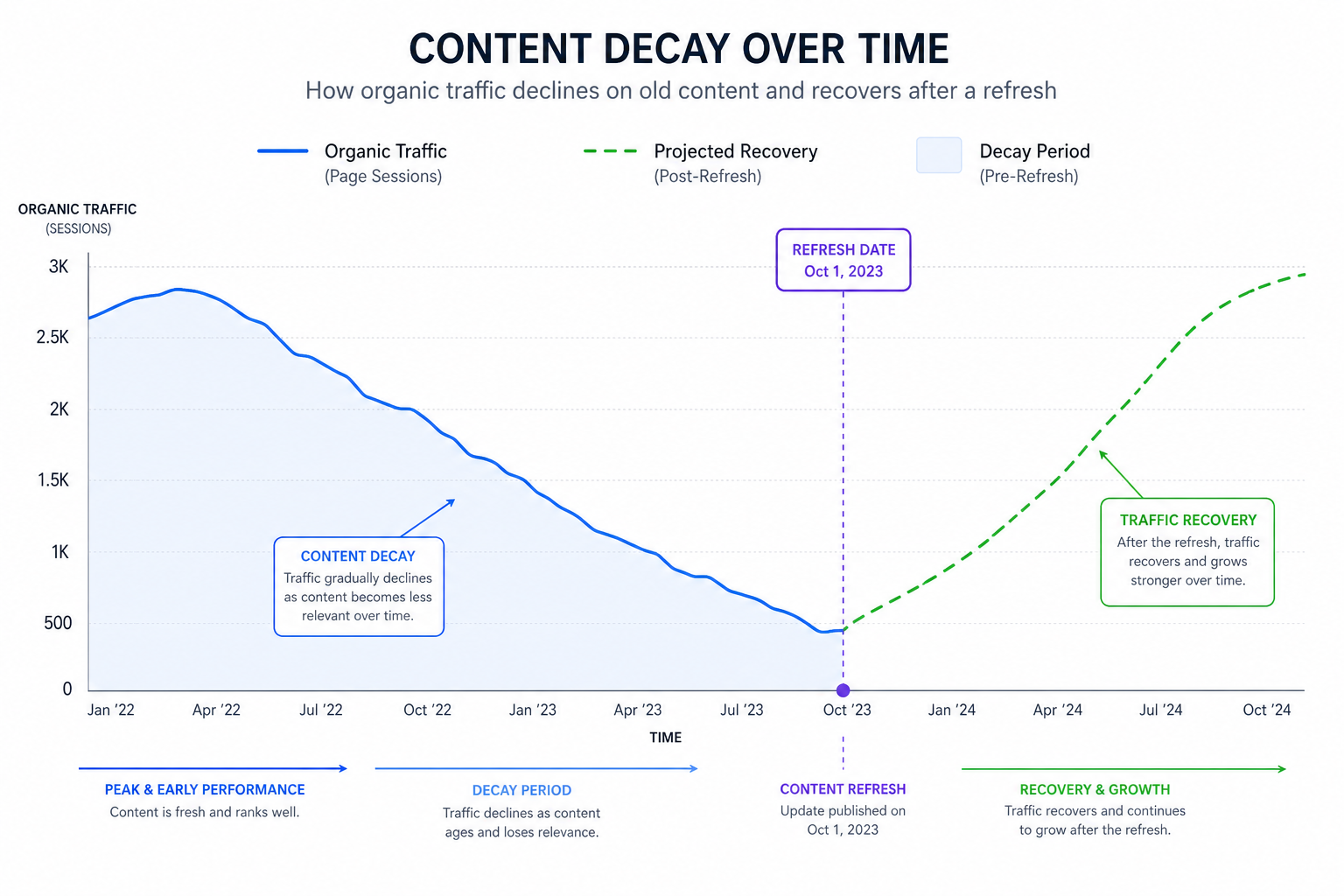
Content decay is a natural phenomenon: an article that ranked well a year ago gradually loses positions because competitors publish fresher, deeper content, Google’s algorithm weights freshness in certain queries, and outdated facts weaken trust.
Decay does not mean the content is bad — it means it is relatively weaker than before. A refresh often restores competitiveness faster than creating a new article.
Operational SEO is exactly this: systematic monitoring, prioritization, and maintenance — not just new content production.
Why refresh beats a new article
Why content refresh pays off
New content production is expensive. Updating existing content often delivers better ROI: same URL, existing links, faster impact.
Google values freshness and accuracy — especially in fast-moving fields (SEO, tech, regulation). Updated dateModified and genuinely renewed content signal activity.
Pruning (removing weak content) improves overall site quality: less thin content, better crawl efficiency.
- Better ROI than new content alone
- Keeps URL and backlinks
- Improves overall site quality
- Supports pillar structure in content strategy
Spotting content decay
Signs: falling organic traffic to the article (Analytics), ranking drops (Search Console), outdated years and stats in the text, newer competitor articles in the SERP.
Run a monthly report: top 50 articles by traffic change. Articles with > 20 % drop over a year are refresh candidates.
Separate seasonal dips from permanent decay — compare multiple years if data exists.
Refresh vs new content vs pruning
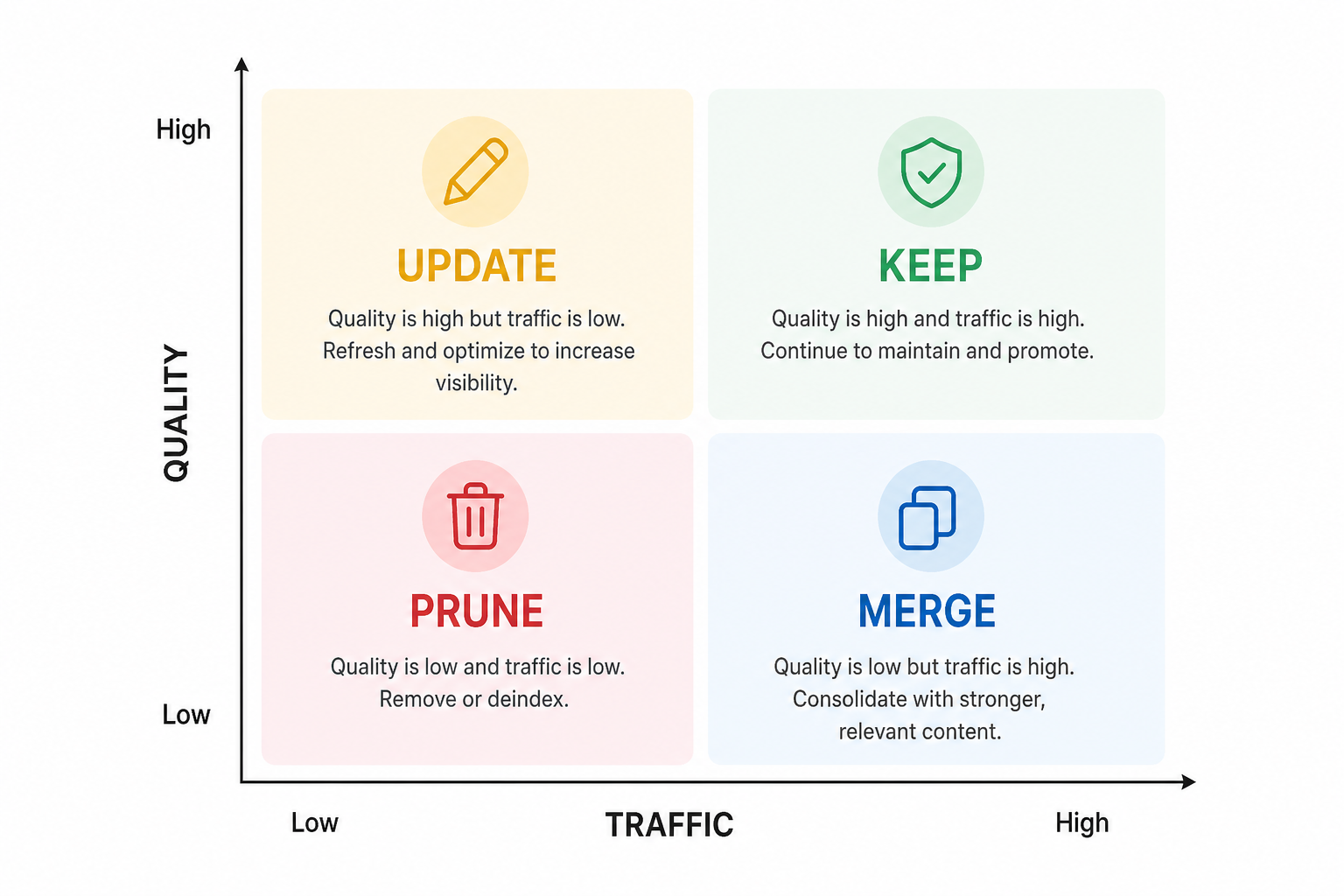
Refresh: update facts, add sections, improve headings, add internal links, update images. Keep the URL and update dateModified.
New content: the topic changed so much the old article no longer fits — create new, 301 from old to new, or merge.
Pruning: thin, overlapping, or irrelevant content is removed (410/404) or merged into a stronger article with 301.
Pruning — when to remove content
Prune when: the article is cannibalized by a stronger one, drives no traffic or business value, is factually wrong and not worth fixing, or hurts overall site quality.
Do not prune on impulse — check GSC: does the page still have long-tail traffic or valuable backlinks?
Prefer 301 merge into a stronger article over deletion — signal transfers, it does not vanish.
GSC tip
dateModified and freshness signals
Update dateModified only when content genuinely changes significantly — not just a date swap. Article schema and sitemap lastmod support the signal.
Show readers an "Updated" date when relevant (facts, regulation). Do not hide the original datePublished — it is part of trust.
Google does not automatically penalize fake refreshes, but users and the algorithm notice if content does not change.
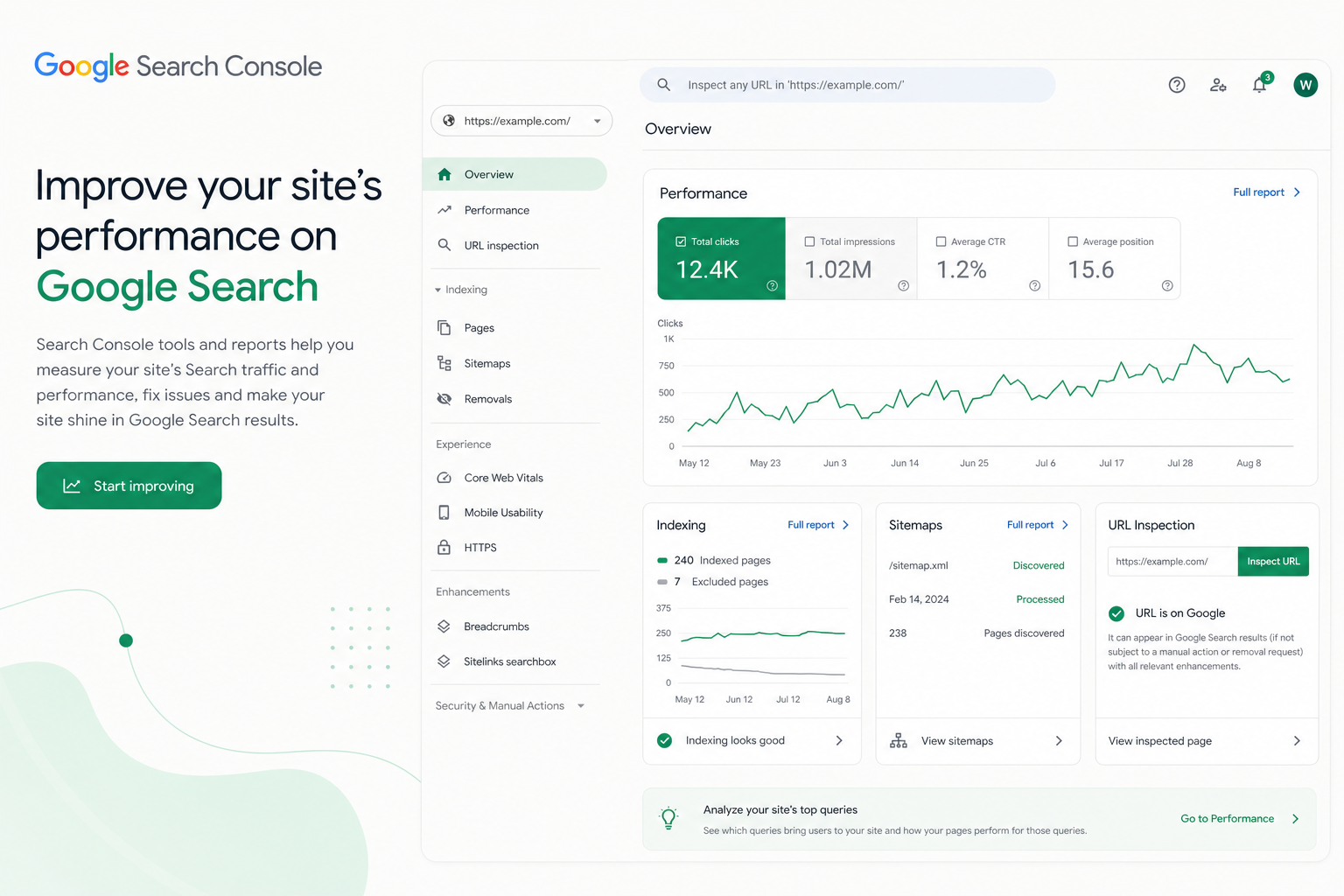
GSC signals for prioritization
Performance report: impressions up, CTR down — title/meta need an update. Rankings down, impressions down — content decay.
Indexing: "Crawled – currently not indexed" or rarely crawled pages may be prune candidates if traffic is zero.
Combine GSC with Analytics: which articles used to drive leads but no longer do?
Update process in practice
Quarterly: list decay candidates, prioritize with the matrix, assign owners, update or prune, document changes.
Per-article refresh checklist: fact check, new sections, internal links, FAQ, schema dateModified, re-index in GSC.
Integrate with content strategy — refresh maintains pillars, pruning cleans the cluster.
Most common errors
Fake refresh: date change only with no content update.
Pruning without 301 — lost backlinks.
New article on the same topic without cannibalization check.
Decay ignored: all resources on new content, no maintenance of old.
Content refresh in numbers
Summary and next steps
Content decay is normal — systematic refresh and pruning keep your library competitive. Use GSC to prioritize, update dateModified honestly, and prune with 301.
Next, integrate the process into content strategy. Need help? Our SEO service.
Content refresh checklist
Run this list in quarterly audits for each refresh candidate.
- GSC: falling rankings and impressions listed
- Prioritize high traffic + decay
- Refresh: facts, sections, links, FAQ
- dateModified only for real updates
- Prune: 301 to stronger article
- Request re-indexing in GSC
- Document changes for the next cycle
Frequently asked questions
What does content decay mean?
Content decay is when old content gradually loses rankings and traffic over time due to competition, freshness, and outdated information.
Update or create a new article?
Prefer a refresh if the URL has value (links, indexing). New content only if the topic changed radically — otherwise 301 from old to new.
What is content pruning?
Pruning means removing or merging weak, overlapping, or irrelevant content into a stronger article with 301.
Should dateModified always be updated?
Only when content genuinely changes significantly. A date swap without changes does not help and can hurt trust.
How do I prioritize updates?
Use GSC: high impressions + falling rankings = first. Combine with Analytics traffic and business value.