Why on-page SEO still matters in 2026
On-page SEO is the part of search optimization you fully control. Unlike link building or algorithm updates, your page content and structure are entirely in your hands.
In 2026, search engines do not just read keywords — they understand context, search intent, and content quality. Good on-page optimization helps both Google and AI search engines interpret what your page is about.
The same optimization serves two goals: better organic rankings and a higher chance of being cited in AI answers. Read about the difference in our SEO vs GEO article.
This guide moves element by element: from title to heading structure, content to internal links, and finally E-E-A-T signals. At the end you get a concrete checklist for every page.
On-page is the foundation
Title tags — the single most important element
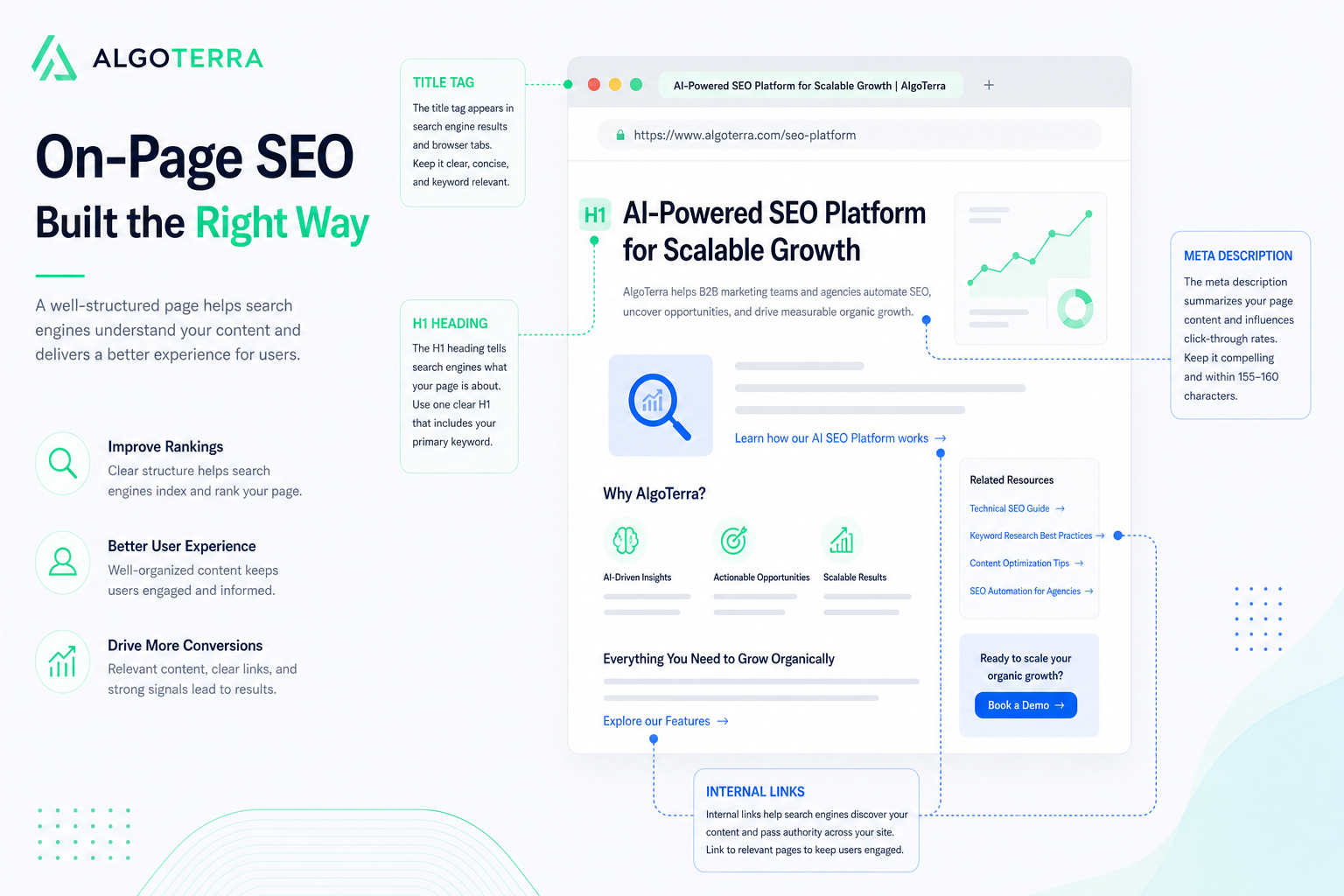
The title tag is still one of the strongest on-page signals and what users see as the headline in search results. It directly affects click-through rate.
Keep the title under 60 characters so it does not get truncated in results. Put the most important keyword first and the brand at the end with a separator.
Every page title is unique. Duplicates confuse Google and waste clicks — especially in e-commerce and service sites.
- Length under 60 characters — avoid truncation in results
- Main keyword first, brand last (e.g. "Keyword — Brand")
- Unique for every page — no duplicates
- Match search intent, do not keyword-stuff
- Compelling: a promise or benefit lifts click-through
Meta descriptions — the click magnet
The meta description is not a direct ranking factor, but it affects click-through rate — and CTR indirectly affects rankings. A good description sells the click.
Keep the description at 150–160 characters, include the keyword naturally, and end with a call to action. If you leave it empty, Google generates one itself — often worse.
Write a unique description for every important page that says exactly what users get when they click. Avoid generic sentences that could fit any page.
- Length 150–160 characters
- Keyword included naturally (shows bold in search)
- Clear promise or benefit + call to action
- Unique for every page
Heading structure (H1–H6) — the page skeleton
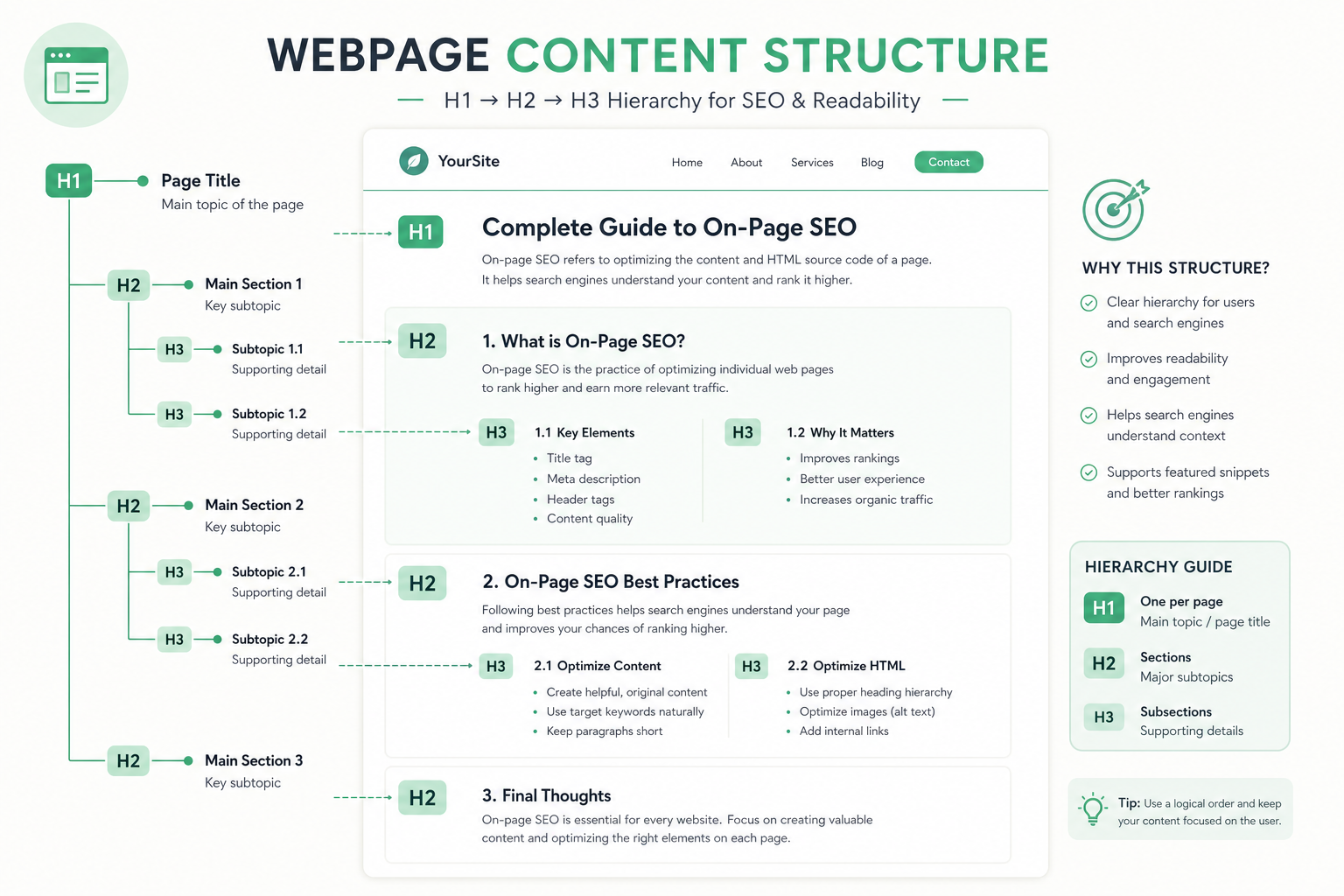
Headings build the page hierarchy for both readers and search engines. A clear structure helps AI search engines pull answers directly from subheadings.
Use exactly one H1 per page — it is the page main topic. Split content into logical H2 sections and use H3 for sub-points.
Do not skip levels (H2 straight to H4) or use headings purely for styling. A heading should always describe the section that follows.
- One H1 per page = the page main topic
- H2 splits main sections, H3 sub-points — do not skip levels
- Place keywords and synonyms in headings naturally
- Question-style H2s help AI answers and FAQ extraction
Content optimization — quality and coverage
Content is the core of on-page SEO. Google and AI search engines reward pages that answer search intent comprehensively and in depth.
Start from search intent: what does the user really want to know? Answer the main question right away and cover related sub-questions in subheadings. Read keyword research and search intent.
Use short paragraphs, lists, and tables to improve scannability. AI search engines most easily extract concise, well-structured answers.
Add related terms and synonyms naturally — do not repeat the same keyword artificially. Semantic coverage beats keyword density.
- Answer search intent — do not write off-topic
- Key answer up top: AI extracts it first
- Short paragraphs (2–3 sentences), lists, and tables
- Semantic coverage: related terms and synonyms
- Update old content — freshness is a signal
Content tip
On-page internal links — context and navigation
Internal links guide both users and search engines to related content and distribute page authority across the site. They are an underrated on-page tool.
Use descriptive anchor text that says where the link goes — not "read more" but for example "technical SEO guide". Link to thematically related pages that deepen the topic.
A deeper internal linking architecture (hub-spoke, anchor text strategy) is its own topic — read our internal linking guide. Here we focus on links within the page.
- Descriptive anchor text, not "click here"
- Link to thematically related pages
- 3–8 internal links per long piece is a good baseline
- Steer authority to your key conversion and pillar pages
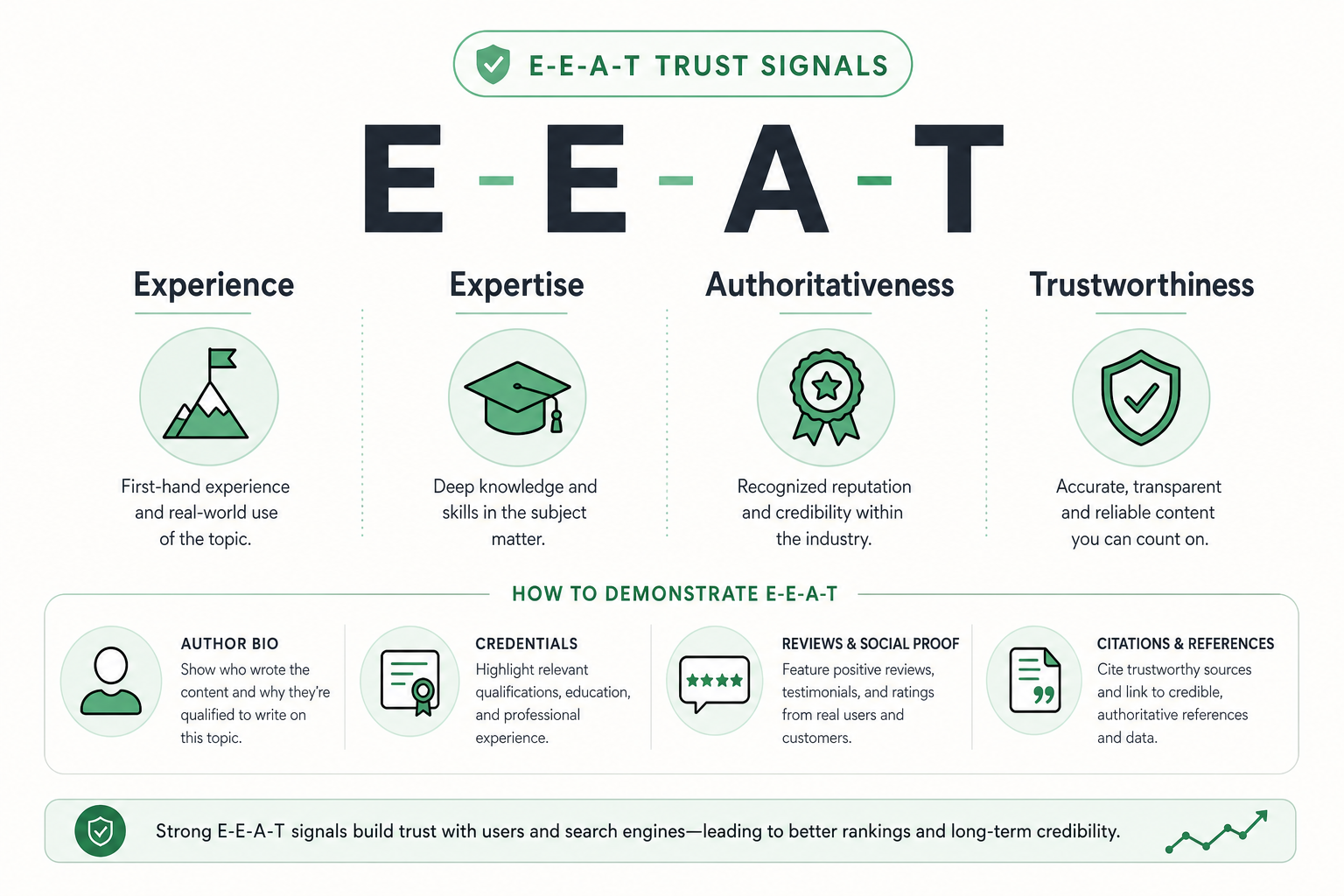
E-E-A-T — experience, expertise, authority, trust
E-E-A-T (Experience, Expertise, Authoritativeness, Trustworthiness) is Google quality evaluation framework, which matters especially in YMYL topics (health, money, safety).
Show genuine experience: first-hand examples, data, images, and concrete cases. AI search engines and Google value content that proves the author knows the topic.
Add clear author attribution, an expert bio, and source citations. Keep content up to date and fix errors — trust is built on consistency.
- Experience: first-hand experience, your own data and examples
- Expertise: show author credentials (bio, attribution)
- Authoritativeness: sources, citations, external recognition
- Trustworthiness: contact info, security (HTTPS), transparency
URL, images, and structured data
The URL is an underrated on-page signal. A short, descriptive URL that includes the keyword helps both users and search engines grasp what the page is about.
Avoid long parameter chains and unnecessary numbers. Use hyphens to separate words and keep the structure logical: /services/seo is clearer than /page?id=482.
Image optimization is part of on-page basics. Add descriptive alt text to every image, compress file size, and use a modern format for page speed.
Structured data (schema) helps search engines understand the content type: article, product, FAQ, or review. It can produce rich results and improve visibility.
These technical on-page elements complement the content. The deeper technical side is in our technical SEO guide.
- Short, descriptive URL with the keyword — hyphens as separators
- Avoid parameters and unnecessary numbers in the URL
- Descriptive alt text and compressed file size for images
- Structured data (schema): article, FAQ, product
- Modern image format and lazy-load for speed
On-page optimization impact in numbers
Measuring success
On-page optimization success is measured by a few key metrics. The most important source is Google Search Console, which shows impressions, clicks, CTR, and average position per query.
Track whether rankings and click-through rate rise after optimization. If impressions grow but clicks do not, the title and meta description need improvement.
Also watch time on page and bounce rate. They indicate whether the content answers search intent — a core on-page goal.
Measure changes patiently: edit one element at a time and track the impact for 4–8 weeks. This is how you learn what actually moves rankings.
Connect on-page metrics to the bigger picture from a SEO vs GEO perspective — the same content also serves AI search.
- Search Console: impressions, clicks, CTR, position
- Ranking and CTR development after optimization
- Time on page and bounce rate
- Change one element at a time, track 4–8 weeks
On-page SEO checklist for every page
Run through this list before you publish or update a page. It covers the critical on-page elements in order.
Once the foundation is solid, move on to technical SEO and content strategy. Need help? Explore our SEO service.
- Unique title under 60 characters with the main keyword
- Compelling 150–160 character meta description
- One H1, logical H2/H3 hierarchy
- Content answers search intent, answer-first structure
- Descriptive internal links to related pages
- E-E-A-T signals: author, sources, update date
- Alt text on images, short and descriptive URL
Frequently asked questions
What does on-page SEO mean?
On-page SEO means all optimization done on the page: title tags, meta descriptions, heading structure, content, internal links, and E-E-A-T signals. It is the part of search optimization you fully control.
How long should a title tag be?
Keep the title under 60 characters so it does not get truncated in search results. Put the most important keyword first and the brand at the end. Every page title should be unique.
Does the meta description affect rankings?
The meta description is not a direct ranking factor, but it affects click-through rate (CTR), which indirectly affects rankings. A good, unique description at 150–160 characters attracts clicks.
What is E-E-A-T and why does it matter?
E-E-A-T stands for Experience, Expertise, Authoritativeness, and Trustworthiness. It is Google quality evaluation framework, important in YMYL topics. Show genuine experience, author credentials, and sources.
How many H1 headings should a page have?
Use exactly one H1 per page — it is the page main topic. Split the rest of the content into H2 and H3 levels as a logical hierarchy and do not skip levels.