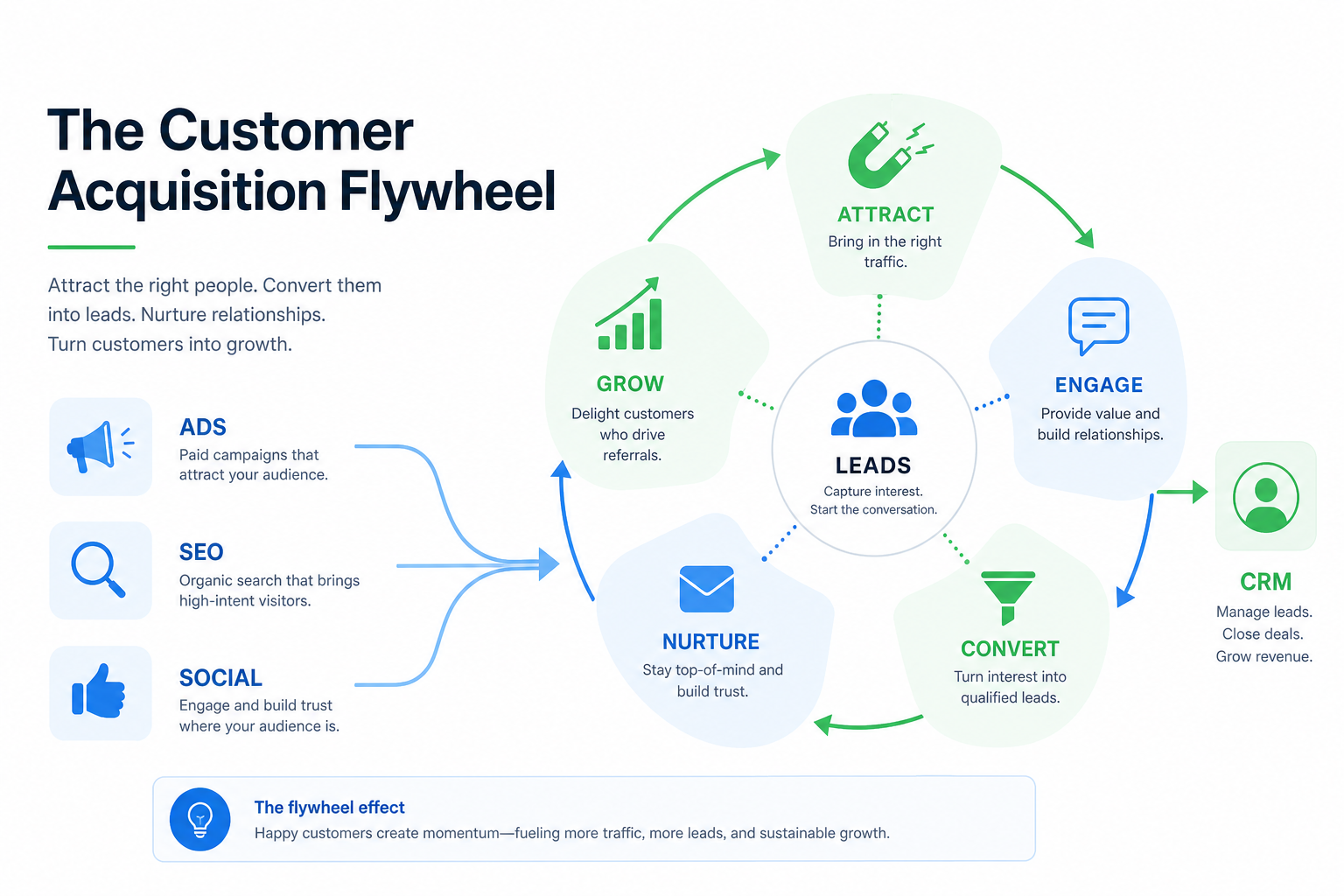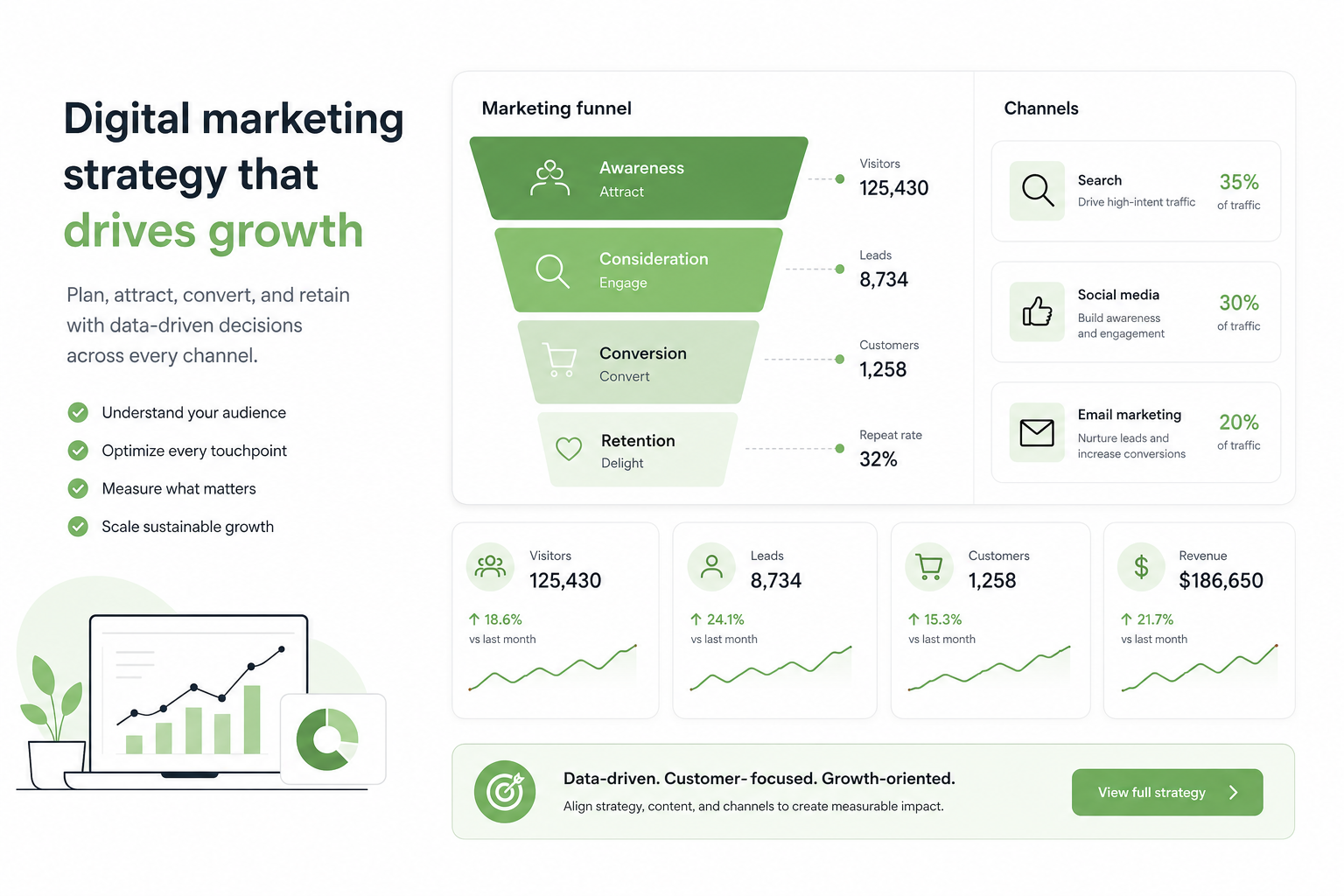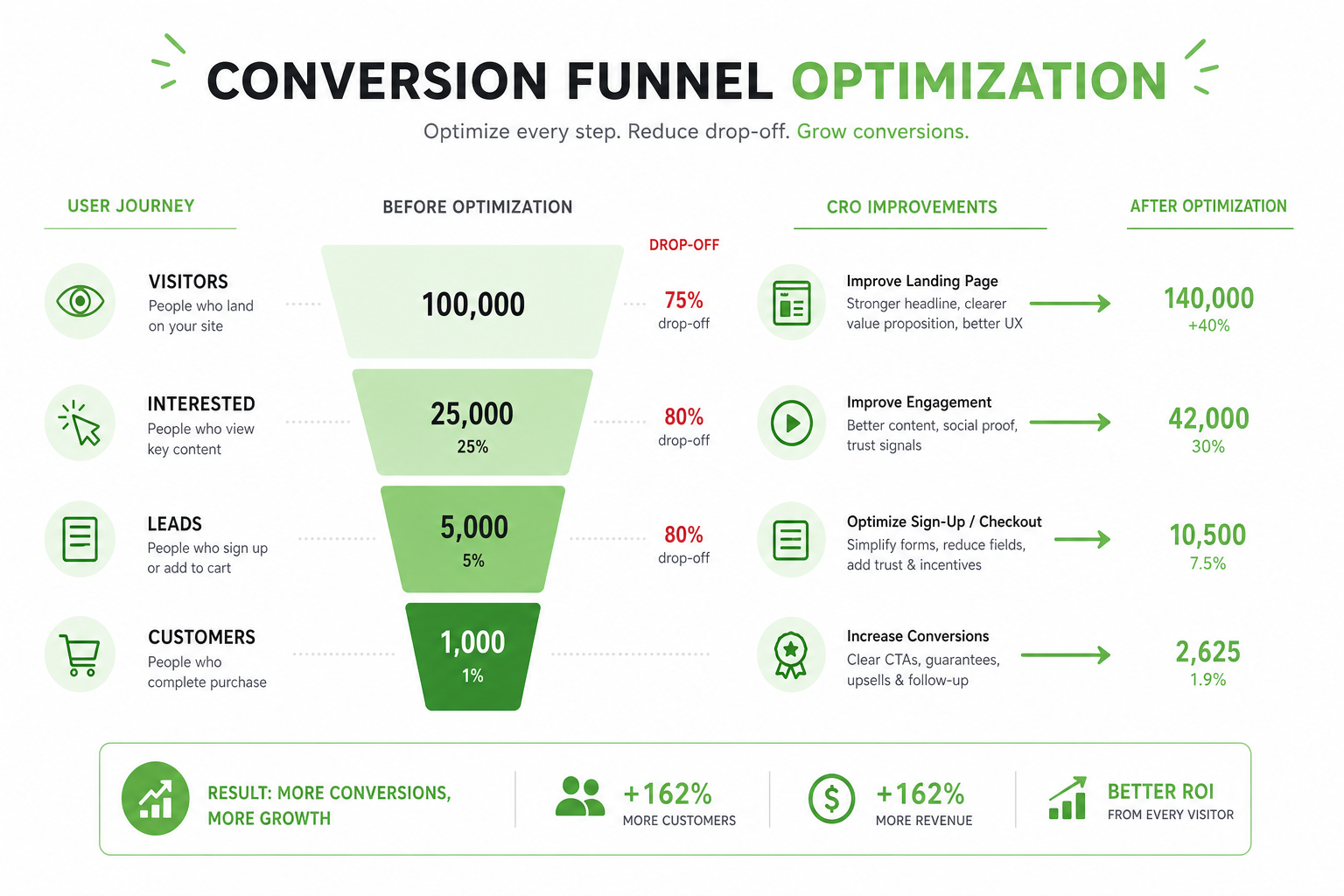
Funnel stages: awareness to conversion
Conversion funnel splits into three stages: awareness (Meta, Display, content), consideration (SEO, retarget, email, comparison), and decision (Search, landing, demo/purchase). Each stage has different metrics and optimization.
Map spend to stage: over-investing in awareness when decision-stage conversion is broken inflates CAC. Stage-level dashboards show where the next euro earns the highest incremental conversion.
Same user passes multiple stages — attribution shows where the bottleneck is. If traffic arrives but conversion does not, the problem is often landing or tracking — not ads alone.
Qualitative research complements funnel data: five user interviews on why they abandoned cart often explain a 40% drop better than heatmaps alone. Schedule interviews when a stage stalls for two consecutive months.
Channel roles in funnel: Meta opens, SEO reinforces, Search converts. See strategy for channel mix.
Funnel metrics differ by stage: awareness (reach, CPM, video view rate), consideration (time on site, pages per session, email signups), decision (conversion rate, CAC, revenue). Optimizing awareness metrics on a decision-stage problem wastes budget.
B2B funnels add MQL and SQL stages between landing and revenue — map content and retarget to each. B2C funnels often compress to product view, cart, and purchase — optimize checkout before top-of-funnel video.
Finding bottlenecks with data
Bottleneck is the stage where most drop off: high bounce on landing, low email open, cart abandonment. GA4 funnel report and per-channel conversion reveal the spot.
Measure step by step: impressions → clicks → landing views → form start → conversion. Where is the biggest drop-off? That gets CRO.
Compare channels fairly: Search often converts better than Display — but Display opens the path. Compare by funnel stage, not apples to oranges.
Session recordings and form analytics reveal why drop-off happens — not just where. High bounce on mobile may be speed or layout; low form completion may be too many fields or missing trust signals.
Cohort analysis by traffic source: users from Meta may convert on visit 3 via Search — single-session funnel reports undervalue upper funnel. Use GA4 path exploration and assisted conversions alongside step funnels.
- GA4 funnel: impressions → conversion
- Drop-off point = bottleneck
- Per-channel conversion separately
- One fix at a time
CRO and A/B testing
Conversion Rate Optimization (CRO) improves conversion rate without extra traffic — headline, CTA, form, social proof, speed. Small gains scale to large impact.
Test systematically: hypothesis → change → measure → learn. One variable at a time. Need enough traffic (e.g. 1000+ landing visitors/month) for reliable tests.
Quick wins: clearer CTA, shorter form, page speed, mobile optimization. Then A/B headline and hero.
Prioritize tests by ICE (impact, confidence, ease): a headline test on high-traffic landing beats a footer colour test. Document learnings in a shared log so paid and web teams do not repeat failed variants.
Statistical significance matters: stop tests early on noise and you reverse winners. Use minimum sample size calculators; if traffic is low, run sequential tests or focus on meaningful UX fixes instead of micro A/B splits.
Exit-intent and on-site surveys on high-traffic pages capture objections quantitative funnels miss — "too expensive," "need more info," or "wrong product variant" become the next CRO test queue.
Landing pages and message continuity
Landing is the funnel's critical point — ad promise and page message aligned. B2B: one clear CTA (demo, download), proof, FAQ. B2C: product, price, trust, fast checkout.
Message continuity: ad headline = landing headline. Different message = high bounce. Landing page conversion article goes deeper.
Mobile first: over half of traffic from mobile — form and CTA work with thumb.
Social proof near CTA lifts B2B conversion: logos, review score, or "used by X companies in your industry." B2C needs shipping, returns, and payment trust badges above the fold on product and checkout pages.
Single-purpose landing pages beat homepage sends for paid traffic: one offer, one CTA, no navigation clutter. Homepage conversion rate is a misleading metric when ads point to dedicated landings.

Tracking in the funnel
Tracking connects channels to funnel: UTM tags, GA4 events (view, form_start, conversion), ad platform conversion import. Without tracking you do not know which channel produces conversions.
Micro-conversions: form start, video view, PDF download — predict macro conversion. Retarget micro-converters.
AlgoTerra Full Stack optimizes the full path: ads, landing, tracking. Free audit maps funnel bottlenecks.
Enhanced conversions and server-side tracking recover data lost to browser restrictions — implement before major CRO tests so you trust the numbers. Funnel optimization without reliable tracking optimizes noise.
We align ad copy, landing headline, and thank-you/next step in one CRO sprint — message continuity from click to conversion, not isolated page tweaks.
Thank-you and confirmation pages are underrated funnel stages: upsell, survey, and calendar booking on B2B thank-you pages recover value from visitors who already converted.
Common funnel mistakes
We see these in audits — traffic grows while conversion rate flatlines and CAC climbs every quarter. Fix the bottleneck before the next media increase.
- Traffic without CRO → high CAC
- Different message in ad and landing → bounce
- No tracking → optimize by guesswork
- All stages at once → do not learn what worked
- Mobile worse than desktop → lost conversion
Frequently asked questions
What is a conversion funnel?
Journey from awareness to conversion: awareness → consideration → decision. Each stage has channels and metrics.
How do I find the bottleneck?
GA4 funnel, drop-off point. Per-channel conversion. One fix at a time.
What is CRO?
Conversion Rate Optimization — improves conversion rate with headline, CTA, form, speed. A/B testing.
Why is landing important?
Critical point — ad promise and page message aligned. Message match lowers bounce.
How does AlgoTerra help with funnel?
A free audit maps bottlenecks. Full Stack optimizes ads, landing, and tracking.