What is an FAQ page in a GEO context?
An FAQ page (Frequently Asked Questions) is a structured collection of question-answer pairs that address real customer questions. In traditional SEO, an FAQ page serves the user and can earn rich snippets. In a GEO context, an FAQ page is something more: it is pre-segmented information that generative search engines can pull directly into their syntheses without interpretation.
Generative search engines — ChatGPT, Perplexity, Google AI Overviews, Copilot — answer questions by composing information from multiple sources. When a source is already formatted as question-answer, the model's job gets easier: it identifies the question, finds the answer, and cites the source. An FAQ page is therefore GEO's natural content format, not just an SEO add-on.
In a GEO strategy, think of FAQ pages on three levels: FAQ sections at the end of articles (4–6 questions), topic-specific FAQ pages (e.g. pricing, delivery, technical support), and a comprehensive brand FAQ. Each level serves different search intents, but the principle is the same: answer the question directly, mark it up with schema, and keep content current. The GEO service helps prioritize FAQ pages and test their visibility in AI search.
The difference from a traditional support page is intent: an FAQ page is built for search engines and AI, not just to ease customer support. Each Q&A pair maps to a specific query, and when the answer is deep and authoritative enough, it competes directly in generative search syntheses. That makes FAQ pages a GEO strategy priority — not a side product.
In practice, each Q&A pair on an FAQ page is a mini-article: the question is the heading, the answer is the lead paragraph plus supporting detail. Built this way, FAQ pages serve three goals simultaneously: customer support, traditional SEO, and GEO citability. Few other content formats offer the same triple benefit.
Why does Q&A structure work in AI search?
AI search engines do not read content like humans do. They parse HTML and text looking for clear signals: headings, lists, definitions, and especially question-answer pairs. Q&A structure provides these signals ready-made — the question is explicit, the answer is a separate block, and both are semantically linked.
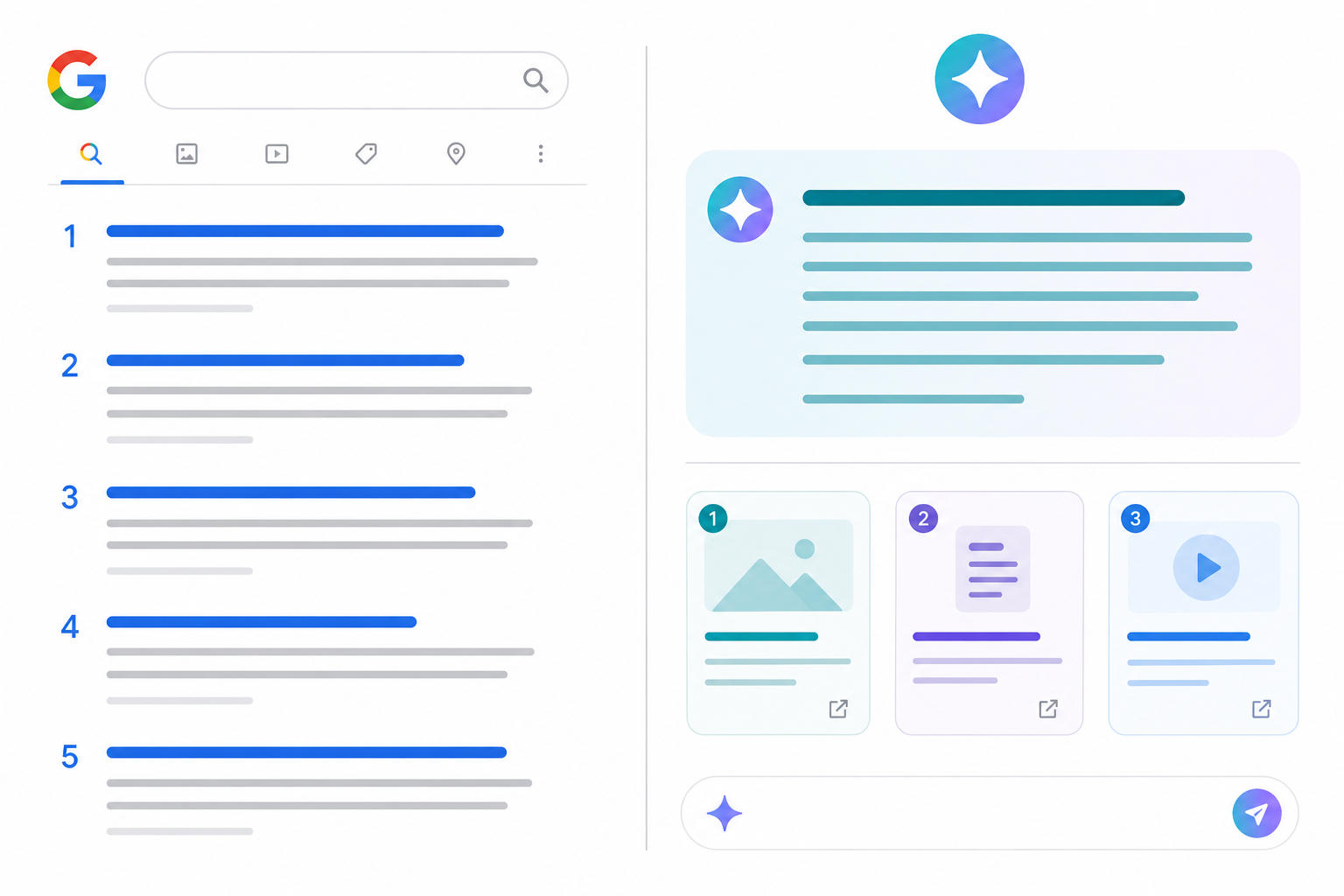
Search engines have used People Also Ask for years — essentially Google's own FAQ UI. AI Overviews takes the same logic further: it does not just show Q&A pairs but composes a synthesis from them. An FAQ page already in Q&A format is optimal raw material for that process.
This differs from a traditional article where the answer is buried in paragraphs. The model must interpret which sentence answers the question. In FAQ structure, interpretation is unnecessary: the question is in an H3 or schema field, the answer follows immediately. Citability improves significantly, as covered in detail in the AI-citable content guide.
Q&A structure also works for humans: a busy user scans questions and opens only the relevant answer. Accordion UI compresses the page without losing content from the index (when implemented correctly). Human and machine needs align on FAQ pages — a rare case where SEO, GEO, and UX support each other.
Research and practical GEO project findings confirm the same: pages with clear FAQ structure and FAQPage schema get cited 2–3 times more often than equivalent articles without Q&A formatting. The reason is not schema alone but that Q&A makes extraction easy — schema only strengthens the signal.
FAQPage schema in practice
FAQPage is a schema.org type that marks a page as question-answer content. Google and other search engines use it for rich snippets, but in a GEO context its value is deeper: schema makes the Q&A structure machine-readable without HTML interpretation.
Schema.org FAQPage has existed for years, but GEO has raised its importance to a new level. Perplexity and ChatGPT do not currently use schema in crawling the same way Google does, but clear Q&A HTML combined with FAQPage schema creates the best possible signal for all AI search engines.
Basic FAQPage structure includes a mainEntity array where each item is a Question type. Question contains a name field (the question) and an acceptedAnswer object whose text field is the answer. The answer can be HTML, but keep it concise — long answers in schema fields can cause validation errors.
Combine FAQPage with other schema types: Organization defines the brand, WebPage or Article provides FAQ page context, and BreadcrumbList navigation. With @id references you build a knowledge graph where FAQ connects to brand and topic. This supports both E-E-A-T signals and AI's ability to link answers to the right source.
Practical JSON-LD example: in FAQPage mainEntity, each Question contains a name field and acceptedAnswer.text. Answers can include HTML links but keep them relevant. Google Rich Results Test validates structure — fix errors before publishing. Schema does not guarantee rich snippets but significantly improves GEO citability.
- FAQPage + Question + Answer: base structure for each Q&A pair
- Organization @id: connects FAQ to brand
- Article or WebPage: contextualizes the FAQ page topic
- BreadcrumbList: clarifies the page's place in site structure
- Validate with Rich Results Test before publishing
- Answer in schema field: concise, under 300 words per pair
Accordion vs. open FAQ layout
Accordion (collapse/expand) compresses the FAQ page visually: the user sees questions and opens the answer by clicking. Open layout shows all answers at once. Both work in GEO as long as content is crawlable and indexable.
From a design perspective, accordion improves UX on long FAQ pages: users find the relevant question faster without scrolling through all answers. Open layout works better for short FAQ pages and when you want maximum "all answers visible" signal. In both cases FAQPage schema is decisive — it ensures Q&A structure is machine-readable regardless of UI.
The accordion risk is hiding: if the answer appears in the DOM only after JavaScript or is hidden with display:none without a crawlable fallback, search bots may not see it. Solution: render answers in HTML on the server (SSR) or ensure content is in the DOM at load time — hiding with CSS only (visibility, max-height) is usually safe.
Open layout is simplest for GEO: all Q&A pairs are visible directly. It suits short FAQ pages (5–10 questions). Accordion scales better for long FAQ pages (20+ questions) without scroll fatigue. Choose by structure, but always test with Google Search Console URL Inspection that all answers are indexed.
Accordion implementation checklist: (1) answers render via SSR or static HTML; (2) FAQPage schema includes all Q&A pairs regardless of UI state; (3) URL Inspection shows all answers in "Rendered HTML"; (4) page works without JavaScript or uses progressive enhancement. These four checks make accordion GEO-safe.
FAQ page content strategy
A good FAQ page comes from real questions, not marketing copy. Collect questions from customer support, sales, Search Console (People Also Ask), AI search tests, and competitor FAQ pages. Prioritize questions where your brand can give an authoritative, concrete answer.
Avoid the "fake FAQ" trap: questions where the answer is always "contact us" or "read more on our blog" deliver no GEO value. Each Q&A pair is a standalone answer suitable for AI citation. If you cannot answer directly, leave it out of the FAQ and cover it in an article.
Each answer follows the inverted pyramid model: a direct, concise answer in the first sentence, reasoning and details after. Avoid "contact us" answers for GEO-critical questions — they offer nothing extractable. If an answer requires contact, still give a concrete partial answer before the CTA.
Update FAQ pages regularly: an outdated FAQ is worse than no FAQ. Mark dateModified in schema and visibly on the page. When product, price, or process changes, update the answer immediately. Freshness is a GEO signal especially in fast-moving topics.
Three-phase content strategy: (1) collect 30–50 raw questions from support, sales, and search data; (2) prioritize 15–20 where you can give the best answer in your industry; (3) write answers using inverted pyramid and publish in phases — start with highest search volume questions. This minimizes effort and maximizes GEO impact quickly.
FAQ and GEO optimization
An FAQ page is the core of GEO optimization, but it does not replace other content. Integrate FAQ into a broader GEO strategy: article FAQ sections, topic-specific FAQ pages, and the brand main FAQ form a network where each page links to relevant articles and services.
Leveraging FAQ for GEO means three actions in practice: (1) convert existing customer questions into FAQ pages; (2) add an FAQ section to every GEO article; (3) test and iterate citability monthly. This cyclical process creates compound effect: each new FAQ strengthens the whole network's GEO visibility.
Link from FAQ pages to deeper content: "Read more about pricing" → pricing page, "How does GEO differ from SEO?" → SEO vs GEO article. Internal links help both users and crawlers understand the topic cluster. They do not directly improve citability, but they build authority.
Test your FAQ pages for GEO visibility: ask ChatGPT, Perplexity, and Google AI Overviews the same questions your FAQ covers. Document whether your brand is cited. If not, analyze why: is the answer too short, is authority missing, or is a competitor's FAQ better structured? Iterate content based on tests.
Internal linking from FAQ pages is part of GEO strategy: each FAQ answer can link to a deeper article, service page, or another FAQ page. This creates a topic cluster where FAQ acts as entry point and deeper content builds authority. Think FAQ network, not a single page.
Technical implementation and crawlability
An FAQ page's technical foundation is the same as other content: the page must load fast, be mobile-friendly, and indexable. Ensure robots.txt or noindex does not block FAQ pages. If you use accordion, test rendered HTML with Google's URL Inspection tool.
Core Web Vitals affect both indexing and UX: a slow FAQ page gets less crawl budget and worse user signals. Optimize LCP, INP, and CLS like any other page. On FAQ pages INP matters especially for accordion implementations — ensure expand/collapse is responsive.
FAQPage schema can be embedded in JSON-LD in the page head or inline script tag. JSON-LD is the recommended approach: it does not mix with visual HTML and is easy to maintain. In dynamic CMS systems, generate schema automatically from FAQ fields — manual maintenance scales poorly.
Also ensure AI crawlers can access FAQ content. Check robots.txt and llms.txt: are you accidentally blocking GPTBot, PerplexityBot, or Google-Extended? The llms.txt guide covers crawler rules and recommended llms.txt structure. An FAQ page is valuable only if crawlers can read it.
In CMS implementations, automate FAQPage schema generation: when a content editor adds a Q&A pair in the CMS, schema generates automatically. Manual JSON-LD maintenance always breaks at scale. Add validation to the publishing workflow — schema errors should not block publishing but must be fixed before the next indexing cycle.
Measurement and tracking
Measuring FAQ page GEO visibility combines traditional SEO data and generative search testing. In Google Search Console, track FAQ page impressions, clicks, and average position. The rich results report shows whether FAQ snippets appear in search results.
Measuring generative visibility is more manual: test 10–20 key questions monthly in ChatGPT, Perplexity, and Google. Document whether your brand is mentioned, in what context, and alongside competitors. Share of Voice (your mentions / all mentions) gives trend direction.
Combine data in a dashboard: GSC traffic to FAQ pages, rich snippet visibility, manual GEO testing, and customer support question volume (FAQ can reduce support requests). If an FAQ page drives traffic but not GEO citations, improve answer depth and authority. If it drives citations but not clicks, check CTAs and internal links.
Monthly FAQ-GEO report: (1) GSC — FAQ page clicks, impressions, CTR, and rich snippet visibility; (2) manual testing — 10 key questions in three AI search engines, Share of Voice; (3) support — new questions not yet covered by FAQ; (4) actions — new Q&A pairs, updates, technical fixes. This four-point cycle keeps FAQ pages GEO-competitive.
Common FAQ page mistakes
These mistakes repeat on FAQ pages and weaken both SEO and GEO visibility. Avoid them from the start.
- Marketing questions without concrete answers → nothing extractable for AI
- Missing or invalid FAQPage schema → structure left to interpretation
- Accordion hides answers from crawlers → content not indexed
- Outdated answers without updates → trust and freshness suffer
- One giant FAQ for all topics → weak focus, hard to cite
- No internal links to deeper content → wasted authority
- Identical Q&A pairs on multiple pages → duplicate content issues
Practical example: FAQ page in a GEO strategy
Imagine a B2B SaaS company getting the same questions weekly: pricing, integrations, security, onboarding, and competitor comparison. The traditional fix would expand the support site. The GEO fix is five topic-specific FAQ pages, each with 8–12 Q&A pairs marked up with FAQPage schema.
Publish order: security FAQ first (highest search intent and authority potential), then pricing, integrations, onboarding, and competitor comparison. Each FAQ page links to relevant blog articles and service pages. Monthly GEO testing tracks Share of Voice change in each category.
After six months, expect: rich snippet visibility on FAQ pages, organic traffic from informational queries, GEO citations in ChatGPT and Perplexity, and fewer repeat support questions. An FAQ page delivers quadruple benefit — support, SEO, GEO, and conversion — when built strategically, not just as a support page.
This pattern repeats across industries: service businesses cover process and pricing, e-commerce covers delivery and returns, expert organizations cover methodology and references. The common denominator is intent: each FAQ answer addresses a question a customer or AI asks before purchase or citation.
Frequently asked questions
Why do FAQ pages work so well in GEO?
FAQ pages provide ready-made question-answer pairs that AI search engines can pull directly into their syntheses. Q&A structure is AI's natural content format — it directly matches how generative search engines answer questions.
Do I need FAQPage schema?
Yes, recommended. FAQPage schema makes Q&A structure machine-readable, supports rich snippets in Google, and helps AI search engines identify question-answer pairs without HTML interpretation.
Does accordion work in GEO?
Yes, as long as answers are crawlable and indexable. Render answers in HTML (SSR) or ensure they are in the DOM at load time. Test with Google Search Console URL Inspection.
How many questions per FAQ page?
4–6 for an article FAQ section, 8–15 for a topic-specific FAQ page, 15–25 for a brand main FAQ. Stay focused: multiple small, topic-specific FAQ pages beat one 100-question mega-page.