Why Search is still the foundation
Even as Performance Max and Demand Gen grow, Search remains the most profitable campaign type for most B2B and service businesses. The user is actively searching — intent is high, and conversion happens closer to the purchase decision than with display or video.
Search gives precise control: keywords, match types, negatives, and ad copy. Smart Bidding optimizes bids from conversion data, but it needs quality inputs: relevant keywords, strong RSAs, and a working landing page.
Search works best alongside other campaign types, not instead of them. Keep separate Search campaigns for brand and purchase keywords — you retain control while PMax expands reach. Without Search, you lose visibility on your most important queries.
Responsive search ads (RSA)
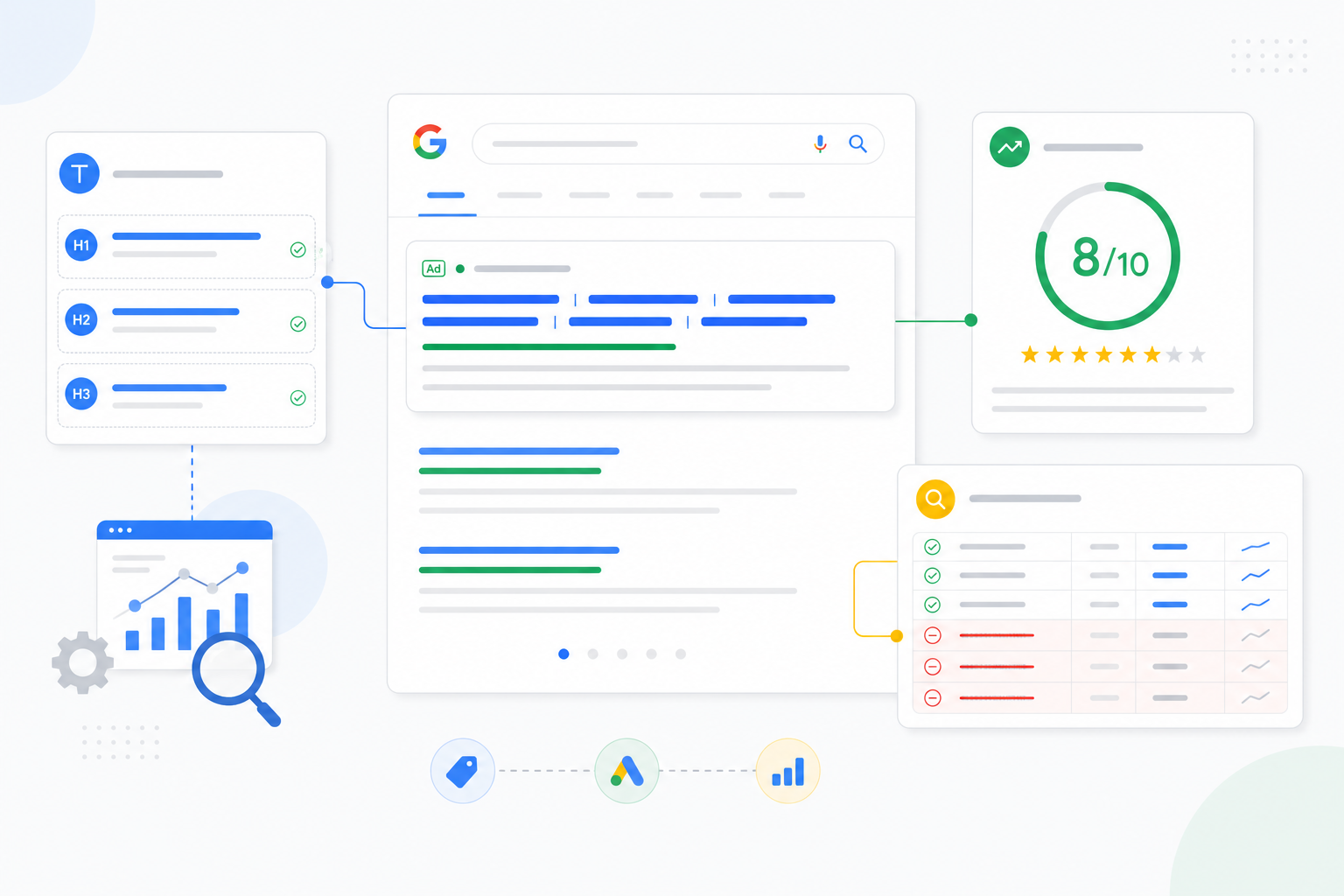
The responsive search ad (RSA) is Search's default format: you supply multiple headlines and descriptions; Google combines them into the best mix for each context. Aim to fill all 15 headlines and 4 descriptions — more options mean better testing.
Split headlines by role: brand, product/service, benefit, call to action (CTA), and differentiators. Use pinning sparingly — too much pinning limits Google's optimization. Test messages and retire weak assets regularly.
Ad extensions (sitelinks, callouts, structured snippets) improve visibility and CTR. They don't fix weak headlines, but a solid extension set makes the ad more competitive in the SERP.
Quality Score and expected CTR
Quality Score reflects three factors: expected click-through rate (CTR), ad relevance, and landing page experience. Scores affect actual CPC and ad rank — a high Quality Score often means cheaper clicks at the same position.
Expected CTR is a historical comparison: how often your ad is clicked vs. others on the same keywords. Improve it with strong headlines, relevant copy, and the right keywords. Ad relevance rises when keyword, ad, and landing page align.
Landing page experience covers speed, mobile usability, and content match to search intent. A weak landing page lowers Quality Score — and conversion. Search optimization isn't ad-side only.
Search terms report and negative keywords
The search terms report shows the actual queries that triggered your ads. It's Search's most important maintenance report: without weekly review, budget leaks to irrelevant queries — especially with broad or phrase match.
Negative keywords block ads on specific terms. Build negative lists systematically: jobs, free, DIY, competitors (if you don't want to pay for them), wrong product categories. Apply negatives at campaign or ad group level as needed.
Match type affects risk: exact match ([keyword]) is tightest, phrase ("keyword") moderate, broad match riskiest. Start tighter and expand only when negatives and conversion data support it.
- Review search terms at least weekly
- Add irrelevant terms as negatives immediately
- Separate brand, generic, and competitor terms into ad groups
- Use broad match only when data supports it
Lead gen vs. ecommerce in Search
In lead gen Search, the goal is a qualified lead: form, call, or demo request. Measure CPA and lead quality — a cheap click isn't enough if CRM conversion is weak. Enhanced Conversions for Leads and offline conversions improve Smart Bidding signals in long B2B sales cycles.
In ecommerce, Search captures purchase queries (product + buy, price, compare). Product and category pages serve as landing pages; brand terms are the cheapest, highest-ROAS source. Shopping and PMax complement, but Search keeps control on top queries.
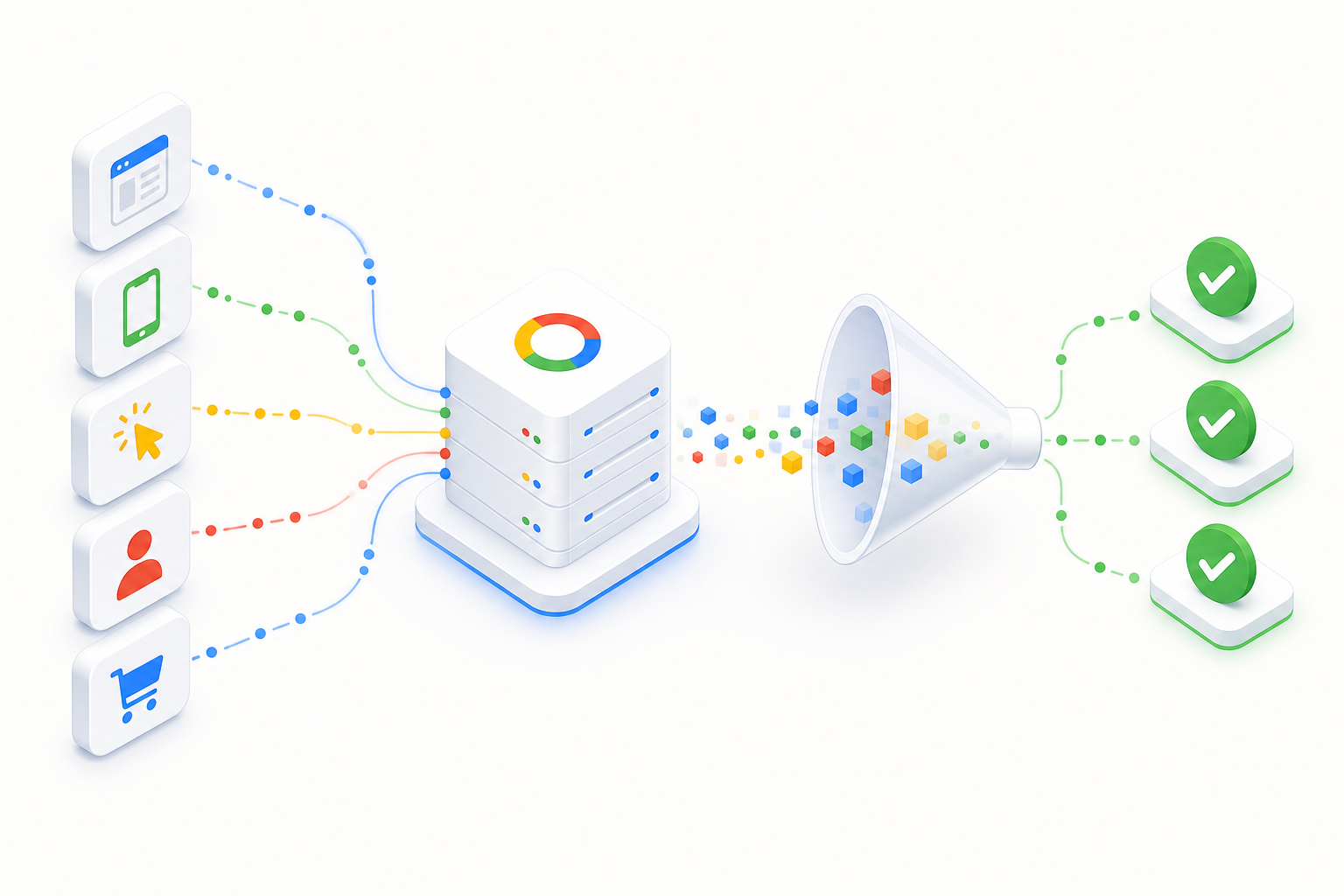
In both models, conversion tracking is mandatory: without reliable data, Smart Bidding optimizes the wrong way. Pair Search with landing page optimization and conversion tracking before scaling budget.
Common Search campaign mistakes
We see these mistakes repeatedly in Search account audits.
- Too few RSA assets → Google can't optimize combinations
- No search term monitoring → budget leaks to junk queries
- All keywords in one ad group → weak relevance and Quality Score
- Landing page doesn't match intent → poor conversion and QS
- Smart Bidding without enough conversion data → the algorithm guesses
- Search replaced by PMax only → lost control on brand and purchase terms
Frequently asked questions
How many RSA headlines should I use?
Fill as close to 15 headlines and 4 descriptions as possible. More unique, relevant options let Google test combinations across queries.
How do I improve Quality Score?
Improve expected CTR with strong headlines, boost relevance with tight ad groups and matching copy, and improve landing page speed and content alignment with search intent.
How often should I review the search terms report?
At least weekly on active accounts. On new campaigns or broad match, even daily in the first weeks so budget doesn't leak to irrelevant queries.
Should I use only Performance Max without Search?
Not recommended. PMax doesn't give the same control on brand and purchase keywords. Best practice: separate Search campaigns for top terms and PMax to expand reach.
Which Smart Bidding strategy fits Search?
Depends on goal and data: Maximize Conversions or Target CPA for lead gen, Target ROAS for ecommerce when you have enough conversions. Reliable conversion tracking is required before the algorithm performs well.