Why is the Meta pixel no longer enough in 2026?
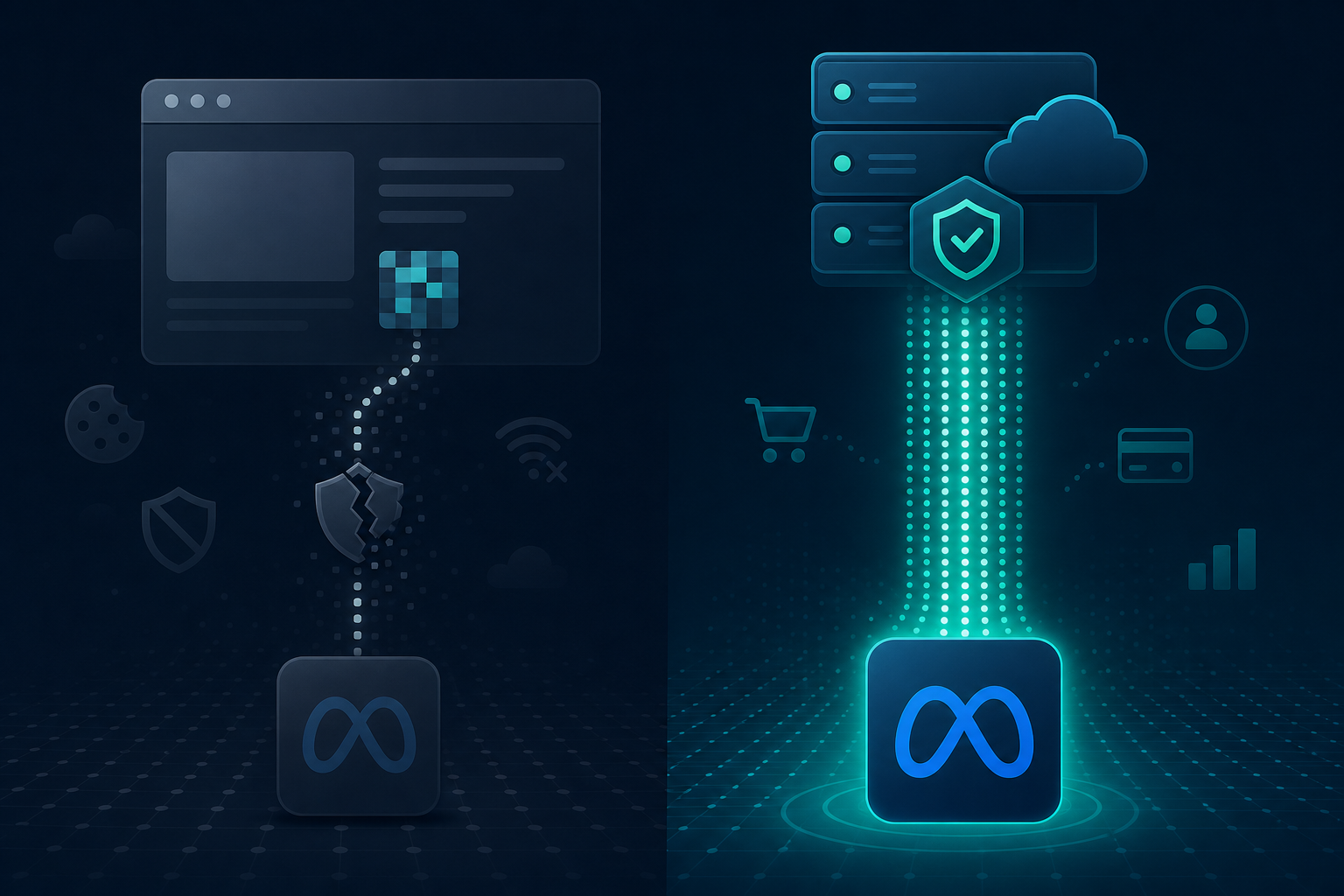
The Meta pixel is client-side tracking code that fires on user actions on your site and sends events to Meta. It is still important — but it is also the most fragile part of the measurement chain. Every browser restriction, ad blocker, and cookie rejection cuts the signal before it reaches Meta.
Since iOS 14.5, ATT (App Tracking Transparency) has significantly limited browser-based tracking. Safari ITP restricts third-party cookies and shortens their lifespan. Ad blockers block pixel scripts directly. Without consent via a cookie banner, the pixel cannot set cookies — and data remains incomplete.
The practical impact is clear: in Meta Events Manager you often see low Event Match Quality, missing conversions, and weakened remarketing audiences. Advantage+ campaigns still optimize — but on incomplete data. Results may look fine in the dashboard, but real optimization falls short.
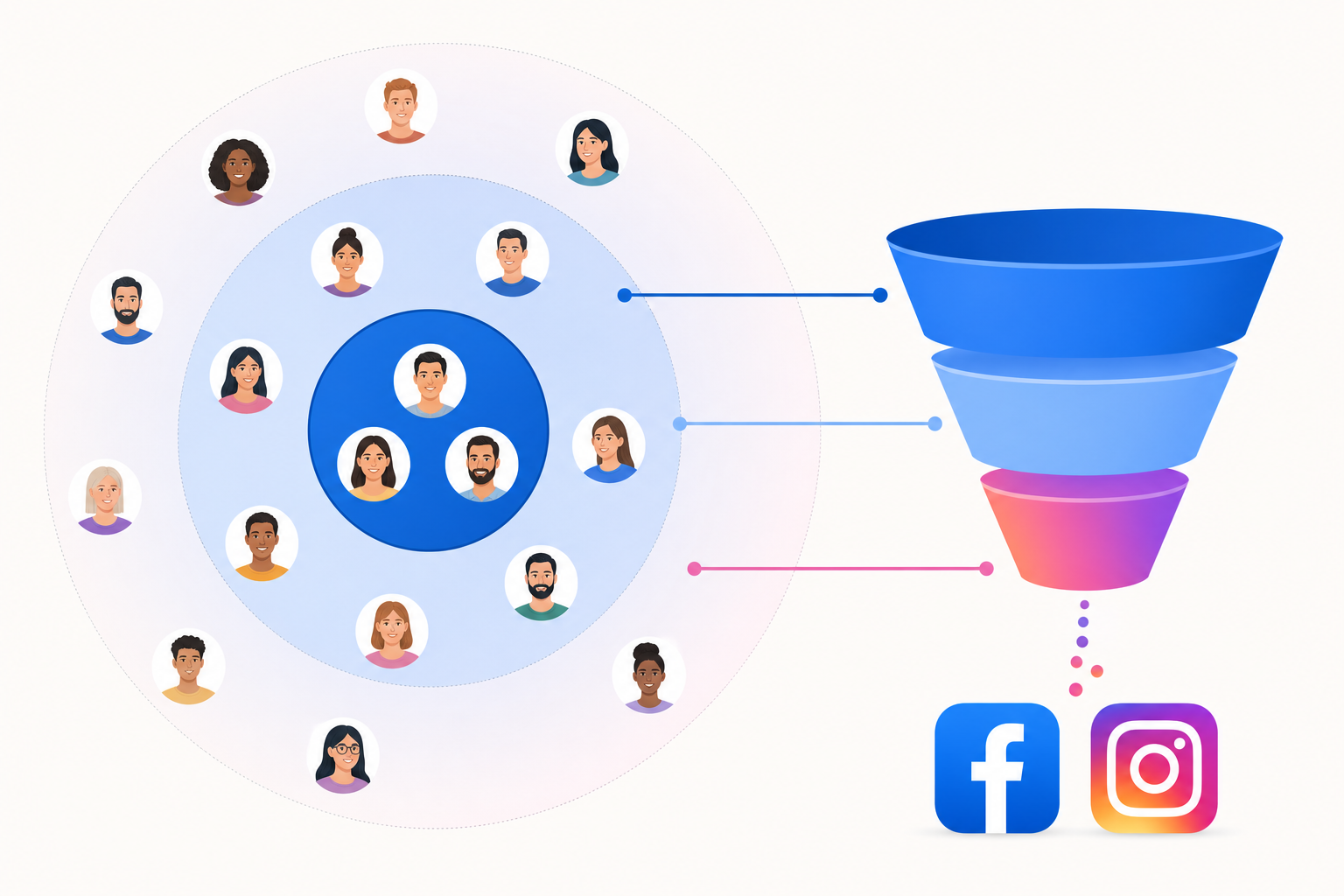
CAPI does not replace the pixel — it supplements it. When both send the same conversion data via different routes, Meta gets a richer signal and the algorithm learns faster. This is especially important in Meta audience strategy, where custom audiences and lookalikes depend on conversion data quality.
What is Meta Conversions API (CAPI)?
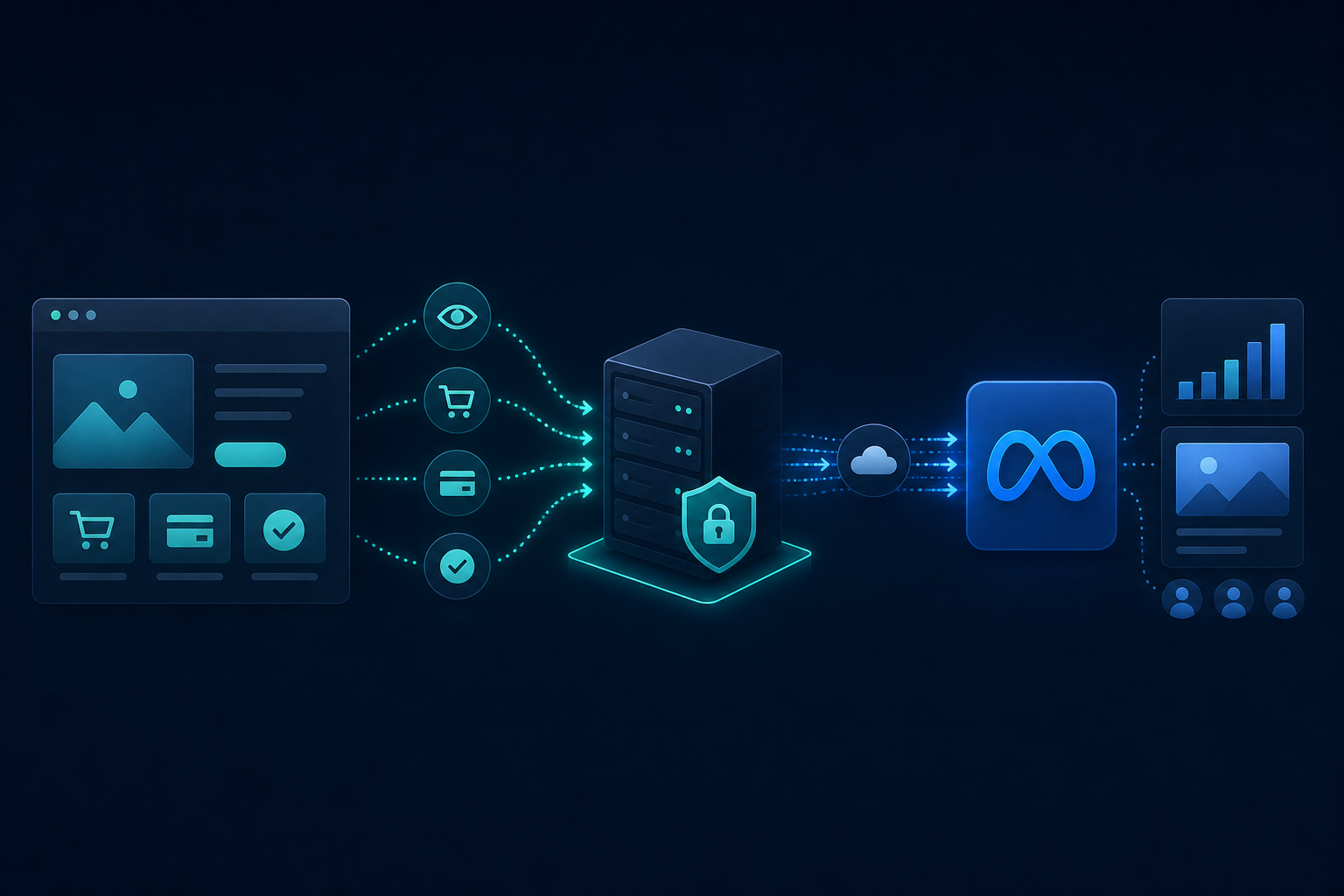
Conversions API (CAPI) is Meta's server-side interface for sending conversion events directly from your server to Meta — without a browser intermediary. Events can be sent from the cart, form, CRM, or any backend process where the conversion actually happens.
CAPI's advantage is reliability: server-side events do not depend on browser cookies, ad blockers, or JavaScript errors. You can send richer data — hashed email, phone number, IP address, user agent — which significantly improves Meta Event Match Quality.
Meta strongly recommends a hybrid model: pixel on the client and CAPI on the server. The pixel collects on-site behavior and retargeting audiences; CAPI ensures conversions are recorded reliably. Together they form the foundation of modern Meta tracking — the same logic as Google Enhanced Conversions and server-side tracking in conversion tracking.
Pixel vs CAPI: how does data flow?
In the traditional model, a user converts on the site → the pixel fires in the browser → the event is sent to Meta. If anything breaks (ad blocker, iOS, JS error), the conversion is lost.
In the hybrid model, the same conversion is sent from two places: the pixel in the browser (if it succeeds) and CAPI from the server (reliably). Meta combines events via deduplication so the same purchase is not recorded twice.
Typical flow: user submits a form → backend receives the data → backend sends a CAPI event with hashed customer data → pixel fires in parallel in the browser → Meta deduplicates based on event_id. This model also works in e-commerce: instead of relying on the order confirmation page, CAPI is sent from the checkout backend as soon as payment is confirmed.
Event Match Quality: signal strength decides
Event Match Quality (EMQ) is Meta's metric for how well an event can be matched to a Meta user. It scales 0–10: high EMQ means Meta reliably identifies the converter and can target ads and optimize more effectively.
EMQ improves when you send more identifying parameters hashed: email (best), phone number, first name, last name, city, zip code, country. CAPI enables sending these from the server securely — SHA-256 hashed before transmission to Meta.
In Events Manager you see EMQ per event. If Purchase EMQ is below 6, optimization and attribution suffer. The primary goal of a CAPI implementation is to raise EMQ to at least 7–8. This directly affects remarketing audience size and Advantage+ campaign learning speed.
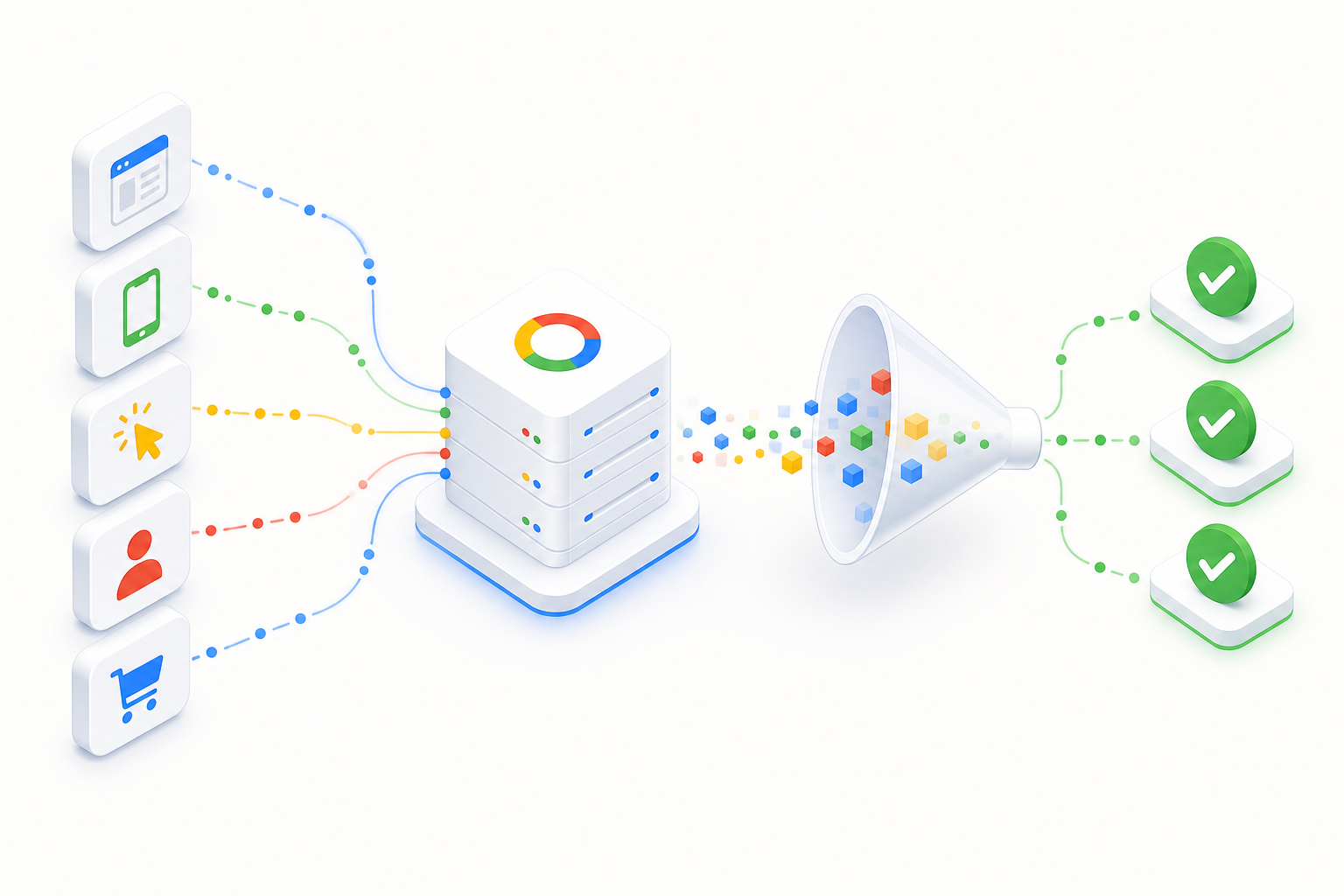
Compare this to the measurement stack: a unified dataLayer and server-side GTM make it easier to collect CAPI data from the same source as GA4 and Google Ads conversions.
Deduplication: do not count conversions twice
When the pixel and CAPI send the same event, Meta needs a way to identify them as one conversion — not two. Deduplication happens via the event_id parameter: the same unique identifier in both sources.
In practice: generate an event_id for each conversion (UUID or order_id) and send it in both the pixel event and the CAPI call. Meta automatically selects the best source (usually CAPI if it has more parameters) and rejects the duplicate.
Without deduplication, conversions are double-counted — attribution is distorted, ROAS looks too good, and the algorithm optimizes on incorrect data. This is one of the most common CAPI implementation mistakes.
CAPI implementation: options and recommendations
CAPI can be implemented in several ways depending on technical capability and infrastructure. The most common options:
Direct API integration: backend calls Meta Graph API directly. Best control, requires development. Suits e-commerce and CRM integrations where conversion happens on the server.
Server-side GTM (sGTM): Meta CAPI tag in server-side Google Tag Manager. Centralized management, easier maintenance than direct API. Good choice if you already use sGTM for other channels.
Partner integrations: Shopify, WooCommerce, HubSpot, and other platforms offer ready-made CAPI connections. Fast deployment, but less customization.
Meta CAPI Gateway: Meta's own hosted solution for smaller accounts. Easy start, but less flexible than sGTM or direct API.
We recommend the hybrid model via sGTM in a full-stack environment: one server-side container serves Meta CAPI, Google Ads Enhanced Conversions, and GA4. This is part of the technical foundation of the Meta Ads service.
Consent, Consent Mode, and privacy
CAPI does not bypass cookie consent. In the EU and GDPR regions, both pixel and CAPI must be tied to user consent — the same logic as Consent Mode v2 in Google. Without consent you cannot send personal data to Meta, even hashed.
In practice: the cookie banner default is "denied". When the user accepts marketing cookies, pixel and CAPI activate. In server-side implementation, consent status is read from Consent Mode signals or the CMP (Cookiebot, OneTrust) and passed to the CAPI call.
Meta supports Limited Data Use (LDU) settings for California and similar privacy settings. Make sure your privacy policy covers CAPI data processing and that hashed data transmission is documented.
Common CAPI mistakes on Meta accounts
We see these mistakes repeatedly in Meta account audits — often on accounts where CAPI is "enabled" but delivers no benefit.
- Pixel only without CAPI → significant data loss in iOS/Safari traffic
- CAPI without deduplication → double counting distorts attribution and ROAS
- Low EMQ (below 6) → weak optimization and small remarketing audiences
- Missing event_id → deduplication fails, data unreliable
- CAPI without consent management → GDPR risk and incorrect data
- CAPI deployment without Events Manager validation → assumes it works, but events never arrive
Frequently asked questions
Does CAPI replace the Meta pixel?
No. CAPI supplements the pixel, it does not replace it. The pixel collects on-site behavior and retargeting audiences in the browser; CAPI ensures conversions are recorded reliably from the server. Meta recommends both with deduplication.
What is Event Match Quality (EMQ)?
EMQ is Meta's 0–10 metric for how well a conversion event can be matched to a Meta user. High EMQ (7+) improves optimization, attribution, and remarketing audiences. CAPI raises EMQ by sending hashed customer parameters from the server.
How does deduplication work between pixel and CAPI?
Send the same event_id in both the pixel event and the CAPI call. Meta identifies the duplicate and counts the conversion once. Without event_id, the same purchase can be recorded twice and distort data.
What is the easiest way to deploy CAPI?
For smaller accounts, Meta CAPI Gateway or a platform-native integration (Shopify, WooCommerce). In a full-stack environment, server-side GTM is the most flexible: one container serves Meta CAPI, Google Ads Enhanced Conversions, and GA4. Start from Events Manager and fix EMQ gaps first.