Why Meta Dynamic Ads for ecommerce?
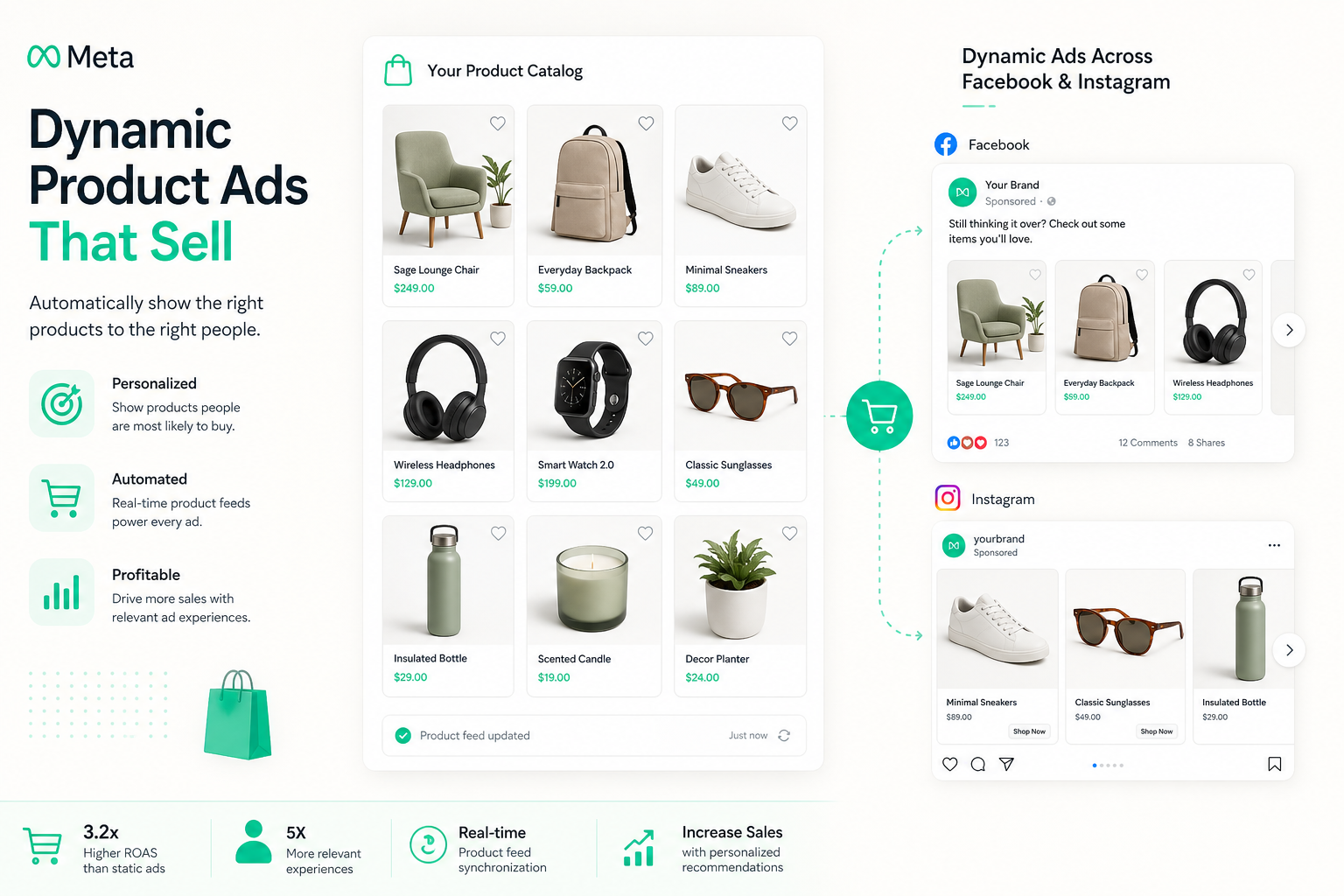
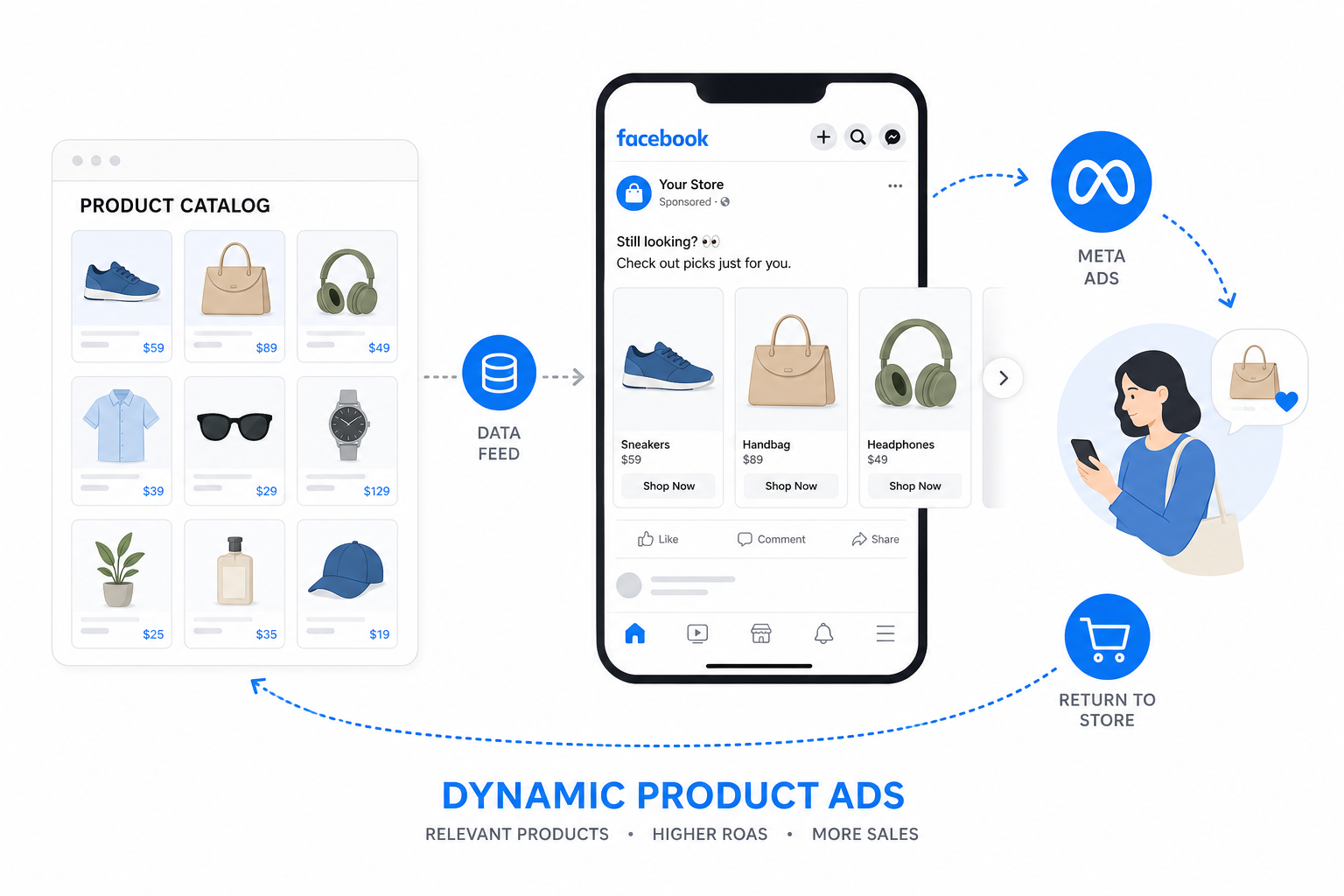
Static product ads don't scale: every product, variant, and price would need its own ad. Dynamic Ads (DPA) pull product data straight from the catalog — image, title, price, and link update automatically. Users see products they viewed or that match their interest.
DPA works for retargeting (site visitors, cart abandoners) and prospecting (lookalike, broad audience + catalog). Meta optimizes which products show to whom — your job is a quality feed and right audiences.
Dynamic Ads complement the Catalog Ads stack and Google Shopping / Pmax advertising. Together they cover the full ecommerce funnel.
Product catalog and feed: the foundation
Meta Product Catalog syncs from a product feed (XML, CSV, API). Required fields: id, title, description, availability, condition, price, link, image_link. Incomplete feed = rejected products and weak ads.
Feed quality decides: unique product images (no watermarks), clear titles (brand + product + variant), correct price and availability. Update feed at least daily — remove sold-out products from ads immediately.
Custom labels (price tier, margin, bestseller) enable campaign-level targeting. Separate high-margin products into their own ad set if ROAS targets differ.
Dynamic retargeting: right product, right person
Retargeting DPA shows products users viewed, added to cart, or purchased (cross-sell). Audiences: product page viewers (7–28 days), cart abandoners, purchasers (new products).
Product set filters: show only certain categories, price tiers, or custom label products. Don't show sold-out items — availability field and product set filters prevent that.
Frequency cap and ad set split: separate campaigns for retargeting vs. prospecting. Retargeting budget 60–70%, prospecting 30–40% is typical for ecommerce.
- Product page viewers: 7–28 day window
- Cart abandoners: highest intent
- Purchasers: cross-sell and new products
- Product set: category, price, custom label
- Exclude: converters as needed
Advantage+ catalog and scaling
Advantage+ Shopping Campaigns (ASC) and Advantage+ catalog campaigns automate targeting, placement, and budget. Meta selects products and audiences from the catalog — you supply creative framework and conversion goal.
ASC fits ecommerce when conversion tracking (Meta Pixel + CAPI) is solid and product feed is quality. Start with retargeting DPA, expand to ASC when ROAS is stable. See the Meta Advantage+ 2026 guide.
Scaling: raise budget 20–30% at a time when ROAS holds target. Add products to catalog and product sets — wider selection gives the algorithm more to optimize.
Feed and campaign optimization
Monitor Catalog Diagnostics: rejected products, policy violations, missing fields. Fix root causes in the feed, not on Meta's side.
A/B test catalog template styles (single product, carousel, collection). Test overlay copy (discount, free shipping) — but don't cover the product image.
Compare Dynamic Ads ROAS to Google Shopping / Pmax. Cross-channel attribution shows which channel delivers marginally best results.
Common Meta Dynamic Ads mistakes
These mistakes show up repeatedly in Dynamic Ads audits.
- Weak product feed → rejected products, poor ads
- Sold-out products in ads → frustrated users
- No retargeting separation → same message for everyone
- Incomplete Pixel/CAPI → algorithm optimizes wrong
- Product set too narrow → won't scale
- Dynamic Ads without Catalog Ads foundation → see Catalog Ads guide first
Frequently asked questions
Difference between Dynamic Ads and Catalog Ads?
Catalog Ads is a campaign type using the product catalog. Dynamic Ads (DPA) is the dynamic product ad format from the catalog — often the same stack. The Catalog Ads guide covers the full structure.
Do I need a separate product feed for Meta?
Yes. Meta Product Catalog requires its own feed (or API sync). Google Merchant Center feed isn't directly compatible — fields and format differ.
How do I choose retargeting window?
Product page viewers: 7–14 days for impulse purchases, 28 days for considered purchases. Cart abandoners: 7 days. Test from data — too long a window raises frequency.
Is Advantage+ catalog suitable for small ecommerce?
Yes, with at least 50+ products and solid conversion tracking. With smaller catalogs, classic DPA retargeting may be enough to start.
How do I connect Dynamic Ads with Google advertising?
Same feed logic in different formats. Google Shopping/Pmax + Meta DPA cover the funnel. Compare ROAS with cross-channel attribution — don't optimize channels in isolation.