What local GEO means
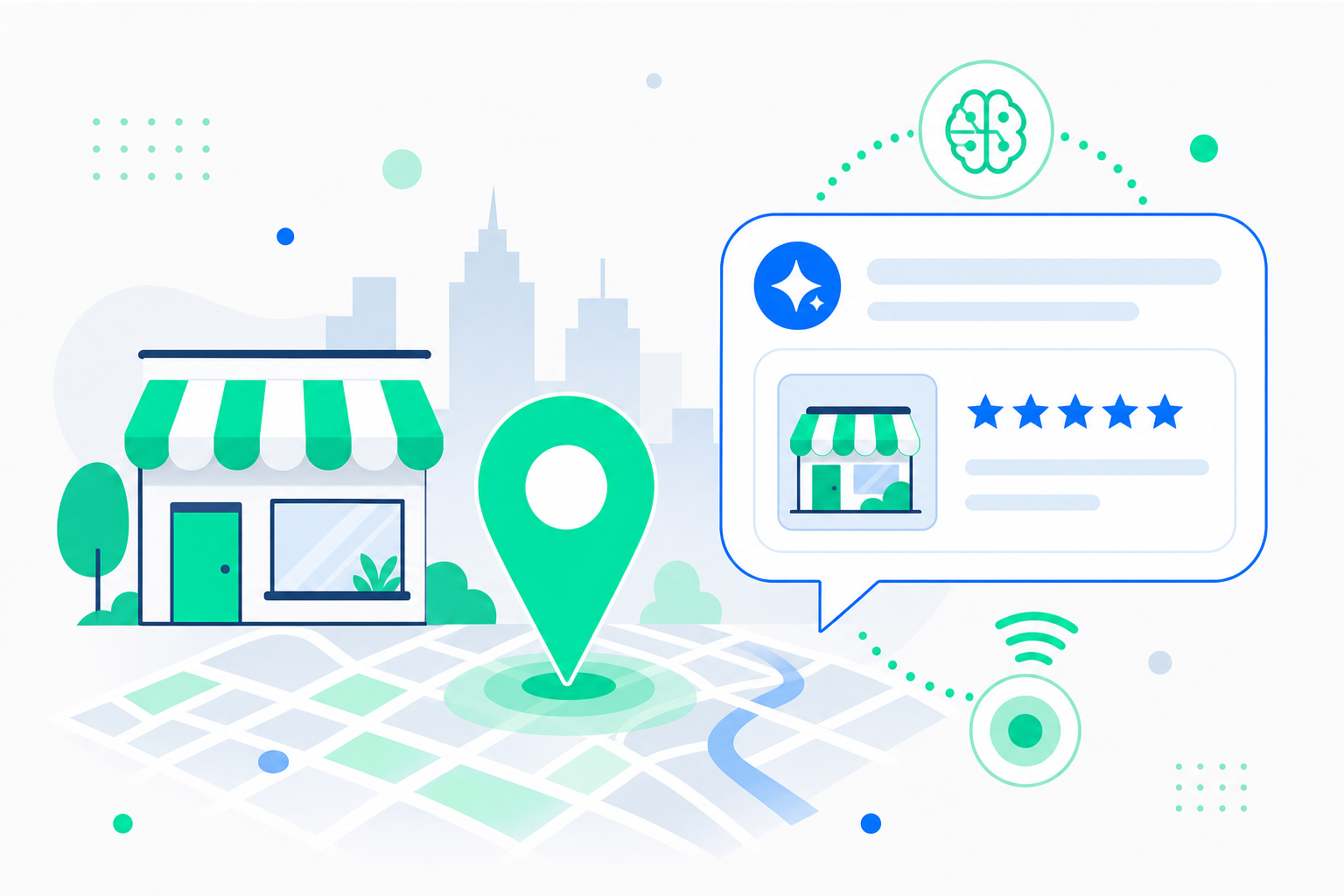
Local GEO is the branch of Generative Engine Optimization focused on geographically scoped queries. When a user asks for "the best lunch spot in Tampere" or "a reliable plumber in Espoo", an AI model pulls together its answer from very different sources than for generic questions.
In local queries, AI leans heavily on Google Business Profile, reviews (Google, Tripadvisor, Yelp, vertical-specific sites), LocalBusiness schema, and local mentions in media and directories. A nice website alone is not enough — you need the whole stack reinforcing itself.
The good news for local businesses: competition in local searches is often smaller than in generic ones, and local relevance levels the playing field against big chains. A small auto repair shop in Lahti can outrank a national chain if its GBP, reviews, and schema are in order.
- Local searches: "best X in city Y", "near me"
- AI uses GBP, reviews, schema, and local mentions
- Local relevance closes the gap to large chains
- Especially powerful for service businesses, restaurants, healthcare
Google Business Profile — the foundation for everything
Google Business Profile (GBP) is the single most important element of local GEO. Google AI Overviews cites it almost always in local queries, and ChatGPT and Perplexity leverage GBP data through their indexes.
Parts of a complete GBP: the official business name (no keyword stuffing), exact address, service area (if no walk-ins), opening hours, phone, email, website, exact categories, and at least 15 quality photos and videos. Keep everything current — stale data is a red flag to AI.
Regularly publish Google Posts with current services, offers, and news. Posts are indexed and surprisingly often cited in AI answers when they are fresh and concrete.
- Official business name, no keyword stuffing
- Exact categories — primary plus 2–9 secondary
- At least 15 photos and 2–3 videos
- Google Posts weekly — AI cites freshness
LocalBusiness schema — say machine-readably who you are
LocalBusiness schema (or a sub-type like Restaurant, MedicalBusiness, AutoRepair) tells AI explicitly your business name, address, phone, opening hours, and service area. It is the machine-readable mirror of your GBP.
Most important is NAP consistency: business Name, Address, and Phone must be identical everywhere — GBP, site schema, directories, Facebook, LinkedIn, Yelp. Even a small mismatch erodes AI’s confidence in your data.
Also add aggregateRating if you collect reviews on your site, geo coordinates, precise openingHoursSpecification, and areaServed if you serve multiple cities.
- LocalBusiness or a more specific sub-type (Restaurant, MedicalBusiness…)
- NAP consistency everywhere — same name, address, phone
- aggregateRating, geo coordinates, openingHoursSpecification
- areaServed if your service area spans multiple cities
Reviews weigh more in AI answers than in classic SEO
Local content and per-location pages
If you serve multiple cities, build a dedicated landing page for each area: a local title ("Plumbing in Espoo"), local content (area specifics, local case references), local FAQ, and contact info. Never duplicate the same text across city pages — AI detects duplicates and ignores them.
Add local case references, ideally with the customer name or at least the neighbourhood. AI is more likely to cite pages with concrete local evidence.
Use local FAQ questions: "Do you serve Hervanta in Tampere?", "What lunch options are open 11–14 in central Tampere?". More guidance in our FAQ pages for GEO article.
- Own page per city — no duplicated text
- Local title, FAQ, and references
- Mentions of neighbourhoods, not just the city name
- Photos from real local projects
Measuring local AI answers
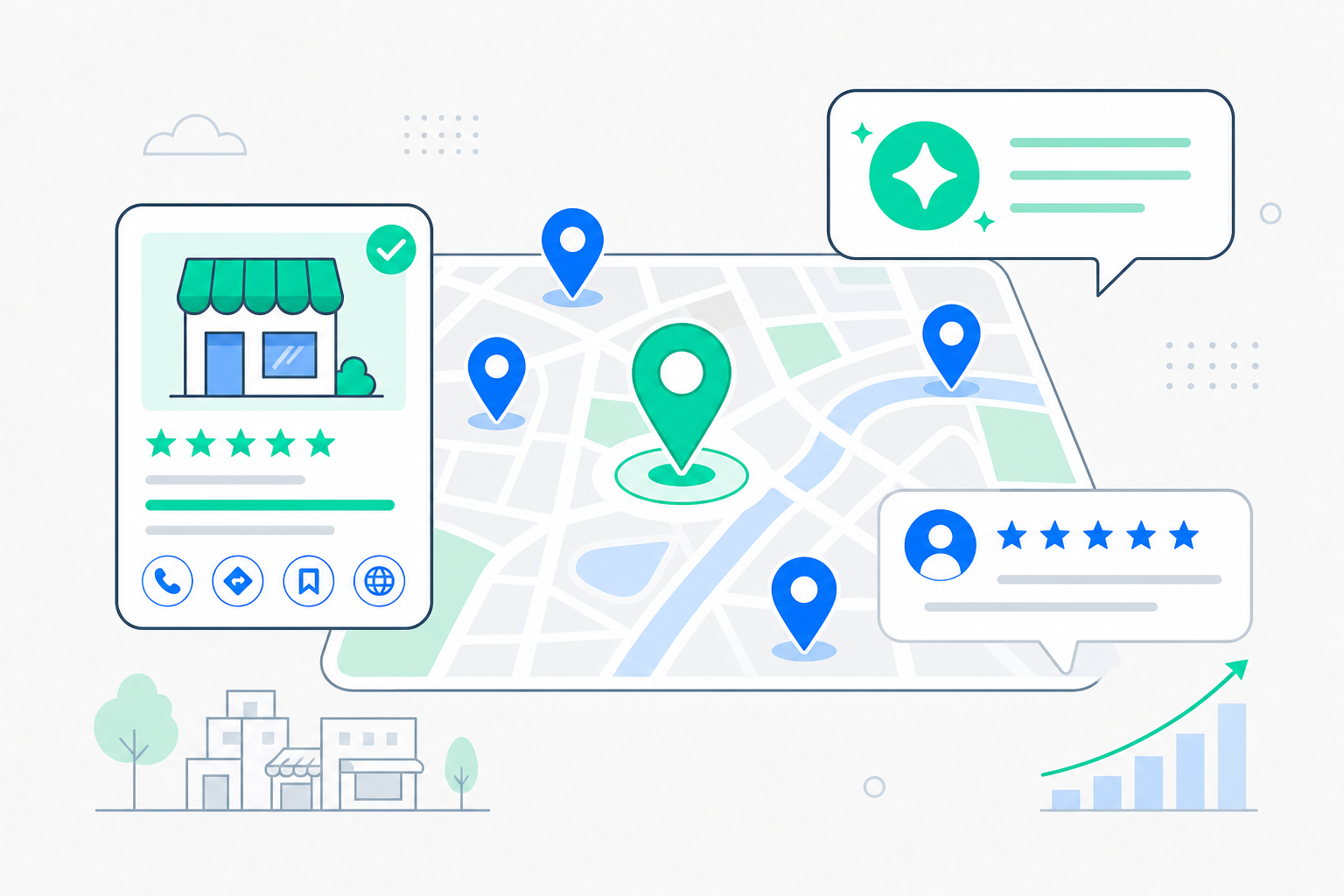
Measure local GEO with your own prompt matrix. Tests must be run via VPN from the actual locality or from real on-site location — AI models factor in IP address or the user’s chosen location in local answers.
Good local prompts: "best [service] in [city]", "reliable [profession] near [neighbourhood]", "where can I get [service] in [city] under €100", "[service] open on Saturdays in [city]". Test also without the city name but with the VPN location set — AI often infers the location without the user stating it.
Pay particular attention to which three businesses AI references. Local answers typically show 3–5 options — aim for top-3 for every target prompt.
- Test via VPN from the locality — IP affects the answer
- Prompts like "best X in city" and "X near Y"
- Goal: top-3 in the local AI answer
- Measure also without the city name; AI infers location
Local GEO impact in numbers
Most common local GEO mistakes
The most common mistake is NAP inconsistency: business name or address written differently across GBP, site, and directories. AI interprets this as entity uncertainty and skips the citation.
A second mistake is keyword stuffing the business name. "Helsinki Plumbing & Repair 24/7 Fast" as a GBP name not only breaks Google rules — it signals to AI that you do not have a stable brand identity.
A third is ignoring reviews. 4.2 stars and 12 reviews will not beat 4.8 stars and 240 reviews — even if the content is better. AI treats reviews as social proof of trustworthiness.
- NAP mismatch across sources
- Keywords in business name → unstable entity
- Sparse or stale review stream
- Same text duplicated across city pages
Local GEO checklist
Following this list builds local AI visibility systematically in your area. Most steps are free and require mainly time.
Once the foundation is in place, measure monthly with the GEO audit playbook. Need help with local GEO? See our GEO service.
- Google Business Profile complete — name, address, categories, 15+ photos
- NAP consistent everywhere
- LocalBusiness schema on site with aggregateRating and geo
- Review collection automated (email, QR, SMS)
- Per-location landing pages, no duplicated text
- Local FAQ page — neighbourhoods and service areas
- Google Posts weekly on GBP
- Test AI answers via VPN from your own location monthly
- Aim for top-3 in the local AI answer for each service
Frequently asked questions
How does a local business become visible in ChatGPT?
Three things matter most: a complete Google Business Profile, LocalBusiness schema on the site, and 50+ genuine reviews with a 4.5+ star average. ChatGPT and Perplexity leverage indexed GBP data, reviews, and local mentions in local queries.
What is LocalBusiness schema?
LocalBusiness schema is a schema.org structured-data markup that tells search engines and AI in a machine-readable way your business name, address, phone, opening hours, and service area. Use a more specific sub-type (Restaurant, MedicalBusiness, AutoRepair) where applicable.
How many reviews does a local business need for AI visibility?
A practical minimum is 50 reviews with a 4.5 star average. Studies show AI models prefer businesses that pass this threshold in local recommendations. Recency matters too — new reviews within the last month.
Should a local business create separate pages for each city?
Yes, if you genuinely serve different cities. Build each one its own landing page with a local title, FAQ, references, and contact details. Never duplicate the same text and swap the city name — AI detects duplicates and drops them.
How do I test local AI answers in different cities?
Use a VPN or mobile from the location being tested. AI models factor in IP address or shared location for local answers. The same prompt "best lunch spot" yields different answers in Helsinki than in Oulu.