Why the budget split determines results
Meta advertising results depend not only on budget size but on how it is split. The wrong split wastes money on either too narrow an audience or untested ideas.
The most common mistake is over-investing in remarketing because it looks efficient (cheap ROAS). In reality, remarketing only harvests what prospecting sows.
The second mistake is dropping testing entirely. Without ongoing testing, advertising stalls when current creatives fatigue.
A clear budget model solves these problems in advance. We walk through the 70/20/10 model, which balances growth, efficiency, and learning.
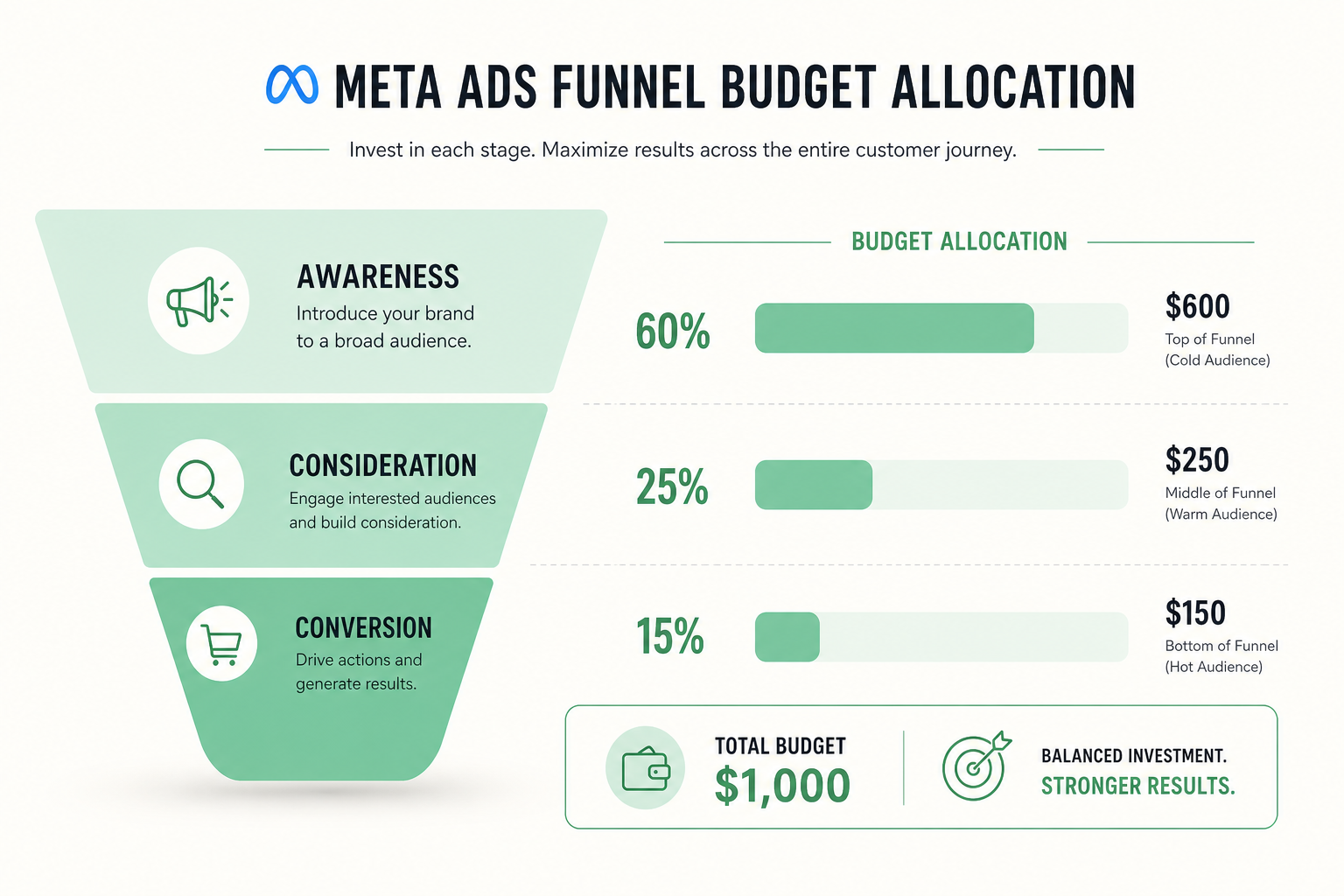
Budget follows the funnel
The 70/20/10 model — balance between growth and efficiency
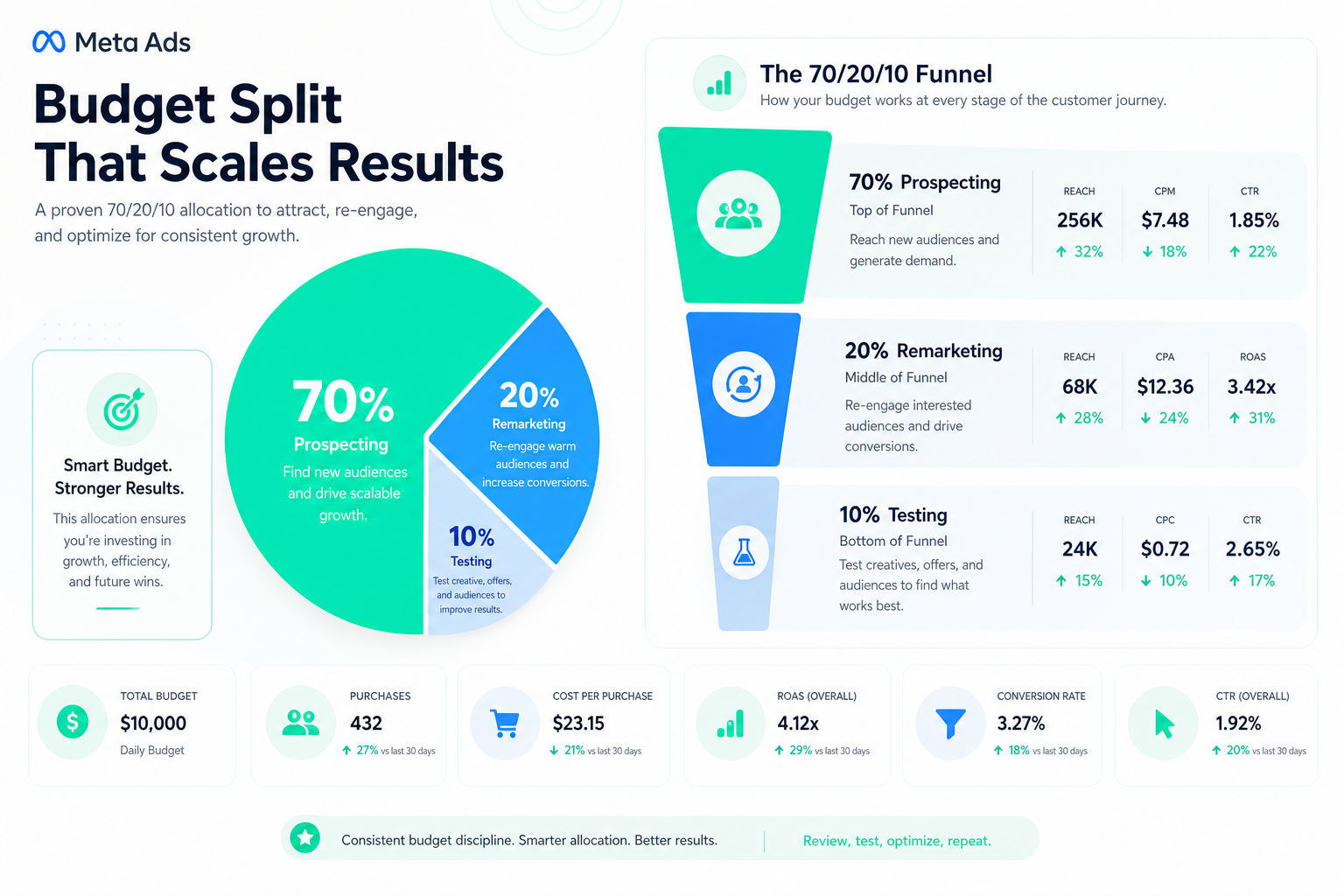
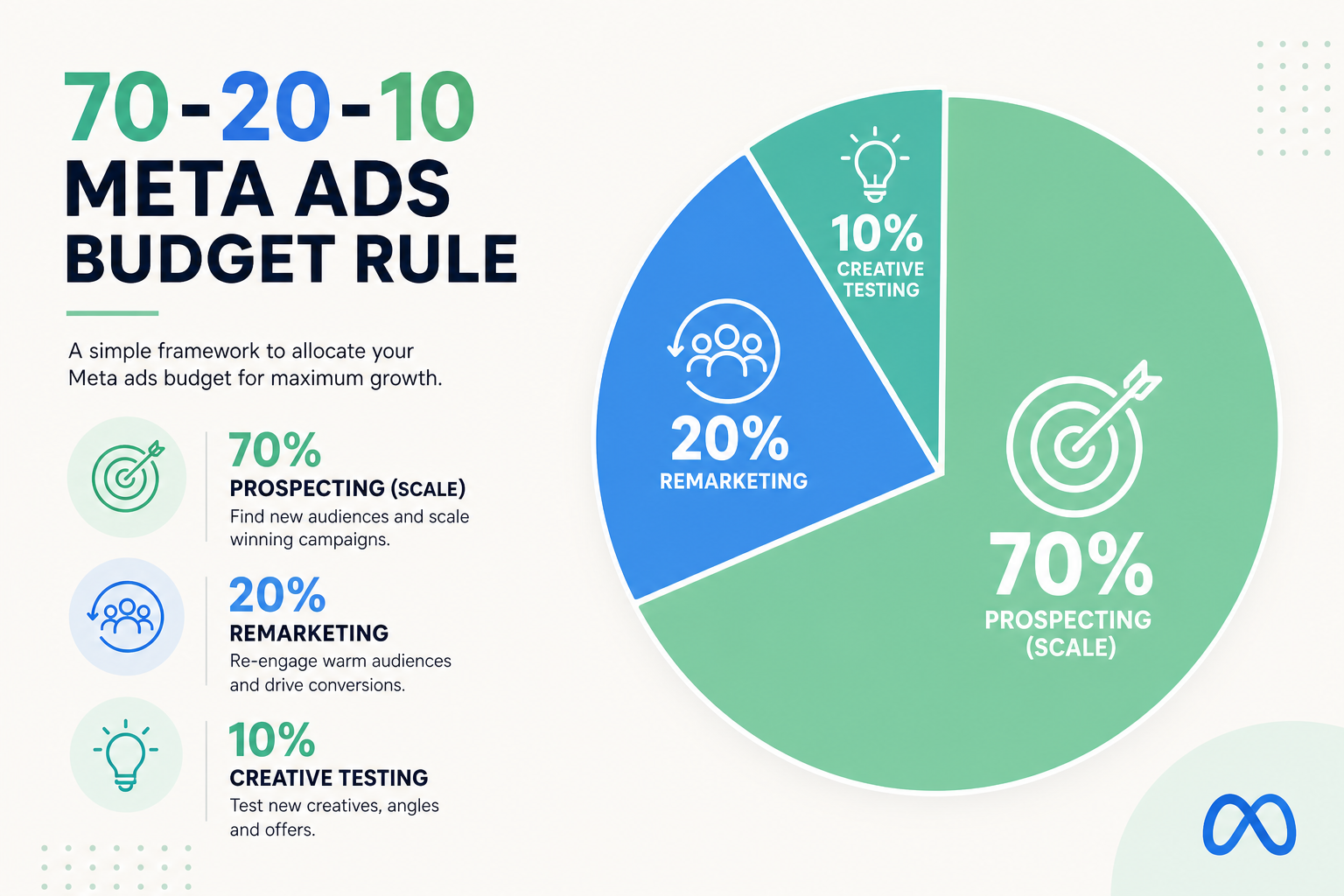
The 70/20/10 model splits the budget across three purposes: 70 % to prospecting, 20 % to remarketing, and 10 % to testing. It is a solid starting point for most advertisers.
The model ensures most of the budget goes to growth (new customers), some to harvesting (warm audience), and a small portion to learning (new ideas).
The ratios are not set in stone. An e-commerce store with a large warm audience can spend more on remarketing; a new brand should weight prospecting even more heavily.
- 70 % prospecting: new customer acquisition, filling the funnel
- 20 % remarketing: converting the warm audience
- 10 % testing: new creatives, audiences, and formats
- Adjust ratios based on your business and data
Prospecting (70 %) — the growth engine
Prospecting means reaching new people who do not yet know your brand. This is the top of the funnel and the actual source of growth.
Use Meta broad audiences and Advantage+ tools that let the algorithm find buyers. Read more about audiences in Meta audiences and retargeting.
Prospecting requires the most creative variety because you constantly reach new people. Strong creative (Meta ads creative strategy) is the most important success factor.
- Reaches new people who do not know your brand
- Broad audiences + Advantage+ targeting
- Requires the most creative variety
- Top of funnel = source of growth
Remarketing (20 %) — harvesting
Remarketing reaches people who have already engaged with your brand: visitors, cart abandoners, video viewers. Converting them is efficient.
Keep the remarketing budget proportional to audience size. Too large a budget on a small audience pushes frequency too high and fatigues the audience fast.
Segment remarketing by intent: cart abandoners deserve a different message than casual browsers. High-intent audiences convert best.
- Reaches the already-warm (visitors, cart abandoners)
- Size the budget to the audience — avoid over-frequency
- Segment by intent with different messages
- Efficient ROAS, but does not scale on its own
Testing (10 %) — continuous learning
The testing budget is dedicated to new ideas: new creatives, audiences, ad formats, and message angles. It is insurance for future performance.
Without testing, advertising stalls when current winners fatigue (creative fatigue). 10 % of the budget secures a steady flow of new winners.
Keep testing separate from main campaigns so you learn clearly what works. Move winners into prospecting and drop losers quickly.
- New creatives, audiences, formats, and message angles
- Insurance against creative fatigue
- Keep separate from main campaigns — clear learning
- Winners → prospecting, losers out quickly
Scaling and adjustments — when to raise the budget
When prospecting is profitable, scale the budget gradually (e.g. 20–30 % at a time) so the algorithm can adapt. Raising too fast collapses performance.
Track total ROAS and CAC, not just per-campaign numbers. Remarketing high ROAS can hide the fact that prospecting carries the growth.
A deeper scaling strategy (horizontal vs. vertical, CBO) is its own topic — read Meta ads scaling. Connect the budget to broader marketing in our budget allocation guide.
- Scale prospecting 20–30 % at a time
- Track total ROAS and CAC, not just campaign level
- Let the algorithm adapt before the next increase
- Adjust the 70/20/10 ratios based on data
Example: splitting a €3,000 budget
Take a concrete example: a €3,000 monthly budget split with the 70/20/10 model. Prospecting gets €2,100, remarketing €600, and testing €300.
The €2,100 for prospecting goes to one or two broad campaigns where the algorithm gets enough data. Split across too many small campaigns, learning slows down.
The €600 for remarketing is enough for a typical warm audience without pushing frequency too high. If the audience is large, you can raise the share.
The €300 for testing runs 2–3 new creatives or audiences per month. Winners move into prospecting in the next cycle.
When scaling, grow the total budget and keep the ratios — or adjust them based on data if the remarketing audience grows significantly.
This split is a starting point, not the final truth. An e-commerce store with a large pool of repeat buyers can run a larger remarketing share.
- €3,000 → €2,100 prospecting, €600 remarketing, €300 testing
- Prospecting in 1–2 broad campaigns for learning
- Remarketing share based on audience size
- Testing runs 2–3 new ideas per month
The model in numbers
Metrics and tracking
Budget split success is measured by total profitability, not the ROAS of individual campaigns. Track total ROAS, CAC (cost of acquiring a customer), and margin.
In prospecting, track the number of new customers and CAC. In remarketing, track conversion rate and frequency — too high a frequency is a warning sign.
In testing, measure learning: how many new winners you found and how quickly. A good testing process continuously produces new scalable creatives.
Use reliable measurement (Conversions API) so budget decisions rest on accurate data, not incomplete pixel data.
Review the budget split monthly and adjust based on data. Markets, seasons, and audience saturation change the optimal split.
- Total ROAS, CAC, and margin — not just campaign ROAS
- Prospecting: new customers and CAC
- Remarketing: conversion rate and frequency
- Testing: number of winners found
- Review and adjust the split monthly
Common budgeting mistakes
We see these mistakes often when budgets are split by intuition rather than funnel logic.
- Too large a remarketing share — the funnel does not grow
- No testing budget — advertising stalls
- Scaling too fast collapses performance
- Measuring the budget only by per-campaign ROAS
- Prospecting budget too small for growth goals
- Remarketing budget exceeds audience size → over-frequency
Do not chase ROAS alone
Budget split checklist
Run through this list when building or adjusting your Meta budget. It ensures balance between growth, efficiency, and learning.
Connect budgeting with scaling and overall marketing: read Meta ads scaling and marketing budget allocation. Explore our Meta advertising service.
- Most of the budget to prospecting (~70 %)
- Remarketing sized to the audience (~20 %)
- Testing budget reserved (~10 %)
- Scale gradually, at the algorithm pace
- Measure total ROAS and CAC, not just campaign level
- Winning tests moved into prospecting
Frequently asked questions
How should a Meta ad budget be split?
A solid starting point is the 70/20/10 model: 70 % to prospecting (new customer acquisition), 20 % to remarketing (warm audience), and 10 % to testing (new ideas). Adjust the ratios to your business and data.
What is the 70/20/10 rule?
The 70/20/10 rule is a budget model that directs most of the money to growth (prospecting), some to harvesting (remarketing), and a small portion to learning (testing). It balances growth, efficiency, and ongoing improvement.
Why can I not put everything into remarketing?
A remarketing audience is made of people prospecting brought to your site. If you cut prospecting, the remarketing audience shrinks and growth stops. Remarketing harvests what prospecting sows.
How much of the budget should go to testing?
About 10 % of the budget. Testing is insurance against creative fatigue: without ongoing testing of new creatives and audiences, advertising stalls when current winners fatigue.
How do I scale a Meta budget safely?
Scale prospecting gradually, for example 20–30 % at a time, and let the algorithm adapt before the next increase. Raising the budget too fast collapses performance.