Why a 30-day plan works
GEO can easily look like a complex project where you must do everything at once. In practice the most effective way to start is a time-boxed 30-day sprint that builds the foundation and switches on continuous measurement. Bigger projects tend to drown in day-to-day work.
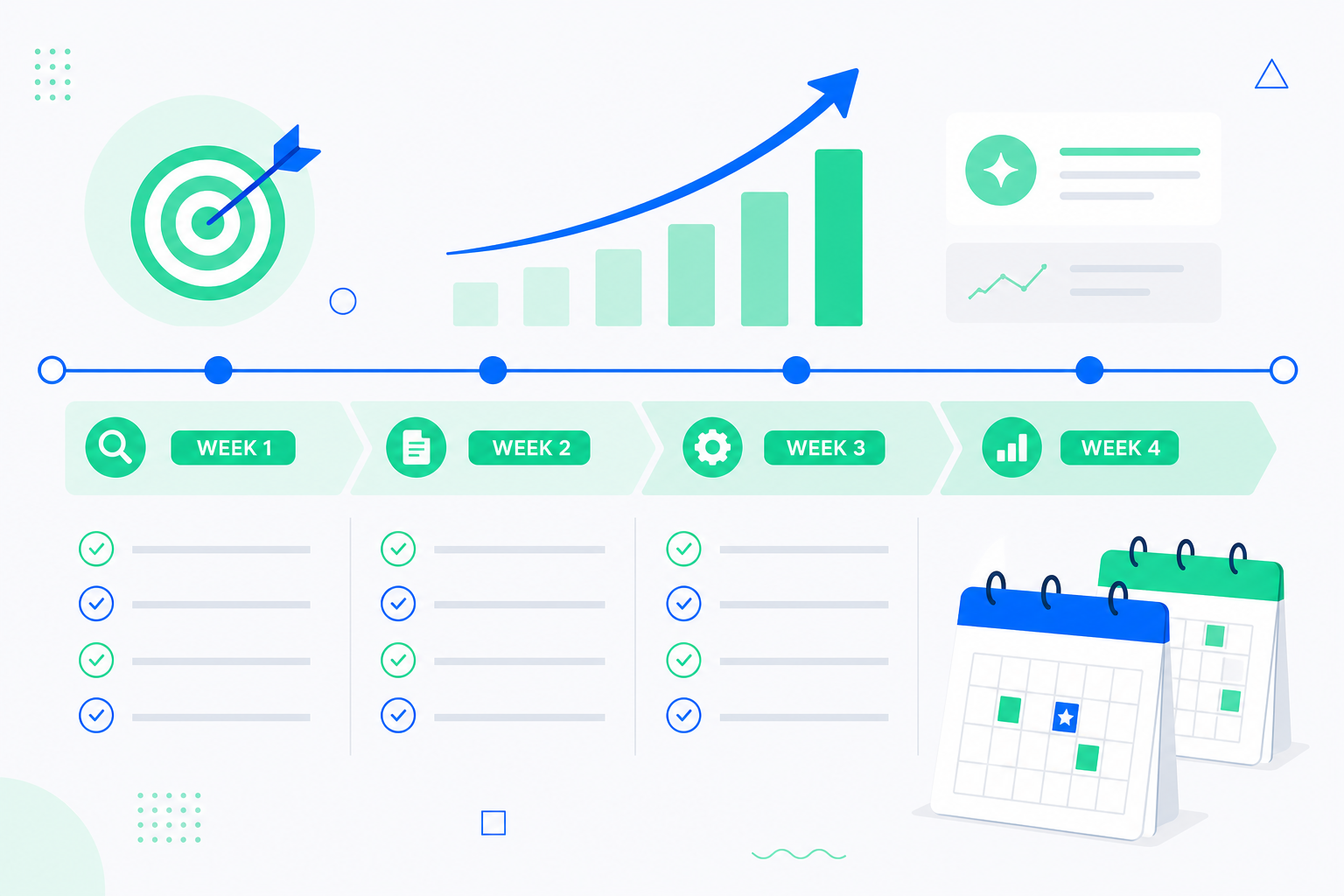
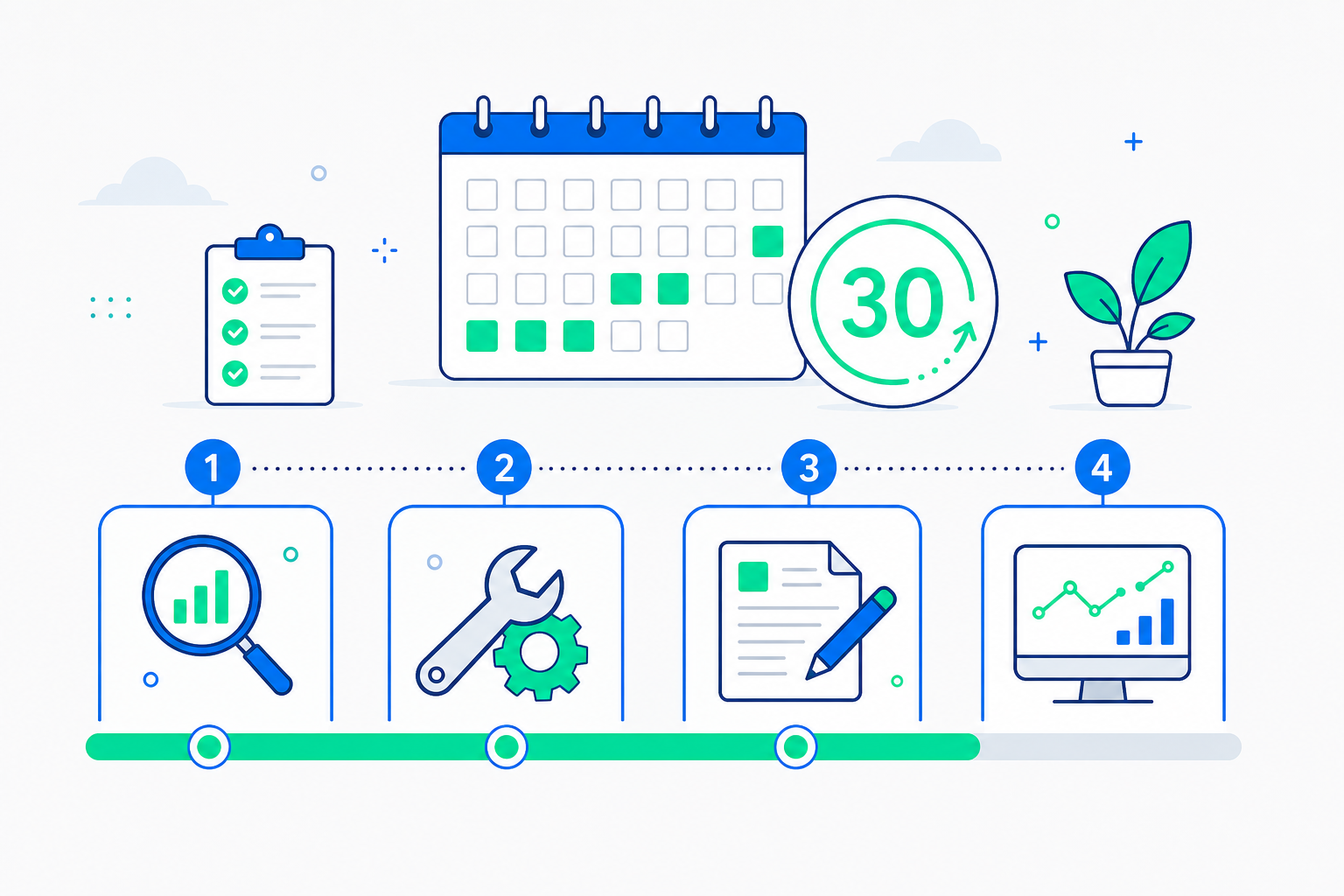
30 days is long enough to push the foundation through but short enough to keep the team focused. The plan is split across four weeks, each with one clear focus: audit, entity and schema, content, measurement.
After the first 30 days you will not yet see a flood of AI mentions — those come around the 60–90 day mark. But you will have a working system that keeps running and concrete numbers whose trend you can track.
- A time-boxed project keeps the team focused
- 4 weeks, each with its own theme
- Goal: foundation ready + measurement running
- First systematic AI mentions at 60–90 days
Week 1: Audit and baseline
The first week is dedicated to understanding the current state. Do not change anything yet — gather information. This is the baseline against which all results are measured and the source for prioritizing what to fix.
Run three audits in parallel: (1) a technical GEO audit (indexing, AI crawler access, schema, llms.txt, Core Web Vitals), (2) an entity audit (Wikidata, LinkedIn, Crunchbase, Organization schema), and (3) a prompt baseline (test 20 prompts in ChatGPT, Perplexity, and Google AI Overviews; log Share of Voice).
End the week by prioritizing findings: which fix produces the most value fastest. Usually the biggest easy wins are schema gaps, missing FAQ pages, and inconsistencies in how the brand name is written. More detail in our GEO audit article.
- Day 1–2: Technical GEO audit (AI crawlers, schema, llms.txt)
- Day 3–4: Entity audit (Wikidata, LinkedIn, Organization)
- Day 5–6: Prompt baseline with 20 prompts across 3 models
- Day 7: Prioritization and roadmap for the next 3 weeks
Week 2: Entity, schema, and technical foundation
Week 2 focuses on strengthening the brand entity and the technical foundation. This is the highest return per hour in a GEO project: AI needs a machine-readable, consistent entity before it dares to cite you.
Tasks: update or create a Wikidata profile, complete the LinkedIn company page and key expert profiles, add or update Organization, Person, and Service schemas, fix NAP consistency (name, address, phone) everywhere, and publish llms.txt at the site root.
End the week by verifying the key AI crawlers (GPTBot, PerplexityBot, ClaudeBot, Google-Extended) are not blocked in robots.txt or at the server level. More in our llms.txt article.
- Day 8–9: Wikidata + LinkedIn + Crunchbase updates
- Day 10–11: Organization, Person, and Service schemas
- Day 12: NAP consistency across all sources
- Day 13–14: llms.txt + AI crawler access verified
Week 3: Citable content and FAQ pages
Week 3 builds content AI actually cites. The goal is not to refresh every page — it is to publish or update 2–3 strategic pages so they become sources in AI answers.
Tasks: (1) create one central FAQ page per main service (8–15 questions, 40–120 words per answer, FAQPage schema), (2) update 2–3 most important service pages or blog articles to be citation-friendly (answer first, numbers visible, lists and tables), and (3) add 1–2 case studies with concrete numbers.
Detailed instructions for FAQ pages are in our FAQ pages for GEO article, and guidance for citation-friendly content in our AI-citable content article.
- Day 15–16: One FAQ page per main service, 8–15 questions
- Day 17–18: Update 2–3 service pages to be citation-friendly
- Day 19–20: 1–2 case studies with concrete numbers
- Day 21: HowTo schemas on guides, Article schemas on blogs
Week 4: Measurement, optimization, and continuity
Week 4 is dedicated to setting up measurement so the work continues systematically after 30 days. GEO is not a one-off project — it is a process that runs on a monthly cadence.
Tasks: (1) build a monthly prompt matrix (30+ prompts, 3+ models, standardized conditions), (2) pick a tracking tool (Profound, AthenaHQ, Goodie, Otterly, or your own Google Sheet), (3) define quarterly targets for Share of Voice and key prompts, and (4) lock the content calendar for the next quarter.
Finally, compare your week 4 prompt results against the week 1 baseline. Even if the change is small, you already see signals about direction. Detailed measurement instructions are in our GEO audit and Share of Voice article.
- Day 22–23: Monthly prompt matrix with 30+ prompts
- Day 24–25: Tracking tool selected and in use
- Day 26–27: Quarterly targets for SoV and key prompts
- Day 28–30: Q2 content calendar + re-test vs. baseline
Critical metrics during the first 30 days
Realistic results after 30 days
What to avoid in the first month
Do not try to refresh every page at once. In 30 days you can do 2–3 strategic pages properly — and that produces more than 30 pages updated superficially. Quality beats quantity in GEO.
Also do not over-index on the week 2 prompt results. AI models react to schema changes with a lag — usually weeks, not days. One page update will not show up in ChatGPT answers the very next day.
A third risk is starting with content before the entity and schema are in order. Even with great content, AI does not trust a source whose entity it cannot recognise. Keep the order: audit → entity → content → measurement.
- Do not try to update every page — 2–3 strategic ones are enough
- Do not expect AI answers to change in a week — the lag is weeks to months
- Keep the order: audit → entity → content → measurement
- Do not skip baseline measurement — without it you do not know if you are improving
30-day playbook checklist
This checklist condenses the 30-day playbook tasks into one view. Print it or import it into your project tool and track progress weekly.
Once the 30-day foundation is in place, continue with ongoing measurement or step into the broader GEO and ChatGPT visibility strategy. Need help getting started? See our GEO service.
- Week 1: Technical audit + entity audit + prompt baseline
- Week 2: Wikidata + LinkedIn + Organization/Person/Service schemas
- Week 2: NAP consistency + llms.txt + AI crawlers allowed
- Week 3: 1 FAQ per main service, 8–15 questions, FAQPage schema
- Week 3: 2–3 service pages made citation-friendly
- Week 3: 1–2 case studies with concrete numbers
- Week 4: Monthly prompt matrix with 30+ prompts
- Week 4: Tracking tool in use
- Week 4: Quarterly SoV targets defined
- Week 4: Content calendar for Q2 ready
Frequently asked questions
Can GEO be started in 30 days?
Yes — in 30 days you build the technical foundation, the entity, your first citation-friendly pages, and a measurement system. First AI mentions typically appear around the 60–90 day mark, but the foundation is ready and running by then.
What are the most important phases of a 30-day GEO project?
Four weeks, each with a theme: week 1 audit and baseline, week 2 entity and schema, week 3 citable content and FAQ, week 4 measurement and optimization. One focus per week keeps the team moving.
Will I see AI mentions already after 30 days?
Single mentions may show, but not systematically yet. AI models react to schema and content changes with a lag, typically 4–12 weeks. Measure the trend at a quarterly level, not weekly.
What tools does a 30-day GEO project need?
Required: a schema validator (Google Rich Results Test), an incognito browser for manual prompt testing, and a Google Sheet or Notion to log results. Optional: a GEO measurement tool (Profound, AthenaHQ, Goodie, Otterly) for week 4 automation.
After 30 days, should GEO continue in-house or be outsourced?
Most companies can do the 30-day foundation in-house with good guidance. The ongoing measurement, content production, and optimization should be either clearly resourced internally or outsourced to a GEO agency. AlgoTerra’s team supports both routes.