Two stages, one funnel
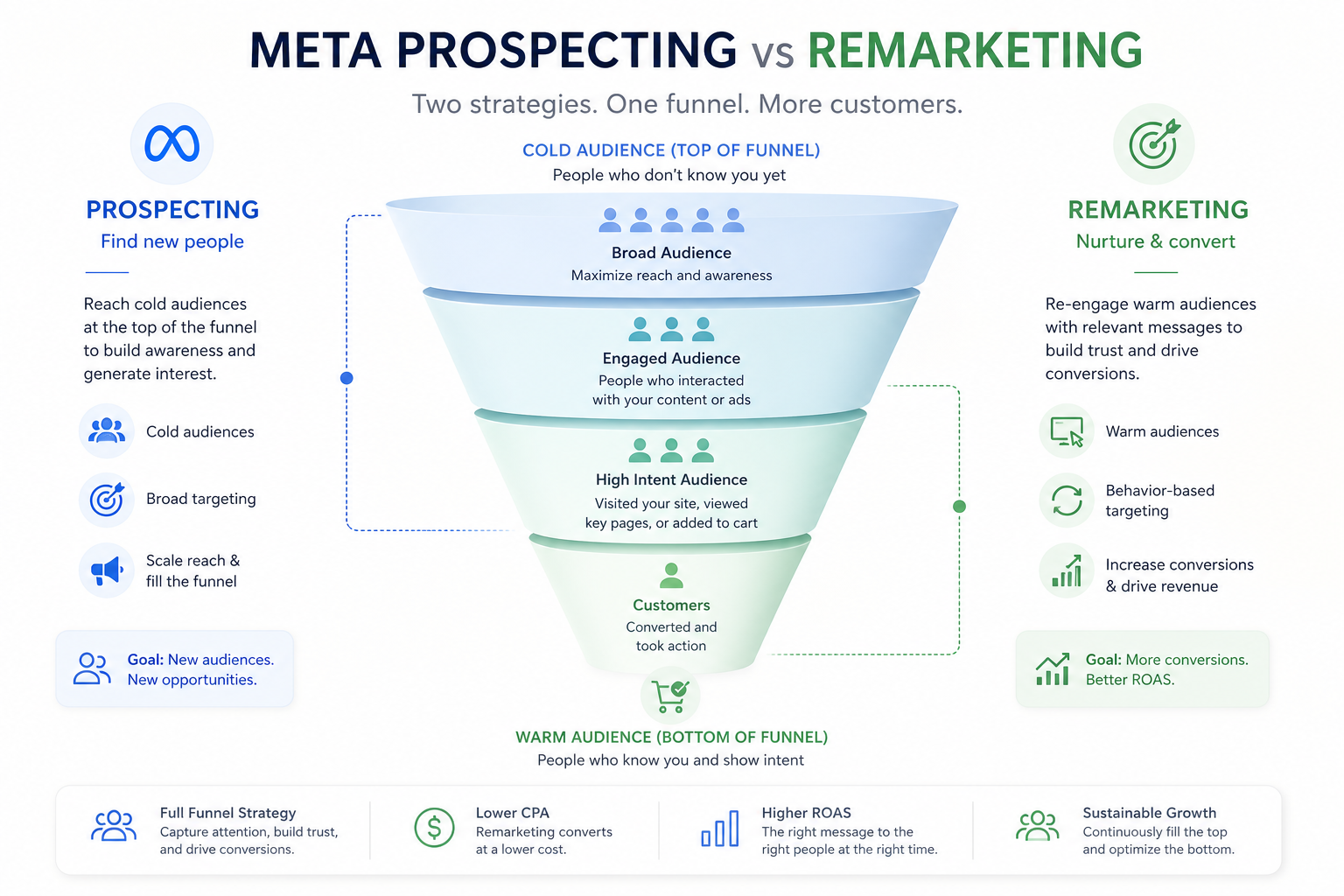
Prospecting and retargeting are two stages of the same funnel, not separate strategies. One brings people in, the other takes them to the finish.
A common misconception is that they compete for budget. In reality they support each other: without prospecting the retargeting audience dries up, and without retargeting some of the warmed-up people go to waste.
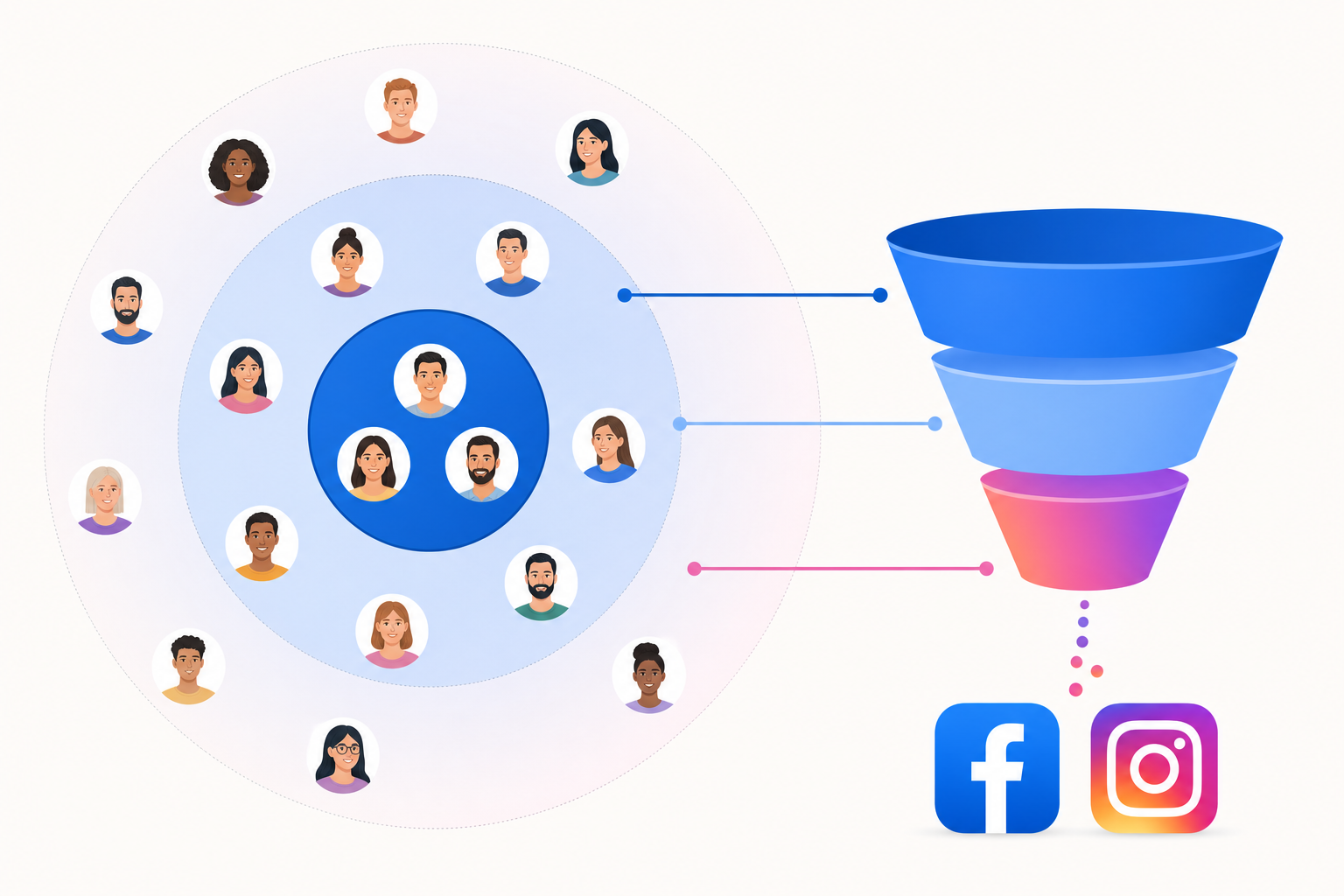
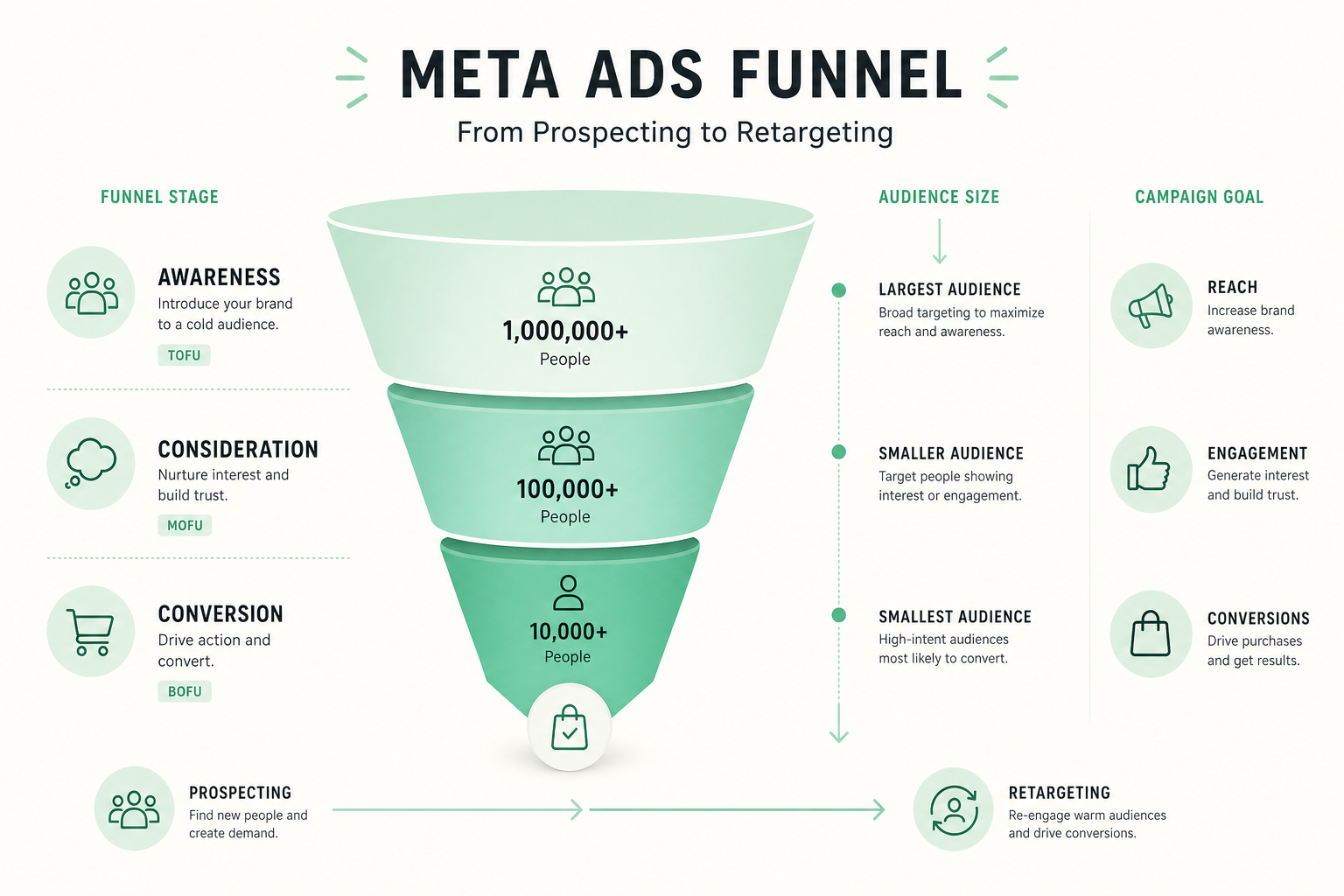
To understand the strategy you must grasp the funnel: cold audience (new), warm audience (engaged), and hot audience (close to buying). Each stage needs its own message.
This guide explains the differences, audience layers, and when to scale each. The budget split details are in our budget split guide.
Cooperation, not competition
What prospecting is — reaching the cold audience
Prospecting means reaching new people who do not yet know your brand. This is the top of the funnel (TOFU) and the actual source of growth.
The goal is to spark interest and bring new people into the funnel. Use broad audiences and let Meta algorithm find the buyers.
Prospecting needs an attention-grabbing, explanatory creative because the audience does not know you yet. Read Meta ads creative strategy.
- Reaches the cold audience (does not know the brand)
- Top of funnel = source of growth
- Broad audiences + Advantage+ targeting
- Creative job: spark interest and explain
What retargeting is — converting the warm audience
Retargeting reaches people who have already engaged with your brand: site visitors, video viewers, cart abandoners.
Because the audience already knows you, the message can be more direct: an offer, social proof, or a reminder of an unfinished purchase. Conversion is efficient.
But retargeting does not scale on its own — its audience is limited and depends on prospecting. Segmenting by intent is key (Meta audiences and retargeting).
- Reaches the warm audience (already engaged)
- Middle and bottom of funnel (MOFU/BOFU)
- Direct message: offer, proof, reminder
- Limited audience → does not scale without prospecting
Key differences between prospecting and retargeting
Although both are Meta advertising, they differ in goal, audience, message, and metrics. Understanding the differences prevents wrong expectations.
Prospecting goal is reach and new visitors; retargeting goal is conversion. Prospecting CPA is naturally higher, retargeting lower.
Do not compare them with the same metrics: retargeting always wins a ROAS comparison, but that does not mean you should move the entire budget there.
- Goal: prospecting = reach, retargeting = conversion
- Audience: cold vs. warm
- Message: explanatory vs. direct call to action
- Metrics: a higher CPA is normal in prospecting
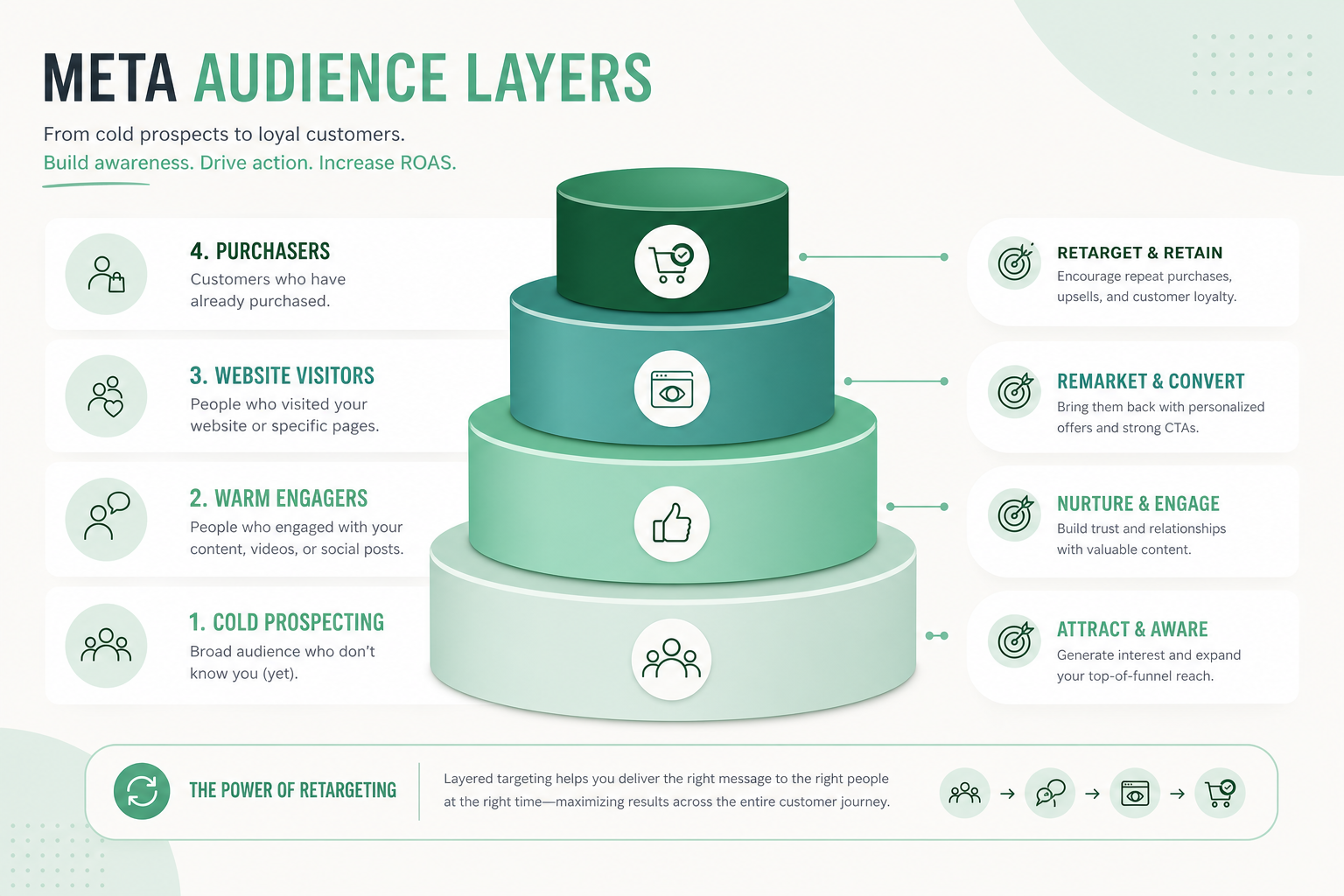
Audience layers — from cold to hot
Think of audiences as layers by temperature. The cold layer (prospecting) reaches new people, the warm layer the engaged, and the hot layer the nearly purchase-ready.
Build a dedicated message and offer for each layer. The hot layer (e.g. cart abandoners) deserves the most direct call to action, the cold layer the softest opening.
Lookalike audiences are a bridge: they are based on warm data but reach new people, so they fit between prospecting and retargeting.
- Cold: broad audiences, prospecting
- Warm: site visitors, engaged
- Hot: cart abandoners, nearly purchase-ready
- Lookalike: bridge between cold and warm
When to scale each
Scale prospecting when you want to grow the top of the funnel and bring in more new people. This is the right move when growth goals increase or the retargeting audience runs low.
Scale retargeting only if the warm audience is large enough. If you grow the retargeting budget on a small audience, frequency rises too high and results decline.
Practical rule: grow prospecting first, let it fill the funnel, and let retargeting scale naturally as the audience grows. Read more in Meta ads scaling and secure measurement in the Conversions API (CAPI) guide.
- Prospecting: scale to grow the top of the funnel
- Retargeting: scale only with a large enough audience
- Prospecting first, retargeting follows naturally
- Secure measurement (CAPI) before scaling
Creative per stage — a different message per temperature
The creative varies by funnel stage. In prospecting, the creative job is to stop the scroller and explain who you are and why it is worth their time.
In prospecting, use attention-grabbing openings, a clear value proposition, and brand introduction. Video and UGC-style content often work well for a cold audience.
In retargeting, the creative can be more direct: a product image, an offer, a testimonial, or a reminder. The audience already knows you, so you can get to the point.
Avoid using the same creative across all stages. An ad aimed at a cold audience does not perform optimally for a warm one, and vice versa.
Continuously test new creative angles for each stage. Creative fatigue hits prospecting fastest because you reach a large audience.
A deeper creative strategy is in our Meta ads creative strategy article.
- Prospecting: stop, explain, introduce the brand
- Video and UGC work well for a cold audience
- Retargeting: product image, offer, testimonial, reminder
- Do not use the same creative across all funnel stages
The funnel in numbers
Metrics per stage
Each funnel stage is measured with different metrics. In prospecting, focus on reach, cost per click (CPC), and the number of new visitors.
In retargeting, track conversion rate, frequency, and ROAS. High frequency on a small audience is a sign the budget is too large.
Do not compare stages with the same metric. Prospecting CPA is always higher because it reaches people who do not know you.
The most important overall metric is incremental return: how much extra sales advertising produces compared to not advertising at all.
Secure reliable measurement following our Conversions API guide before making scaling decisions.
- Prospecting: reach, CPC, new visitors
- Retargeting: conversion rate, frequency, ROAS
- Do not compare stages with the same metric
- Overall metric: incremental return
- Secure measurement (CAPI) before scaling
Common strategy mistakes
We see these mistakes often when prospecting and retargeting are treated as separate strategies instead of one funnel.
- Too much weight on retargeting → the funnel dries up
- The same message for cold and warm audiences
- Retargeting budget on a small audience → over-frequency
- Condemning prospecting because of high CPA
- No lookalike bridge between cold and warm
- Measurement does not separate funnel stages
Do not measure stages with the same metric
Prospecting vs. retargeting checklist
Run through this list when building a funnel-based Meta strategy. It ensures both stages support each other.
Connect strategy with budget and measurement: read budget split and Conversions API. Explore our Meta advertising service.
- Prospecting brings new people, retargeting converts
- A dedicated message for each audience layer
- Lookalike bridge between cold and warm
- Retargeting sized to the audience
- Prospecting first in scaling
- Measurement separates funnel stages
Frequently asked questions
What is the difference between prospecting and retargeting?
Prospecting reaches new people who do not know your brand (cold audience); retargeting reaches those who already engaged (warm audience). Prospecting brings people into the funnel, retargeting converts them.
Which one should I invest in more?
Most of the budget should go to prospecting, because it is the source of growth. Retargeting is efficient but limited — it only converts those prospecting brought in. A good starting point is the 70/20/10 model.
What do audience layers mean?
Audience layers split targets by temperature: cold (new), warm (engaged), and hot (nearly purchase-ready). Each layer needs its own message, and a lookalike audience acts as a bridge between cold and warm.
Why is prospecting CPA higher?
Prospecting reaches people who do not yet know your brand, so conversion takes more effort. It is the top of the funnel — judge it by new customer acquisition metrics, do not compare it directly to retargeting ROAS.
When should I scale retargeting?
Scale retargeting only when the warm audience is large enough. If you grow the budget on a small audience, frequency rises too high and results decline. Grow prospecting first, and the retargeting audience grows naturally.