Responsive Search Ads in practice
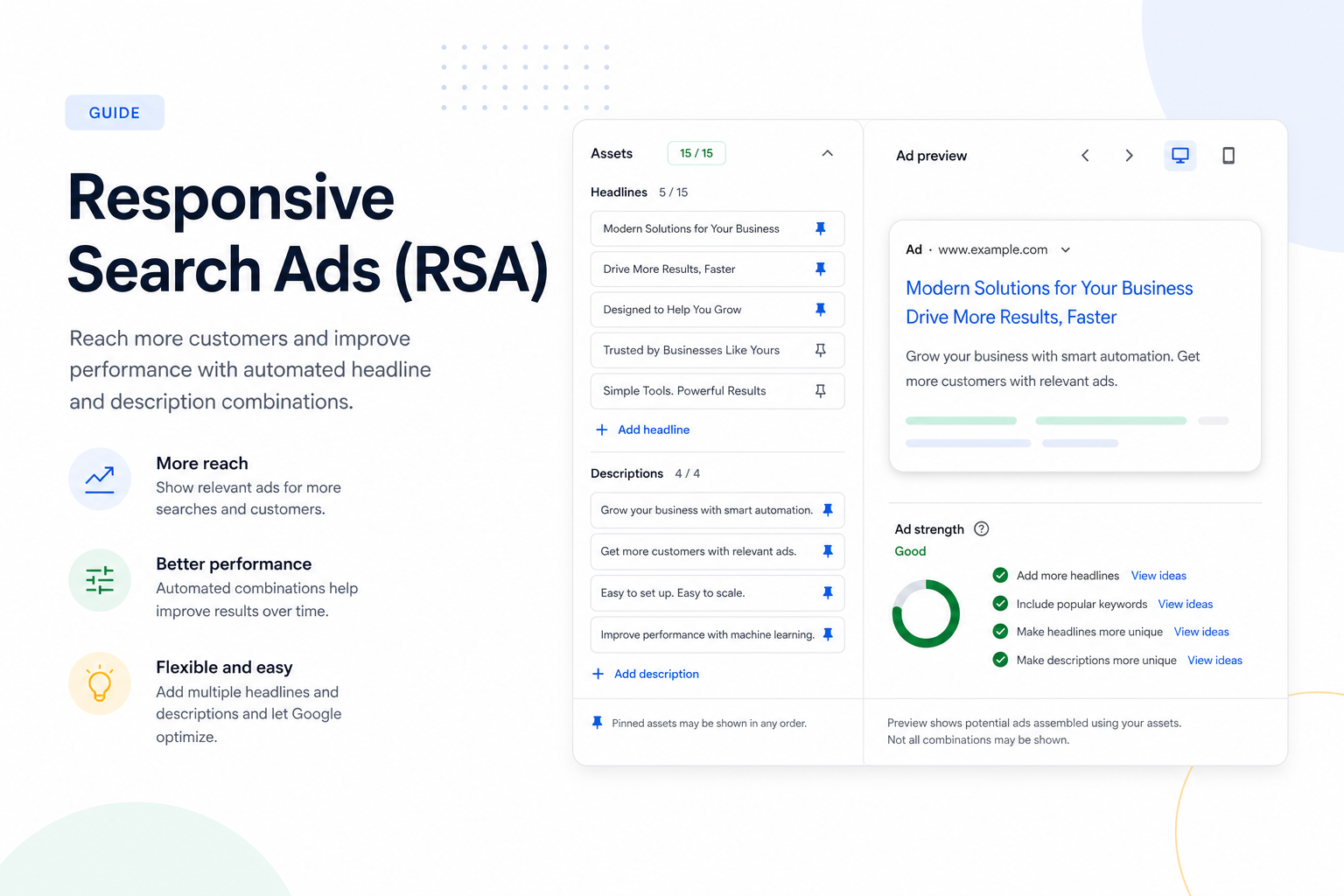
RSA (Responsive Search Ad) largely replaced Expanded Text Ads. Google dynamically combines headlines and descriptions by query, device, and context — you supply raw assets, the algorithm builds the variant.
RSA fits when search intent varies within an ad group. One RSA can serve multiple keywords when copy covers different angles: benefit, feature, social proof, CTA.
RSA does not remove copy work — it moves it into a more structured format. Bad RSA is generic text without a clear value proposition; good RSA is a mini sales page in 15 headlines.
Ad Strength is not the same as performance
Headlines and descriptions — structure
Use all 15 headlines and 4 descriptions when possible. Each headline should add a new angle — do not repeat the same message in different words.
Headlines: 3–5 keyword/intent aligned, 3–5 benefit/USP, 2–3 social proof, 2–3 CTA/urgency. Descriptions: expand benefit, remove risk, add CTA and trust signals.
Keep headlines under 30 characters and descriptions under 90 — Google truncates longer text. Test lengths in Ads Preview before launch.
- Keyword + intent (2–3 headlines)
- Benefit and USP (3–5 headlines)
- Social proof / trust (2–3 headlines)
- CTA and urgency (2–3 headlines)
Pinning — when and how
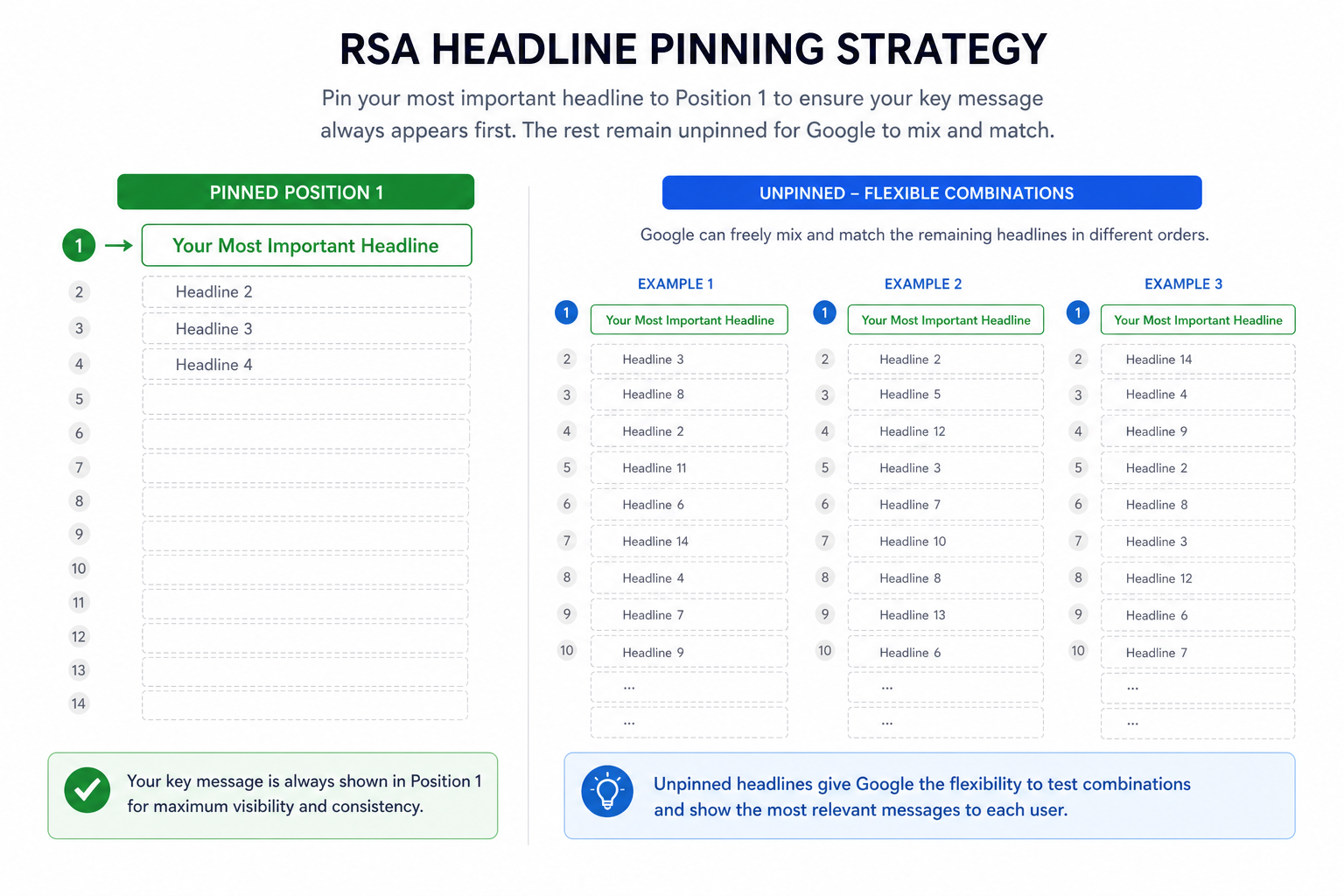
Pinning locks a headline or description to a specific position (1, 2, or 3). Use pinning only when compliance, brand, or legal requires a message always visible.
Too much pinning kills RSA adaptability — Google recommends max 2–3 pinned elements. Pin brand name to position 1 or a required disclaimer in descriptions.
Do not pin all keywords to position 1 for "relevance" — it weakens variant testing and often lowers CTR.
Ad Strength — what it measures
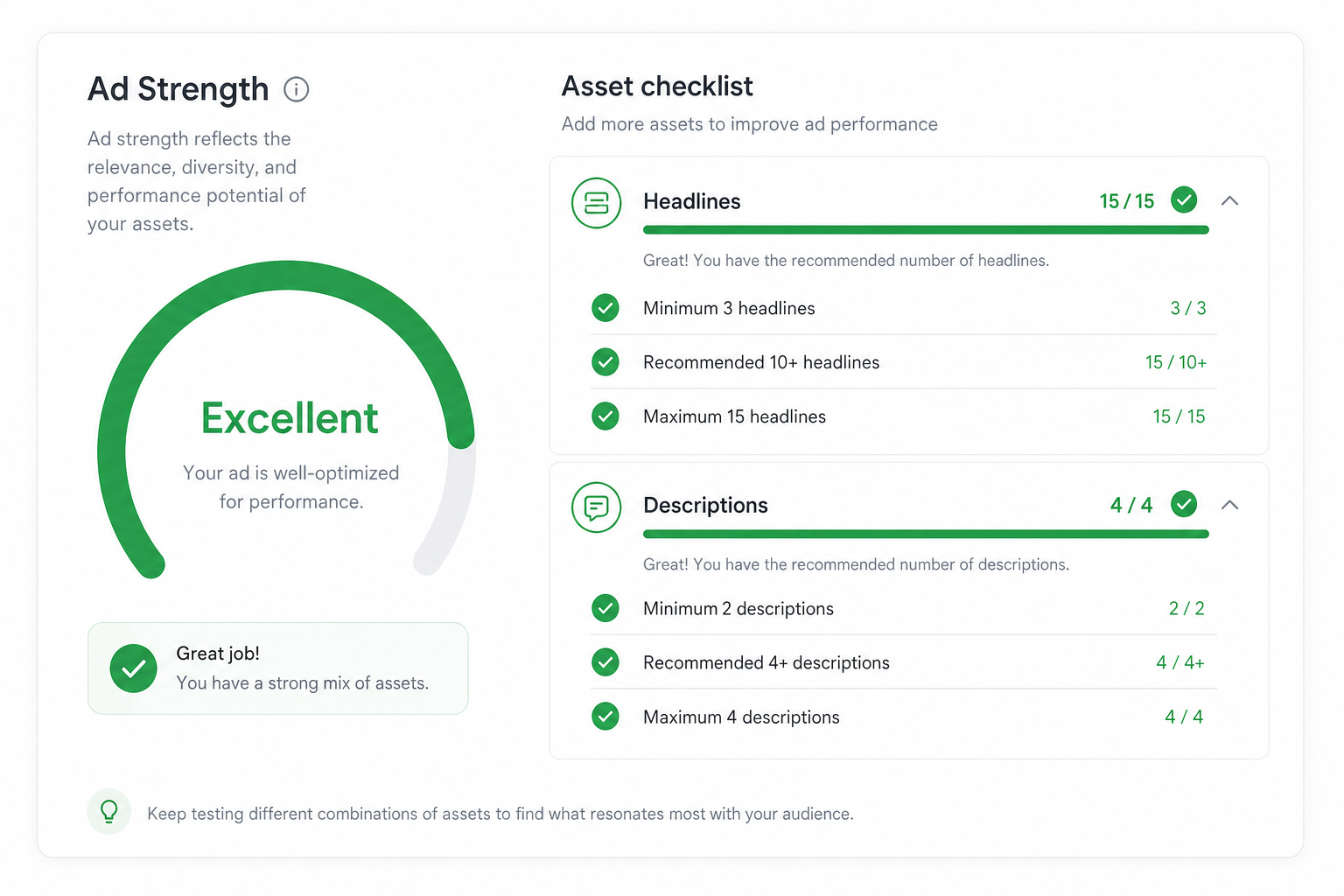
Ad Strength rates RSA quality: headline/description count, uniqueness, keyword inclusion, and pinning amount. Poor → Average → Good → Excellent.
Aim for at least Good — Excellent is a bonus. Ad Strength signals the algorithm has enough material to test, not a direct quality score.
Improve Ad Strength by adding unique headlines, replacing generic phrases with concrete benefits, and ensuring keywords appear naturally.
Testing and iteration
RSA testing happens at headline/description component level — Google reports Best and Low performing assets. Remove or replace Low performers every 4–6 weeks.
Test one variable at a time: new benefit angle, new CTA, new proof line. Do not replace the entire RSA at once — you lose learning.
Compare RSAs at ad group level: CTR, conv rate, cost/conv. If one RSA dominates, analyze which headlines Google favors — replicate the pattern in other groups.
Landing page alignment
RSA promise and landing page headline must match. Message mismatch is the most common cause of good CTR but poor conversion.
Use the same terminology as Search keywords and the landing page. If RSA promises "free audit", the landing page opens with the same promise — not a generic homepage.
Read our landing page conversion guide for deeper optimization. Conversion tracking ensures RSA changes show in data.
Most common RSA mistakes
Too few headlines (under 8) — Ad Strength stays low and variant testing slows.
All headlines identical — "Buy now" 15 different ways is not diversity.
Too much pinning — RSA behaves like a static ad without adaptation.
Generic copy without USP — "Quality service" does not differentiate from competitors.
RSA and Quality Score
RSA affects Quality Score expected CTR and ad relevance. Relevant headlines for keywords raise QS; generic copy lowers it.
Improve QS with RSA: include keywords naturally in 2–3 headlines, use a unique value proposition, and ensure landing page relevance.
RSA in numbers
Summary
RSA is the Search campaign copy engine — structure headlines by intent, pin only required elements, and iterate based on Low-performing assets.
Combine RSA optimization with Search Terms cleanup and brand vs non-brand split. Need help? See our Google Ads service.
RSA checklist
Run through this list when launching a new RSA and in monthly reviews.
- 15 headlines and 4 descriptions filled (or maximum possible)
- Each headline adds a new angle
- Ad Strength at least Good
- Pinning max 2–3 required elements
- Keyword naturally in 2–3 headlines
- Landing page aligned with RSA promise
- Low-performing assets removed/replaced
- Conversion tracking works before major copy changes
Frequently asked questions
How many headlines should an RSA have?
Fill all 15 headlines and 4 descriptions when possible. Ad Strength and variant testing improve significantly with enough assets.
Does Ad Strength need to be Excellent?
Not necessarily. Good is a sufficient minimum. Excellent means Google can test more — measure conversions ultimately.
When is pinning justified?
When compliance, brand, or legal requires a message always visible. Otherwise avoid pinning — it limits adaptation.
How do I test RSAs?
Track asset report Best/Low performing labels. Replace Low-performing headlines every 4–6 weeks with one new angle at a time.
How does RSA relate to landing pages?
RSA promise and landing page headline must match. Message match improves conversion and Quality Score.