What ecommerce SEO means
Ecommerce SEO means search optimization with online store specifics in mind: a large product catalog, dynamic URL parameters, variants, and often repetitive product description content. Standard on-page optimization is not enough if the technical foundation does not hold.
In ecommerce, competition is often at the product level: "buy X", "product Y price", and long-tail queries. Without clear structure and quality product pages, competitors and marketplaces take the visibility.
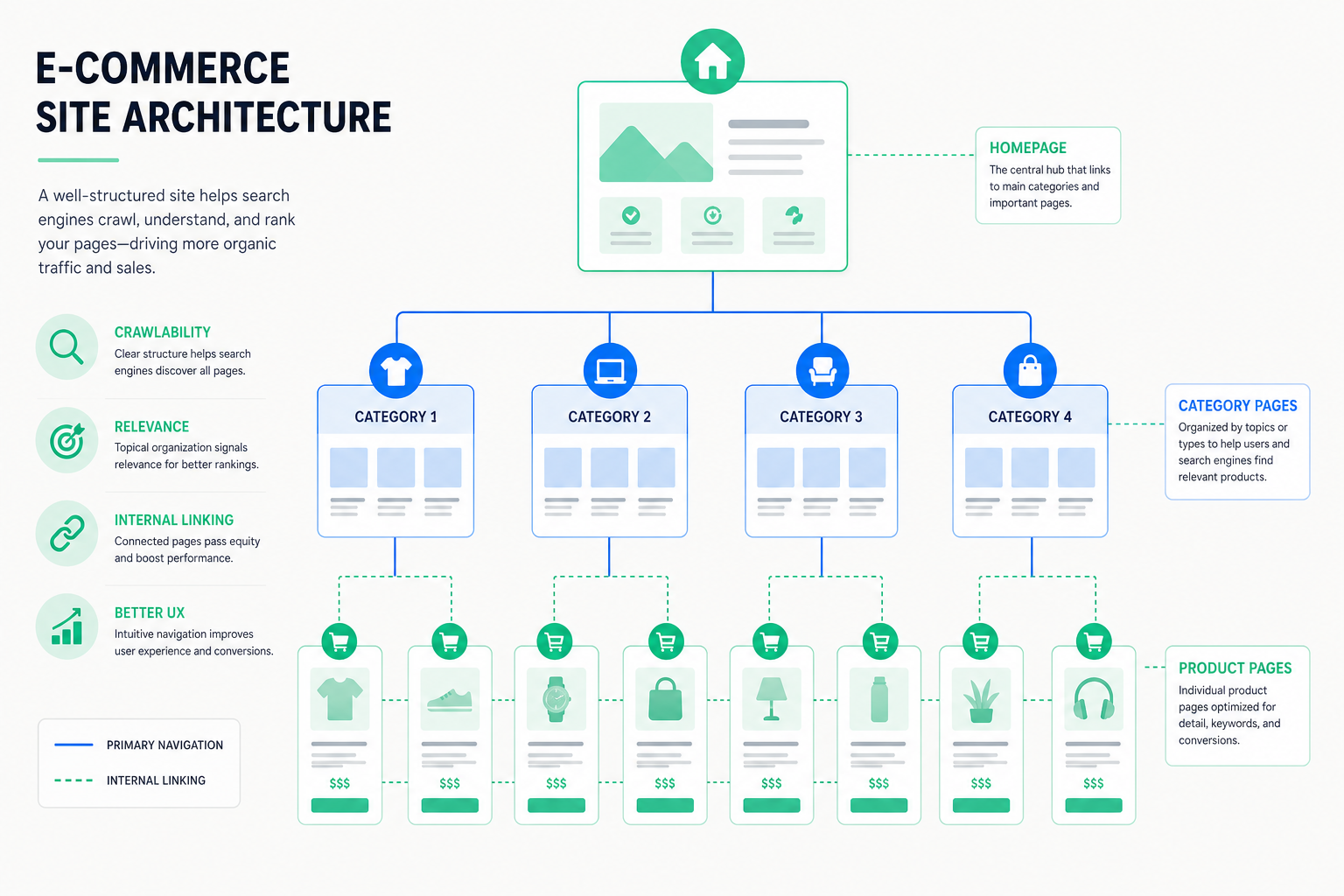
Strong ecommerce SEO rests on three pillars: technical foundation (indexability, speed, canonicals), information architecture (categories, navigation, internal linking), and product page quality (unique content, schema, reviews).
This guide focuses on the big picture. Deeper guides are in product page SEO optimization and category page SEO. Always start with structure — it determines how efficiently Google spends your crawl budget.
Why structure decides
Site structure and category hierarchy
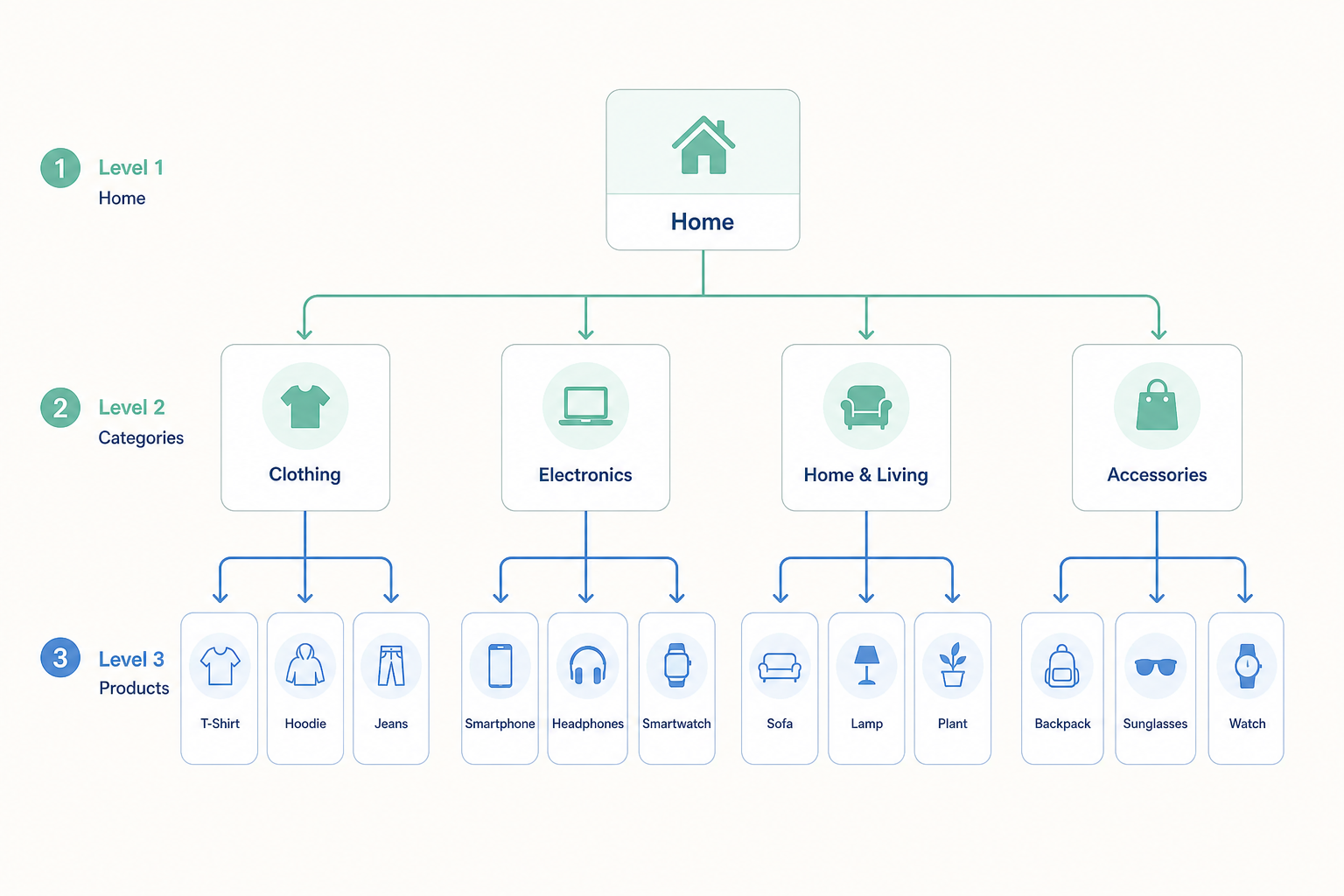
An ideal online store follows a three-level hierarchy: homepage → main category → subcategory → product page. Every product is reachable within at most three clicks from the homepage.
URL structure reflects the hierarchy: /category/subcategory/product. Avoid parameters, session IDs, and unnecessary slashes. Clear structure helps both users and search engines understand the site.
Breadcrumb navigation is mandatory: it improves UX and produces BreadcrumbList schema. Internal linking steers authority from category pages to product pages — read our internal linking guide.
In large stores, use an HTML sitemap (not just XML) and links to key categories on the homepage. This ensures important pages get enough crawl budget share.
The role of category and product pages
Category pages capture traffic from broader queries ("women's party dresses", "garden tools"). They need unique intro copy, a product listing, and facets managed carefully. A product grid alone is not enough to rank.
Product pages target transactional searches and brand + model combinations. Every product needs a unique title, meta description, H1, and enough descriptive content — not just manufacturer copy.
Avoid thin content: if two products differ only by color, use a canonical or combine variants on one page with options. Index separate URLs only when content and search intent differ meaningfully.
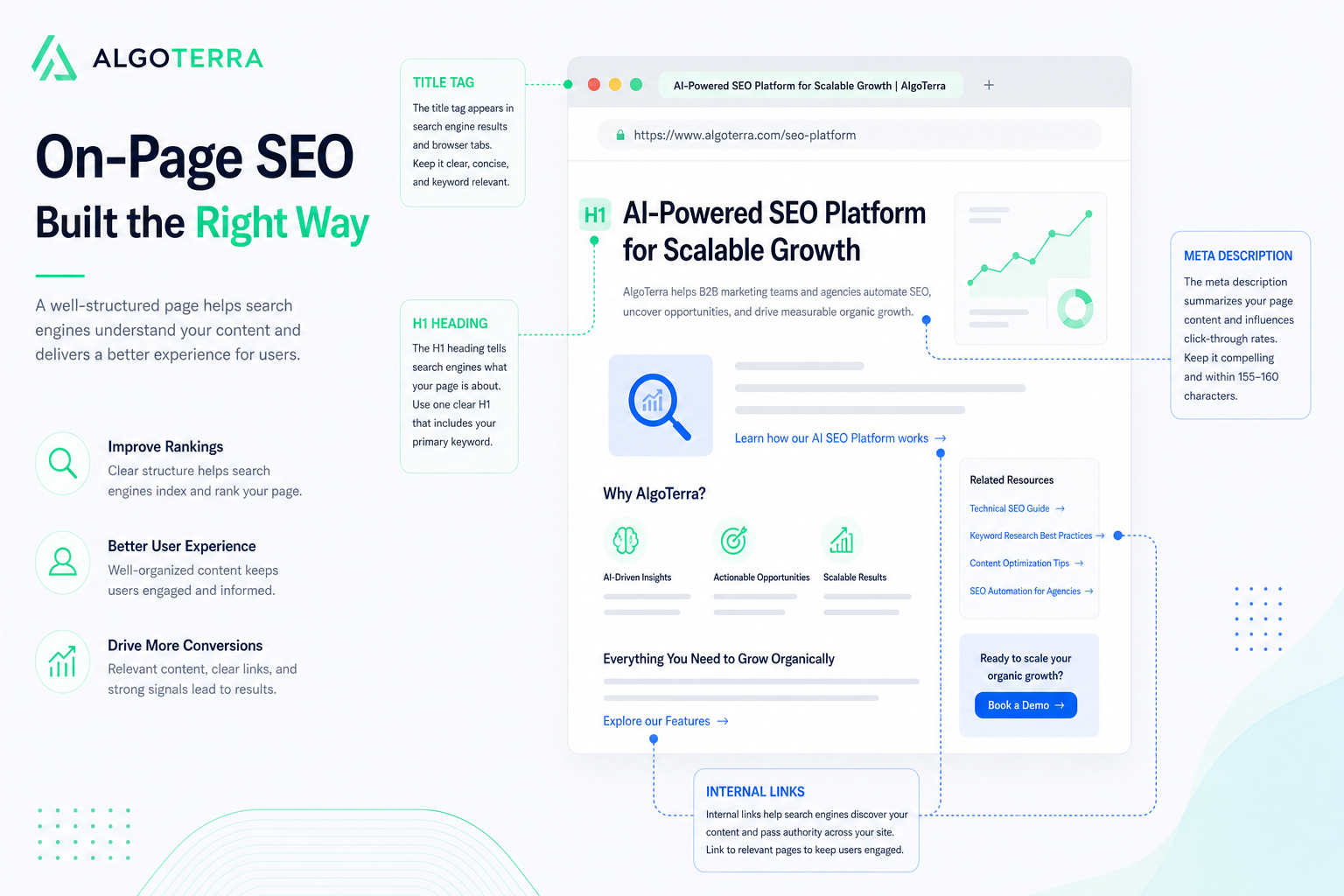
Align category and product optimization with on-page SEO principles: titles, meta, heading structure, and internal links. In ecommerce, small improvements scale to thousands of pages.
- Categories: broad queries, unique intro, internal links to products
- Products: transactional queries, unique content, Product schema
- Variants: canonical or combined page, no duplicate URLs
- Thin content: expand descriptions or noindex
Facet filters and indexing problems
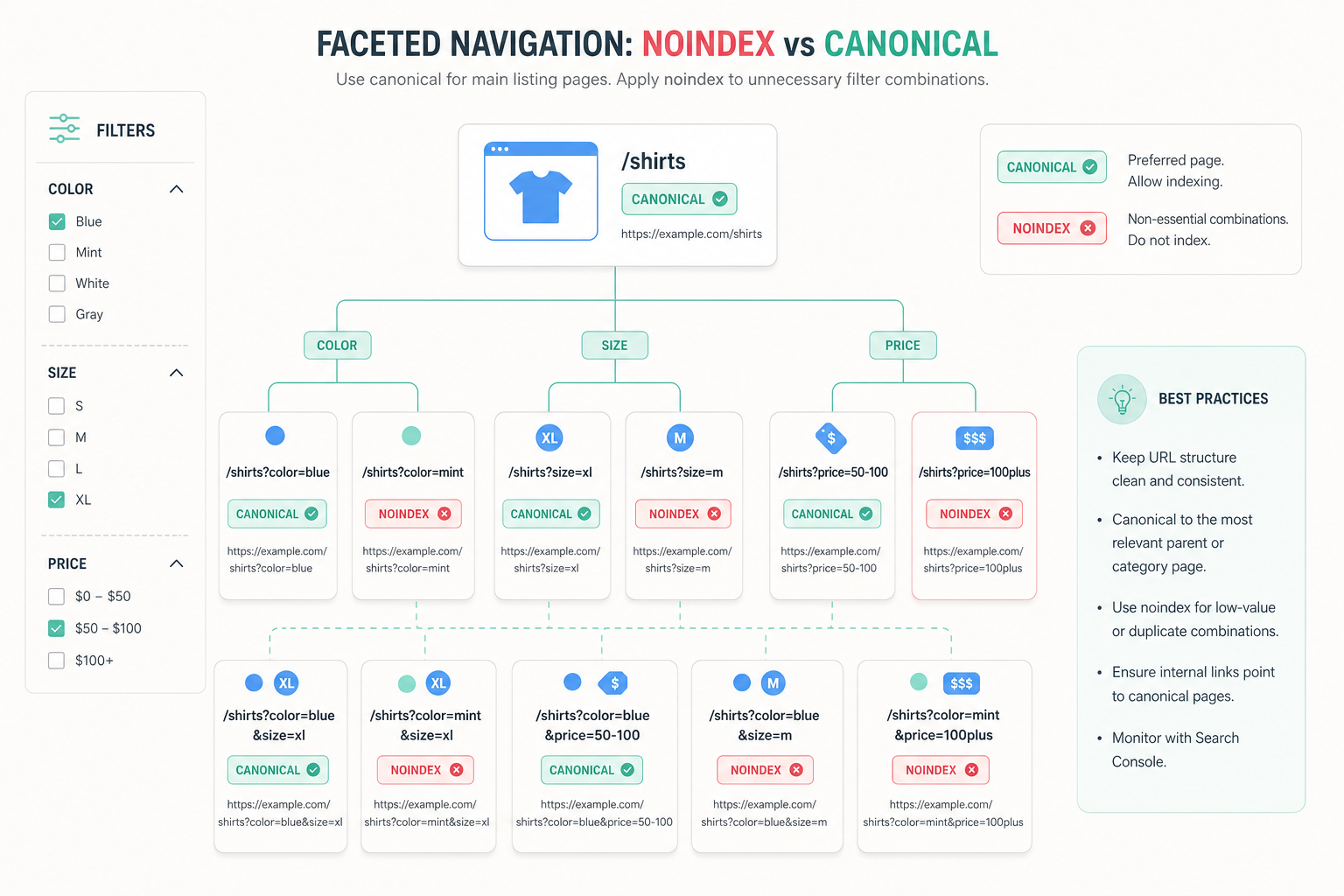
Faceted navigation (color, size, price, brand) easily creates millions of URL combinations. Without control, Google indexes "blue + XL + under $50" pages that are nearly identical and burn crawl budget.
The fix: noindex, follow on filter URLs that do not drive search traffic. Allow indexing only for strategic landing pages with unique content and search demand.
Use canonical tags pointing to the main category or clean category URL. Robots.txt and URL parameter handling in Search Console complement control.
Test indexed URLs in Search Console and by crawling: how many filter URLs are indexed? If the number is high, prioritize facet fixes before content production. Read our technical SEO guide for deeper crawl control.
Crawl budget tip
Crawl budget and prioritization
Crawl budget is how many pages Google's bot visits on your site in a given time. In large stores it is often the bottleneck: important new products do not get indexed because the bot spends time on useless filter URLs.
Prioritize: strengthen internal linking from best-selling categories, update the sitemap regularly, and use hreflang correctly in multilingual stores.
Server response time (TTFB) directly affects crawl efficiency. A slow server means fewer pages crawled per visit. Optimize hosting and caching before content projects.
Monitor "Indexing" → "Pages" in Search Console: a growing "not indexed" count without cause points to crawl or quality issues. Fix the technical foundation before producing more product pages.
Schema markup and rich results
In ecommerce, Product and Offer schemas are essential: price, availability, reviews, and SKU. They enable rich results and improve CTR.
Add AggregateRating when you have enough reviews. BreadcrumbList and Organization complete the picture. Avoid incorrect data — Google penalizes wrong prices or availability.
Use JSON-LD format and validate with the Rich Results Test. On dynamic platforms, ensure schema updates automatically with inventory.
Deeper guide: schema markup guide. Product-level schema is covered in the product page SEO article.
Thin content, duplicates, and manufacturer copy
Manufacturer product descriptions are often identical across hundreds of stores. Google treats them as duplicate and does not rank the page. Write your own short intro for each important product or use templates with unique context added.
The same issue on category pages: identical text across pages weakens the whole domain. Write at least 150–300 words of unique intro per strategic category.
Use noindex temporarily for out-of-stock or test products. 301 to a new product when permanently replaced.
Duplicate control is part of broader technical SEO: canonicals, hreflang, and parameter handling belong to the same system.
Speed and Core Web Vitals in ecommerce
Stores are often heavy: many images, tracking, chat, and payment widgets. LCP suffers from hero and product images, INP from filters and cart JS.
Optimize product images (WebP/AVIF, responsive srcset), lazy-load listings, and defer non-critical JS. Test product and category pages on mobile with PageSpeed Insights.
Speed improves both SEO and conversion — a slow checkout loses buyers. Technical background is in our technical SEO guide.
Ecommerce SEO in numbers
Platform choice and SEO
Shopify, WooCommerce, Magento, and headless setups offer different SEO capabilities. What matters is that you can edit titles, meta descriptions, canonical tags, and sitemaps without a developer on every change.
Many platforms index facet URLs by default — check settings before launch. One wrong checkbox can create thousands of indexed duplicates in the first week.
In headless stores, ensure SSR or prerender produces full HTML for product pages. Client-side rendering alone delays indexing and hurts LCP.
When changing platforms, plan 301 redirects for product and category URLs. SEO migration is often costlier than the platform itself if URL structure changes.
Multilingual and multi-currency stores
In international ecommerce, hreflang tells Google which version serves which market. Without it, .fi and .com versions compete with each other.
Currency and shipping country affect content: pricing, availability, and Offer fields in schema must be correct per market.
Translate title and meta professionally — machine translation often produces odd queries and weak CTR. Keyword research is done per language.
The sitemap may be split by language; ensure each language version links with hreflang and canonical does not accidentally point to another language.
Ecommerce SEO checklist
Run this list before a major product or platform change. Combine with our product page and category page guides.
Need help with scalable ecommerce SEO? Explore our SEO service.
- Hierarchy max 3 levels before product page
- Facet URLs noindex or canonical — only strategic ones indexed
- XML sitemap for important URLs only, lastmod accurate
- Product + Offer + Breadcrumb schema on every product page
- Unique content on strategic category and product pages
- Internal linking from categories to bestsellers
- Core Web Vitals green on mobile
- Search Console: monitor indexed vs. not indexed
Frequently asked questions
What matters most in ecommerce SEO?
Structure and technical foundation above all: hierarchy, facet control, canonicals, and crawl budget. Without them, content does not scale.
Should all filter URLs be indexed?
No. Index only strategic combinations with search demand. Others: noindex or canonical to the main category.
Is manufacturer product copy enough for SEO?
Rarely. The same text across hundreds of stores is duplicate. Add a unique intro or expand the description.
How does schema help ecommerce?
Product schema brings price, availability, and reviews into results and improves CTR. Validate JSON-LD with the Rich Results Test.
What is crawl budget in ecommerce?
It is how many pages Google crawls on your site. Useless facet URLs burn budget — control them with technical SEO.