What "visible in AI" actually means
Being visible in AI means that ChatGPT, Perplexity, Google AI Overviews, or Bing Copilot mentions your brand in its answer when a user asks a question in your industry. You are no longer chasing ten blue links — you are chasing a spot inside the AI answer itself.
This is a new discipline called Generative Engine Optimization (GEO). It extends traditional SEO but requires a different content structure, brand-entity management, and continuous testing inside AI answers.
In practice there are three goals: (1) your brand is named in the AI answer, (2) your site is linked as a source, and (3) the information AI gives about you is accurate and current. Each of the three needs its own actions, which we walk through in the steps below.
- Goal 1: Brand is mentioned by name in the AI answer
- Goal 2: Your site is cited as a source
- Goal 3: The information AI presents is accurate and current
- Metric: Share of Voice — how often you appear vs. competitors
Why GEO matters right now
1. Fix the SEO foundation — GEO builds on top of it
The first mistake is to assume GEO is a separate layer on top of traditional SEO. AI engines use the same signals as Google: authority, technical quality, indexing, and content relevance. If the foundation is broken, no GEO layer will save you.
In practice this means: the site must be indexable, Core Web Vitals in the green, the site structure logically grouped, and content answering the central questions in your industry. AI crawlers (such as GPTBot and PerplexityBot) need the same access Googlebot has.
Read the difference in our SEO vs. GEO article before going further — many teams jump straight to AI-specific actions while the technical foundation leaks badly.
- Indexing in order: no blocks for GPTBot, PerplexityBot, ClaudeBot
- Core Web Vitals green on mobile
- Clear site hierarchy and internal linking
- Fresh content — AI favours recency
2. Strengthen your brand entity — AI sees entities, not just words
AI models do not chase keywords — they chase entities: companies, people, products, and places with a clear identity in known knowledge bases. If your company is not recognizable as an entity, AI cannot reliably reference you.
The practical work starts with Wikidata, a LinkedIn company profile, Crunchbase, and industry-specific directories. You also need a clear Organization schema on your site so AI links the brand name to the site. The details are in our brand entity for GEO article.
A strong entity is also built through external validation: mentions on trusted sites, media hits, and industry conversations where the name appears spelled the same way. The more trusted sources repeat the same fact, the more confidently AI will cite you.
- Wikidata profile: company, founder, industry, location
- Organization schema on home and About pages
- LinkedIn company profile fully completed
- Consistent name in external sources — same spelling
3. Produce citable content — answer the question directly
AI picks as its sources pages that answer the question directly and in a structured way. A long, narrative article without clear answers does not win, even if it is high quality. The most important change is structure: start with the answer, then justify it.
Use questions your customers actually ask as headings, and give a 40–80 word direct answer in the first paragraph. AI often grabs exactly this paragraph or its key sentence as the citation. More in our AI-citable content article.
Add numbers, lists, and tables. AI models love structured information because it is easy to extract and verify. One concrete number from an authority source can raise citability more than a hundred words of abstract prose.
- Answer first, then justify (inverted pyramid)
- Question-form headings: "How…", "What is…", "Should I…"
- Numbers, percentages, and sources visible
- Lists and tables to break up the text
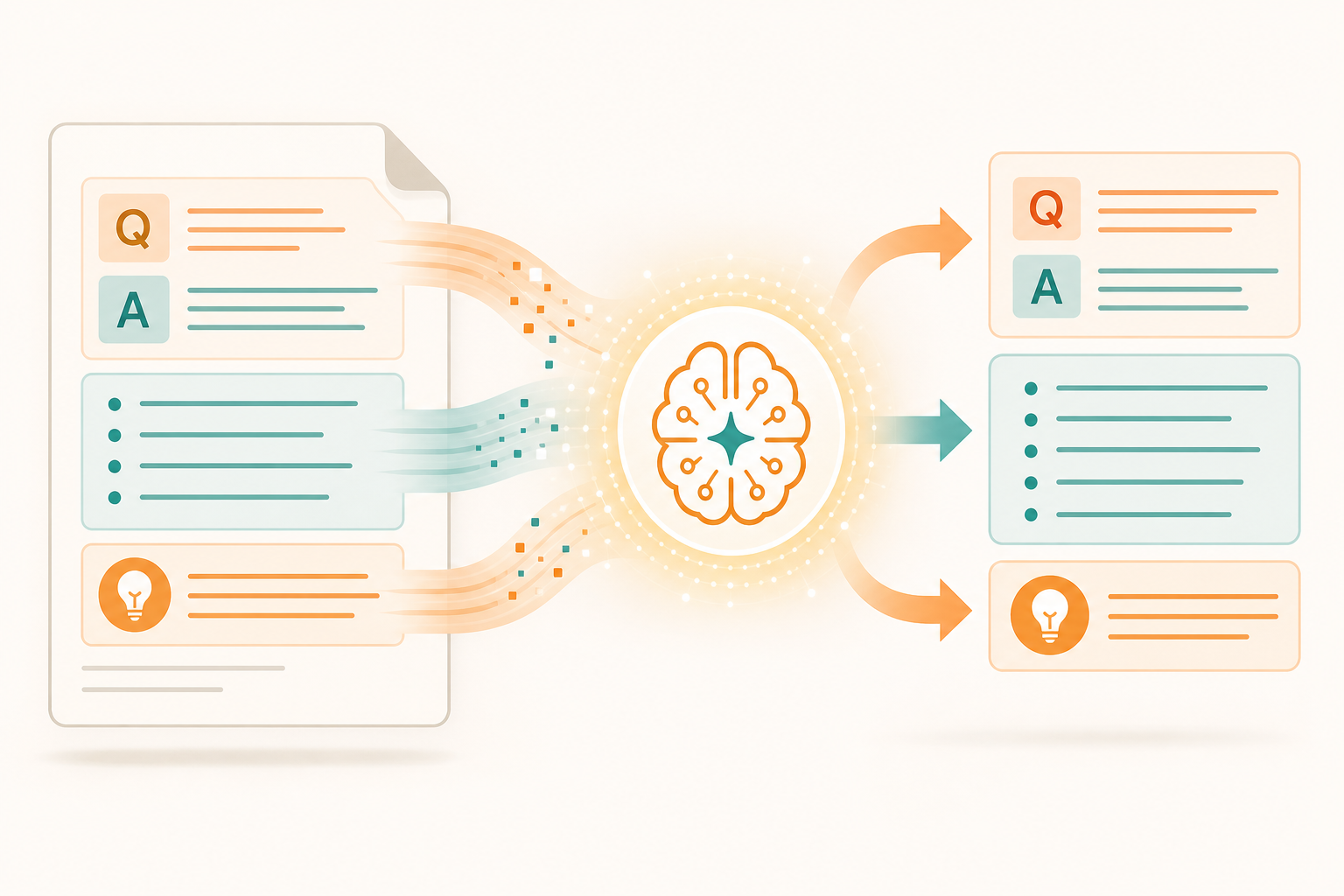
4. Build FAQ pages — AI loves Q&A structure
FAQ pages are GEO’s single most effective content type. Their structure is literally the same as an AI answer: question and concise answer. On top of that, FAQPage schema tells Google and AI explicitly which is the question and which is the answer.
A good FAQ page answers 8–15 real customer questions, each with 40–120 words of direct answer. Avoid marketing speak — AI prefers to cite pages that sound more like an encyclopaedia than a sales pitch.
Details and a template are in our FAQ pages for GEO article. Most important tip: build one central FAQ per service rather than scattering answers across ten different pages.
- 8–15 real customer questions per FAQ page
- Answer 40–120 words, direct and concrete
- FAQPage schema for machine readability
- One FAQ per service — do not scatter answers
5. Schema and llms.txt — tell AI what each page is
The technical foundation for GEO has two parts. The first is structured data: Organization, Person, Product, Article, FAQPage, BreadcrumbList, and HowTo schemas tell AI what each page contains without interpretation.
The second is an llms.txt file, which tells AI crawlers which pages are the primary sources and what content can be used. It does not replace robots.txt — it complements it. Detailed instructions are in our llms.txt and AI crawlers article.
A third useful element is clear canonicalization: one URL per topic, no duplicates. AI crawlers tend to discard duplicates and cite only one version — make sure it is the one you want.
- Organization + Person schema for brand entity
- FAQPage + HowTo + Article on citable content
- llms.txt at site root — prioritize the most important pages
- One canonical URL per topic
Metrics: how you know GEO is working
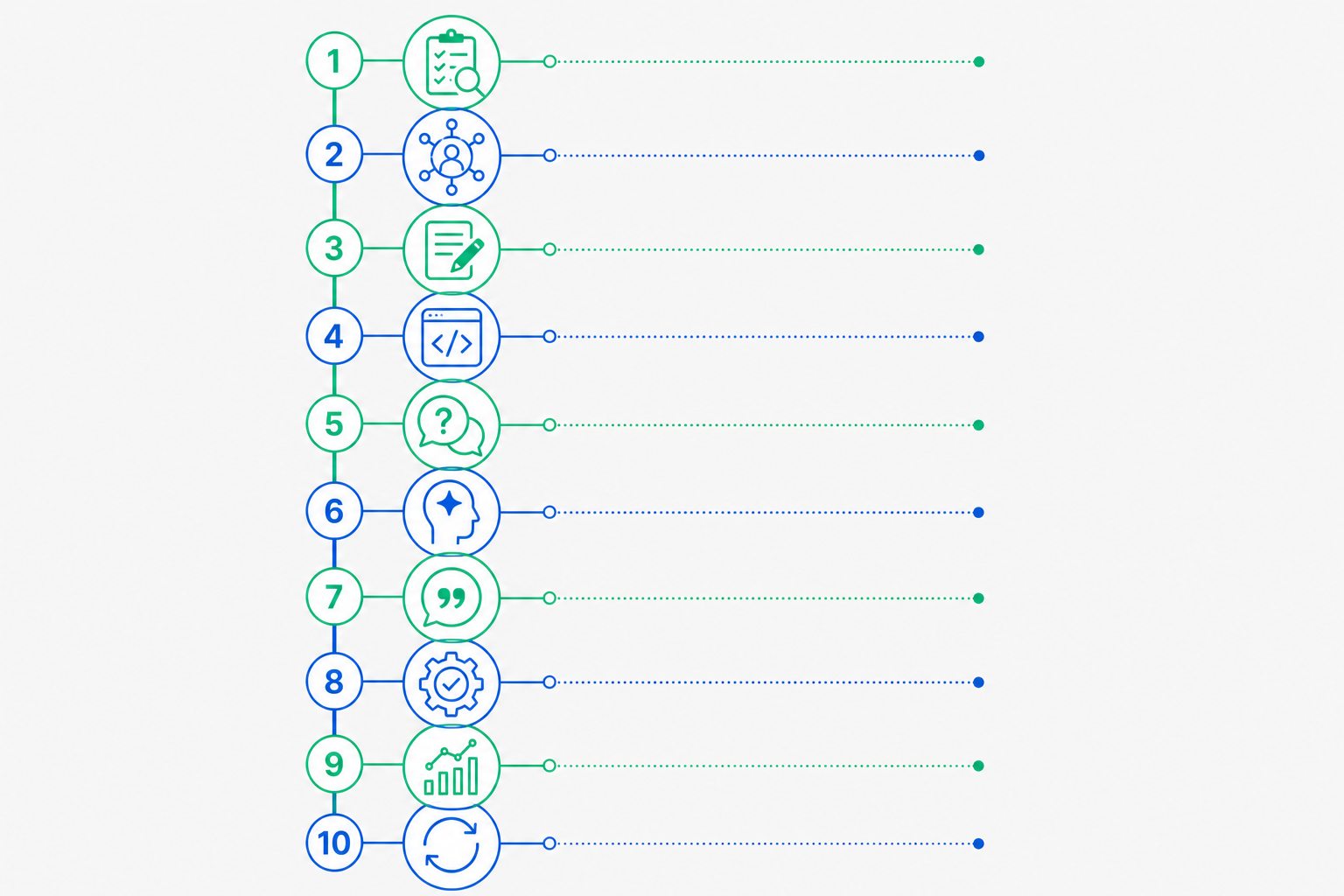
10-step checklist — start today
Run this list in order. Most companies are fine on steps 1–2 but neglect 3–7 — that is exactly where the biggest quick wins live.
Once these 10 steps are done, move on to our GEO audit and Share of Voice article for continuous measurement. Need help? See our GEO service.
- 1. Fix the SEO foundation: indexing, Core Web Vitals, internal links
- 2. Strengthen brand entity: Wikidata, LinkedIn, Organization schema
- 3. Produce citable content: answer first, numbers visible
- 4. Build FAQ pages: 8–15 questions per service
- 5. Add schema: Organization, FAQPage, HowTo, Article
- 6. Publish llms.txt at site root
- 7. Earn external mentions on trusted sites
- 8. Test 20+ prompts in ChatGPT and Perplexity monthly
- 9. Measure Share of Voice vs. three core competitors
- 10. Refresh top-10 content every quarter
Frequently asked questions
How do I get my company visible in ChatGPT?
You need three things: (1) a strong brand entity (Wikidata, LinkedIn, Organization schema), (2) citable content that answers questions directly, and (3) a technical foundation (indexability, schema, llms.txt). First mentions usually appear after 60–90 days of systematic work.
How long does it take to see GEO results?
A realistic timeframe is 3–6 months for first systematic mentions and 6–12 months for meaningful Share of Voice. Speed depends on how strong your SEO foundation already is — those starting from a weak foundation can take longer.
Is GEO the same as SEO?
No, but they share the same foundation. SEO aims for ranking on the search results page, GEO aims to become a source inside the AI answer. Good GEO requires good SEO as its base plus entity work, FAQ pages, and AI-crawler management.
Which AI crawlers should I allow?
At minimum GPTBot (OpenAI), PerplexityBot, ClaudeBot (Anthropic), Google-Extended, and Bingbot. Blocking them means you cannot appear in those services’ answers. Management guidance is in our llms.txt article.
Should a small business invest in GEO?
Yes — and for a small business it can be a bigger opportunity than for a large one. AI answers pick 3–5 sources, not ten. A well-built FAQ page and a strong entity can let a small player outflank a larger competitor with weak content structure.