Demand Gen campaign type role
Demand Gen partly replaced Discovery campaigns and focuses on visual storytelling on YouTube, Discover, and Gmail. It is a mid-funnel tool: builds interest and drives consideration.
Demand Gen does not replace Search for bottom-funnel intent or PMax for full-funnel automation — it fills the gap in visual demand generation within Google ecosystem.
Fits especially B2C brands, product launches, video-first content, and retargeting scale on Display/YouTube.
Demand Gen requires strong creative
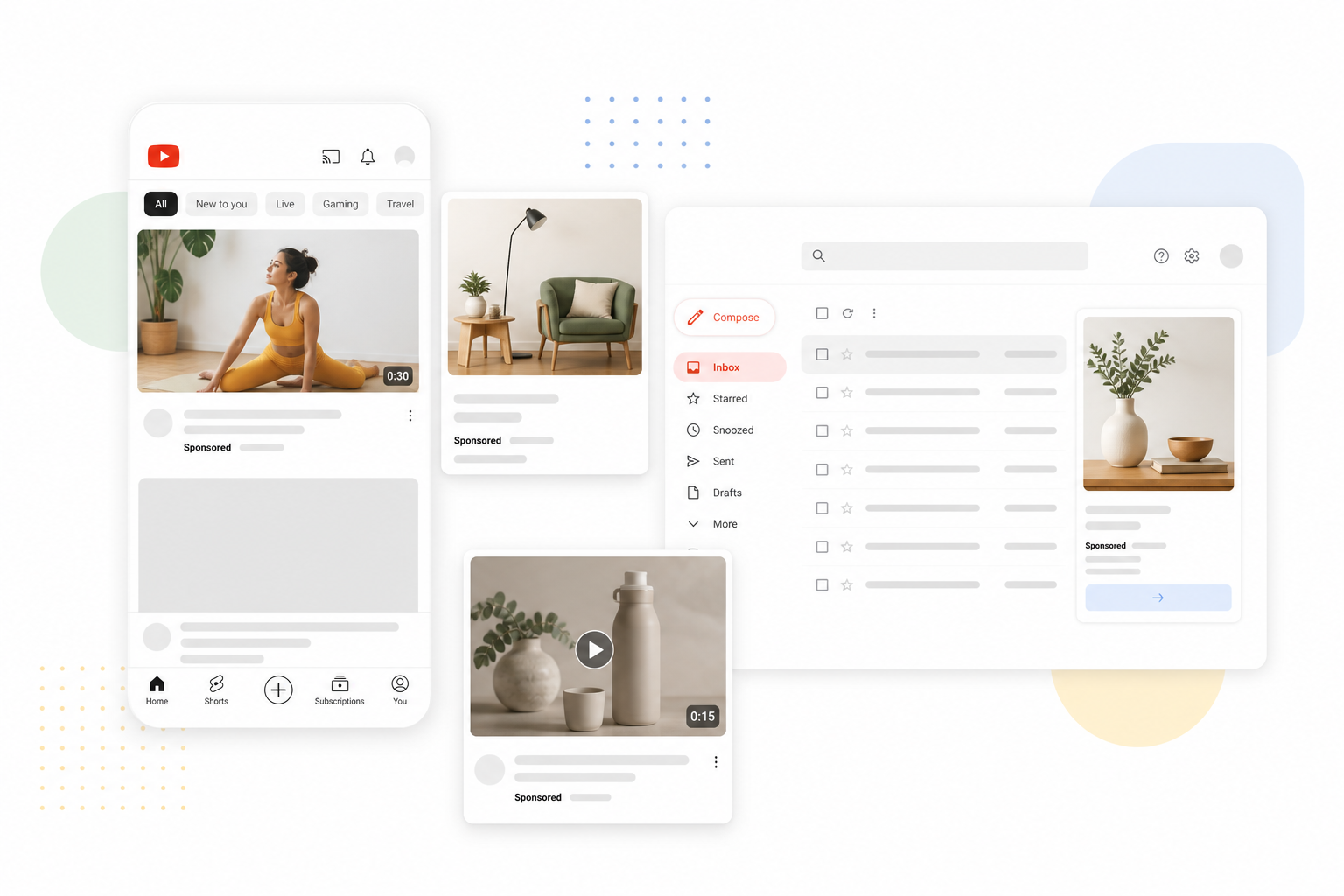
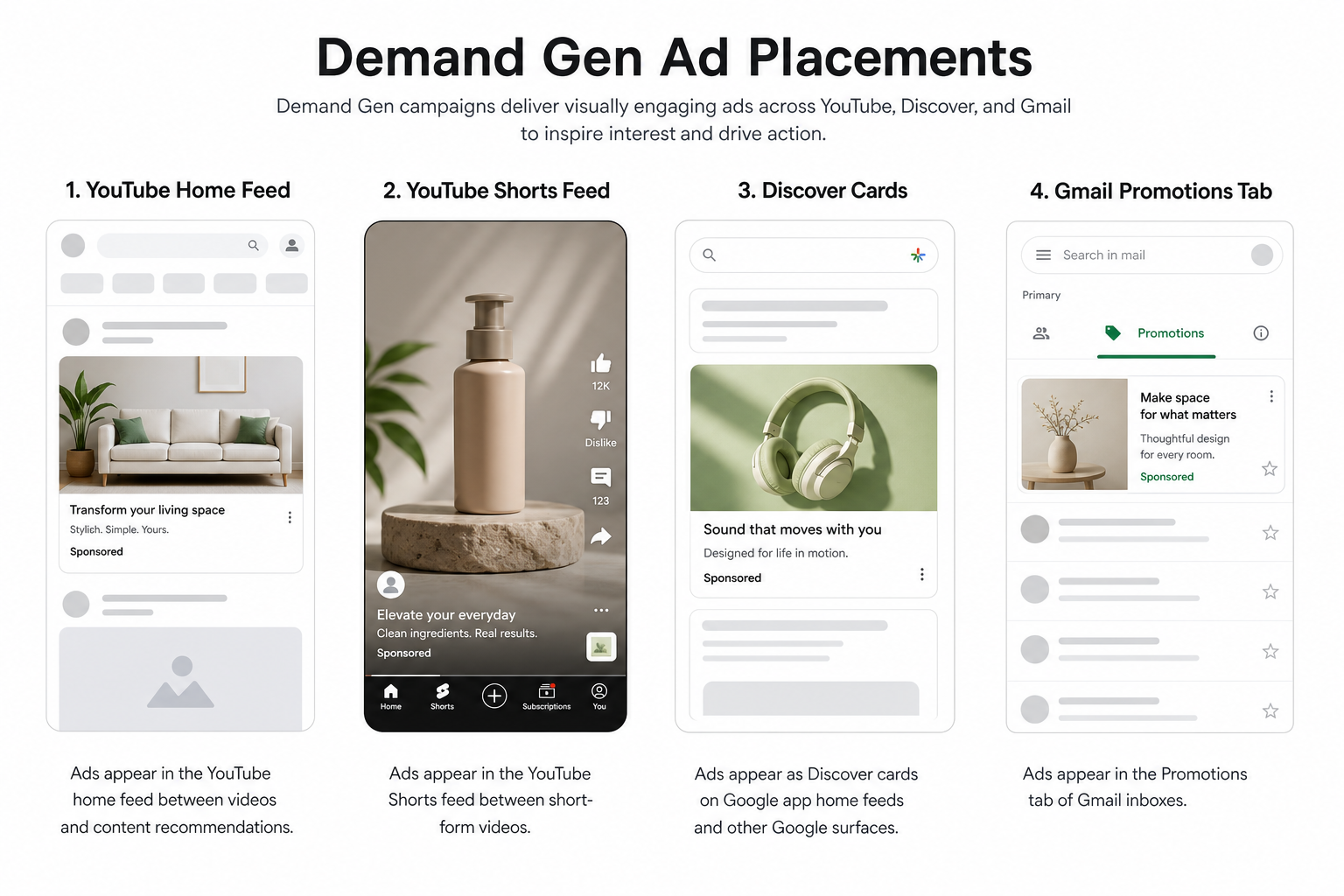
YouTube, Discover, and Gmail
YouTube: In-feed, In-stream (skippable/non-skippable), Shorts. Best for video-first brand stories and product demos.
Discover: Google app home, Discover feed. Visual scroll ads — works with product and lifestyle images.
Gmail: Promotions tab. Wider reach, lower intent — good for awareness.
Demand Gen combines these automatically — you can weight with channel preferences, but the algorithm optimizes placement.
Creative requirements and specs
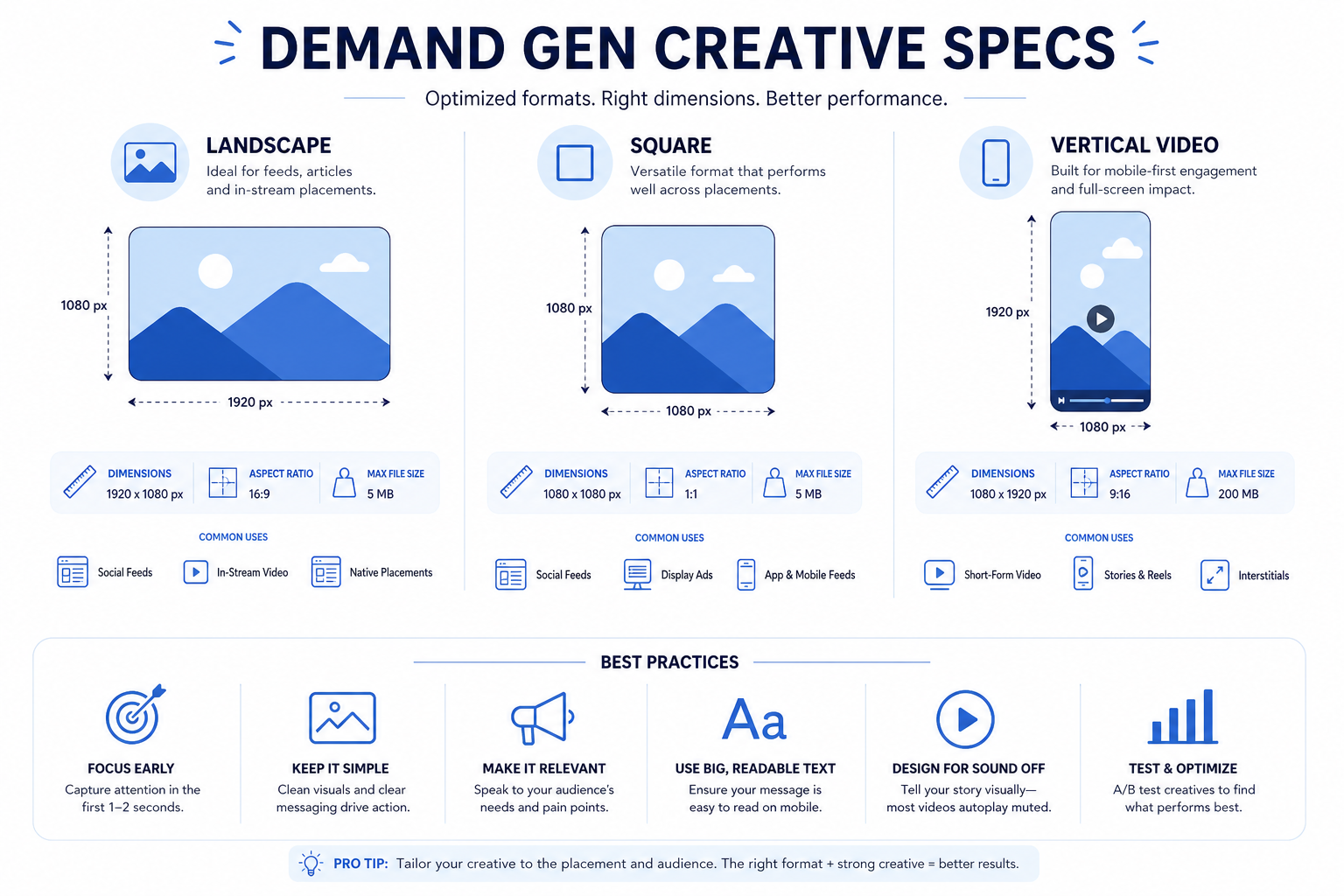
Demand Gen requires: landscape + square + portrait images, video (15–60 s recommended), headlines and descriptions. Google combines the best combinations automatically.
Video: hook in first 3 seconds, brand visible, clear CTA. Static: high contrast, minimal text on image (20% rule).
Read our Meta creative guide — many principles (hook, UGC, social proof) repeat in Demand Gen.
Audience signals and targeting
Demand Gen uses audience signals (custom segments, in-market, remarketing) to guide the algorithm — not tight targeting like manual Display.
Best signals: remarketing (site visitors, video viewers), customer match, in-market segments. Lookalike/custom intent segments in B2B.
Avoid overly narrow audiences — Demand Gen needs reach to learn. Start broader, tighten as data grows.
Demand Gen vs Performance Max
PMax is full-funnel automation across all Google channels — including Search and Shopping. Demand Gen is visual, mid-funnel focus without Search.
Choose Demand Gen when you want control over visual creative and channel preferences. Choose PMax when you want maximum automation and conversion optimization across channels.
Many accounts use both: PMax for conversions, Demand Gen for brand awareness and video reach.
Demand Gen vs Meta
Meta (Facebook/Instagram) offers deeper social targeting and UGC formats. Demand Gen reaches Google ecosystem (YouTube, Discover) — different audience, different context.
Demand Gen fits when YouTube is important or you want Google advertising in one account. Meta fits when social proof and community-style content are core.
In full-stack strategy both can coexist — measure with cross-channel attribution, do not compare platform ROAS directly.
Conversion tracking in Demand Gen
Demand Gen optimizes to conversions or conversion value — same conversion tracking as Search. View-through conversions matter more than in Search.
Set attribution window realistically (7–30 day click, 1–7 day view). Do not compare Demand Gen CPA directly to Search CPA — funnel stage differs.
Budget and role in account
Demand Gen budget: typically 10–25% of Google Ads budget in brand/awareness-focused accounts. Smaller share in B2B, larger in B2C video brands.
Scale when view-through and assisted conversions show in your measurement stack.
Demand Gen in numbers
Summary
Demand Gen is Google visual demand generation campaign for YouTube, Discover, and Gmail. It complements Search and PMax — does not replace them.
Invest in video-first creative, use audience signals, and measure with mid-funnel metrics. Deeper audit: Google Ads audit. Our Google Ads service.
Demand Gen checklist
Run through this list before launching a Demand Gen campaign.
- Video + landscape + square + portrait creatives ready
- 5–10 creative variants for testing
- Audience signals defined (remarketing, in-market)
- Conversion tracking with primary action in place
- Attribution window set for funnel stage
- Channel preferences reviewed
- Role documented vs PMax and Search
- Mid-funnel KPIs defined (not Search CPA alone)
Frequently asked questions
Does Demand Gen replace PMax?
No. PMax is full-funnel automation across all channels. Demand Gen is a visual mid-funnel tool for YouTube/Discover/Gmail.
Is video required for Demand Gen?
Practically yes. Video-first creative performs significantly better than static images alone.
How does Demand Gen differ from Meta ads?
Demand Gen reaches Google ecosystem (YouTube, Discover). Meta offers deeper social targeting. Both can coexist in full-stack strategy.
What are audience signals?
Audience signals guide the algorithm (remarketing, in-market, custom segments) — they do not restrict targeting as tightly as manual Display.
How do you measure Demand Gen success?
With mid-funnel metrics: reach, video views, view-through conversions, assisted conversions — do not compare directly to Search CPA.